Thank you for visiting SNEWPapers!
Sign up free
Literary
July 31, 1805
Norfolk Gazette And Publick Ledger
Norfolk, Virginia
What is this article about?
Kotzebue recounts his tense encounter with Emperor Paul I of Russia over a challenge published in the Court Gazette. The emperor reconciles with him graciously, commissions a satirical piece mocking European powers' inability to end the 11-year war by proposing a single combat among sovereigns, and has it translated and published in the Hamburg Gazette on January 16, 1801.
Clipping
OCR Quality
95%
Excellent
Full Text
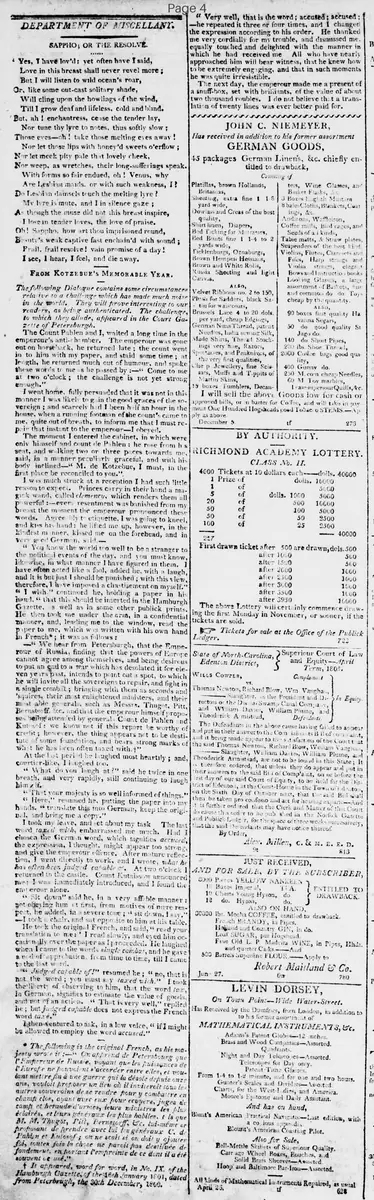
From Kotzebue's Memorable Year.
The following Dialogue contains some circumstances relative to a challenge which has made much noise in the world. They will prove interesting to our readers, as being authenticated. The challenge, to which they allude, appeared in the Court Gazette of Petersburgh.
The Count Pahlen and I, waited a long time in the emperor's anti-chamber. The emperor was gone out on horseback, he returned late; the count went in to him with my paper, and staid some time; at length, he returned much out of humour, and spoke these words to me as he passed by:— "Come to me at two o'clock; the challenge is not yet strong enough."
I went home, fully persuaded that it was not in this manner I was likely to gain the good graces of the sovereign; and scarcely had I been half an hour in the house, when a running footman of the count's came to me, quite out of breath, to inform me that I must repair that instant to the emperor—I obeyed.
The moment I entered the cabinet, in which were only himself and count de Pahlen: he rose from his seat, and walking two or three paces towards me, said, in a manner peculiarly graceful, and with his body inclined— "M. de Kotzebue, I must, in the first place be reconciled to you."
I was much struck at a reception I had such little reason to expect. Princes carry in their hand a magic wand, called clemency, which renders them all powerful:—every resentment was banished from my breast the moment the emperor pronounced these words. Agreeably to etiquette, I was going to kneel, and kiss his hand: he lifted me up, however, in the kindest manner, kissed me on the forehead, and in very good German, said.—
"You know the world too well to be a stranger to the political events of the day, and you must know, likewise, in what manner I have figured in them. I have often acted like a fool, added he, with a laugh, and it is but just I should be punished; with this view, therefore, I have imposed a chastisement on myself."
"I wish," continued he, holding a paper in his hand, "that this should be inserted in the Hamburgh Gazette, as well as in some other publick prints."
He then took me under the arm, in a confidential manner, and, leading me to the window, read the paper to me, which was written with his own hand in French*; it was as follows:
"We hear from Petersburgh, that the Emperor of Russia, finding that the powers of Europe cannot agree among themselves, and being desirous to put an end to a war which has desolated it for eleven years past, intends to point out a spot, to which he will invite all the sovereigns to repair, and fight in a single combat; bringing with them as seconds and 'squires, their most enlightened ministers, and their most able generals, such as Messrs. Thugut, Pitt, Bernstorff, &c. and that the emperor himself proposes being attended by general Count de Pahlen and Kutuzof: we know not if this report be worthy of credit; however, the thing appears not to be destitute of some foundation, and bears strong marks of what he has been often taxed with."
At the last period he laughed most heartily; and, courtier-like, I laughed too.
"What do you laugh at?" said he twice in one breath, and very rapidly, still continuing to laugh himself.
"I beg your majesty is so well informed of things."
"Here," resumed he, putting the paper into my hands, "translate this into German, keep the original, and bring me a copy."
I took my leave, and set about my task. The last word taxed with, embarrassed me much. Had I chosen the German word, which signifies accused, the expression, I thought, might appear too strong, and give the emperor offence. After mature reflection, I went directly to work, and I wrote, what he has often been judged capable of. At two o'clock I returned to the castle. Count Kutaissow announced me: I was immediately introduced, and I found the emperor alone.
"Sit down" said he, in a very affable manner: not obeying him at first, from motives of mere respect, he added, in a severe tone; "sit down, I say."—I took a chair, and sat opposite to him at his table. He took the original French, and said, "read your translation to me:" I read slowly, and eyed him occasionally over the paper as I proceeded. He laughed when I came to the words single combat, and he gave a nod of approbation, from time to time, till I came to the last word.
"Judged capable of!" resumed he; "no, that is not the word; you must say taxed with." I took the liberty of observing to him, that the word tax, in German, signifies to estimate the value of goods, and not of an action. "That is very well," replied he; but judged capable does not express the French word taxe.
I then ventured to ask, in a low voice, "if I might be allowed to employ the word accused."
* The following is the original French, as his majesty wrote it:—"On apprend de Petersbourg que l'Empereur de Russie, voyant que les puissances de l'Europe ne peuvent s'accorder entre elles, et voulant mettre fin à une guerre qui la désole depuis onze ans, vouloit proposer un lieu où il inviteroit tous les autres souverains de se rendre pour y combattre en champ clos, ayant avec eux pour écuyers, juges de camp et hérauts d'armes, leurs ministres les plus éclairés, et leurs généraux les plus habiles, tels que MM. Thugut, Pitt, Bernstorff, &c. lui-même se proposant de s'y rendre avec lui les généraux C. de Pahlen et Kulosof; on ne sait si on doit y ajouter foi, toutes fois la chose ne paroit pas destituée de fondement, en portant l'empreinte de ce dont il a été souvent taxé."
It appeared, word for word, in No. IX. of the Hamburgh Gazette, of the 16th January 1801, dated from Petersburgh, the 30th December 1800.
"Very well, that is the word; accused: accused;"—he repeated it three or four times, and I changed the expression according to his order. He thanked me very cordially for my trouble, and dismissed me, equally touched and delighted with the manner in which he had received me. All who have nearly approached him will bear witness, that he knew how to be extremely engaging, and that in such moments he was quite irresistible.
The next day, the emperor made me a present of a snuff-box, set with brilliants, of the value of about two thousand roubles. I do not believe that a translation of twenty lines was ever better paid for.
The following Dialogue contains some circumstances relative to a challenge which has made much noise in the world. They will prove interesting to our readers, as being authenticated. The challenge, to which they allude, appeared in the Court Gazette of Petersburgh.
The Count Pahlen and I, waited a long time in the emperor's anti-chamber. The emperor was gone out on horseback, he returned late; the count went in to him with my paper, and staid some time; at length, he returned much out of humour, and spoke these words to me as he passed by:— "Come to me at two o'clock; the challenge is not yet strong enough."
I went home, fully persuaded that it was not in this manner I was likely to gain the good graces of the sovereign; and scarcely had I been half an hour in the house, when a running footman of the count's came to me, quite out of breath, to inform me that I must repair that instant to the emperor—I obeyed.
The moment I entered the cabinet, in which were only himself and count de Pahlen: he rose from his seat, and walking two or three paces towards me, said, in a manner peculiarly graceful, and with his body inclined— "M. de Kotzebue, I must, in the first place be reconciled to you."
I was much struck at a reception I had such little reason to expect. Princes carry in their hand a magic wand, called clemency, which renders them all powerful:—every resentment was banished from my breast the moment the emperor pronounced these words. Agreeably to etiquette, I was going to kneel, and kiss his hand: he lifted me up, however, in the kindest manner, kissed me on the forehead, and in very good German, said.—
"You know the world too well to be a stranger to the political events of the day, and you must know, likewise, in what manner I have figured in them. I have often acted like a fool, added he, with a laugh, and it is but just I should be punished; with this view, therefore, I have imposed a chastisement on myself."
"I wish," continued he, holding a paper in his hand, "that this should be inserted in the Hamburgh Gazette, as well as in some other publick prints."
He then took me under the arm, in a confidential manner, and, leading me to the window, read the paper to me, which was written with his own hand in French*; it was as follows:
"We hear from Petersburgh, that the Emperor of Russia, finding that the powers of Europe cannot agree among themselves, and being desirous to put an end to a war which has desolated it for eleven years past, intends to point out a spot, to which he will invite all the sovereigns to repair, and fight in a single combat; bringing with them as seconds and 'squires, their most enlightened ministers, and their most able generals, such as Messrs. Thugut, Pitt, Bernstorff, &c. and that the emperor himself proposes being attended by general Count de Pahlen and Kutuzof: we know not if this report be worthy of credit; however, the thing appears not to be destitute of some foundation, and bears strong marks of what he has been often taxed with."
At the last period he laughed most heartily; and, courtier-like, I laughed too.
"What do you laugh at?" said he twice in one breath, and very rapidly, still continuing to laugh himself.
"I beg your majesty is so well informed of things."
"Here," resumed he, putting the paper into my hands, "translate this into German, keep the original, and bring me a copy."
I took my leave, and set about my task. The last word taxed with, embarrassed me much. Had I chosen the German word, which signifies accused, the expression, I thought, might appear too strong, and give the emperor offence. After mature reflection, I went directly to work, and I wrote, what he has often been judged capable of. At two o'clock I returned to the castle. Count Kutaissow announced me: I was immediately introduced, and I found the emperor alone.
"Sit down" said he, in a very affable manner: not obeying him at first, from motives of mere respect, he added, in a severe tone; "sit down, I say."—I took a chair, and sat opposite to him at his table. He took the original French, and said, "read your translation to me:" I read slowly, and eyed him occasionally over the paper as I proceeded. He laughed when I came to the words single combat, and he gave a nod of approbation, from time to time, till I came to the last word.
"Judged capable of!" resumed he; "no, that is not the word; you must say taxed with." I took the liberty of observing to him, that the word tax, in German, signifies to estimate the value of goods, and not of an action. "That is very well," replied he; but judged capable does not express the French word taxe.
I then ventured to ask, in a low voice, "if I might be allowed to employ the word accused."
* The following is the original French, as his majesty wrote it:—"On apprend de Petersbourg que l'Empereur de Russie, voyant que les puissances de l'Europe ne peuvent s'accorder entre elles, et voulant mettre fin à une guerre qui la désole depuis onze ans, vouloit proposer un lieu où il inviteroit tous les autres souverains de se rendre pour y combattre en champ clos, ayant avec eux pour écuyers, juges de camp et hérauts d'armes, leurs ministres les plus éclairés, et leurs généraux les plus habiles, tels que MM. Thugut, Pitt, Bernstorff, &c. lui-même se proposant de s'y rendre avec lui les généraux C. de Pahlen et Kulosof; on ne sait si on doit y ajouter foi, toutes fois la chose ne paroit pas destituée de fondement, en portant l'empreinte de ce dont il a été souvent taxé."
It appeared, word for word, in No. IX. of the Hamburgh Gazette, of the 16th January 1801, dated from Petersburgh, the 30th December 1800.
"Very well, that is the word; accused: accused;"—he repeated it three or four times, and I changed the expression according to his order. He thanked me very cordially for my trouble, and dismissed me, equally touched and delighted with the manner in which he had received me. All who have nearly approached him will bear witness, that he knew how to be extremely engaging, and that in such moments he was quite irresistible.
The next day, the emperor made me a present of a snuff-box, set with brilliants, of the value of about two thousand roubles. I do not believe that a translation of twenty lines was ever better paid for.
What sub-type of article is it?
Dialogue
Essay
Satire
What themes does it cover?
Political
War Peace
What keywords are associated?
Kotzebue
Emperor Paul
Challenge
Petersburgh
Single Combat
European War
Hamburg Gazette
Clemency
What entities or persons were involved?
From Kotzebue's Memorable Year
Literary Details
Author
From Kotzebue's Memorable Year
Subject
Circumstances Relative To A Challenge Which Has Made Much Noise In The World
Form / Style
Narrative Memoir With Dialogue
Key Lines
"M. De Kotzebue, I Must, In The First Place Be Reconciled To You."
"We Hear From Petersburgh, That The Emperor Of Russia... Bears Strong Marks Of What He Has Been Often Taxed With."
"Very Well, That Is The Word; Accused: Accused;"