Thank you for visiting SNEWPapers!
Sign up free
Editorial
September 8, 1854
The Union And Eastern Journal
Biddeford, York County, Maine
What is this article about?
Editorial promotes wise personal economy over miserliness, stressing that controlling small expenditures builds wealth, citing Quaker advice, Franklin's proverb, and Astor's insights on saving habits.
Clipping
OCR Quality
97%
Excellent
Full Text
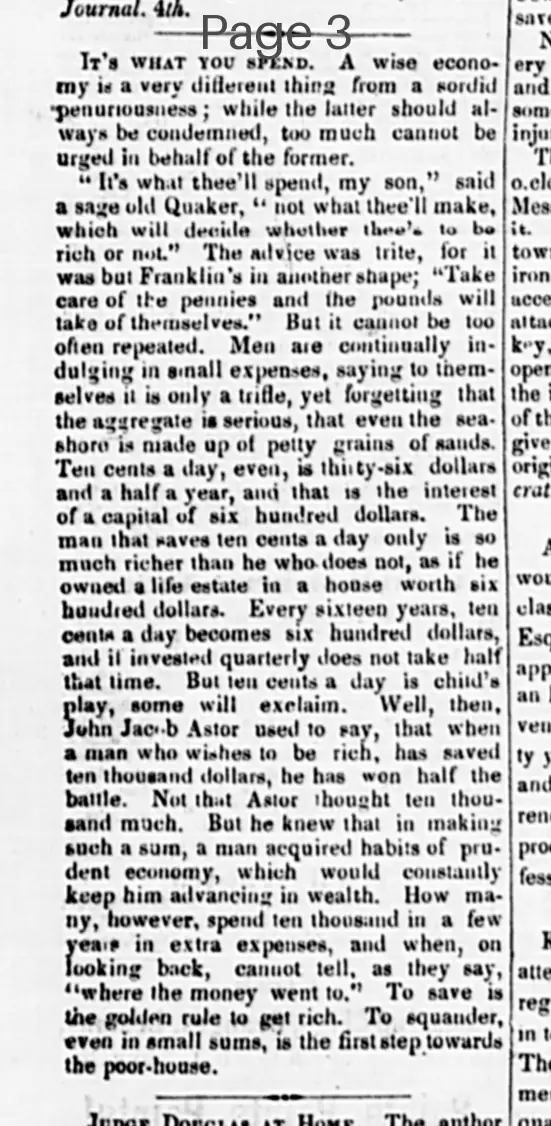
It's What You Spend. A wise economy is a very different thing from a sordid penuriousness; while the latter should always be condemned, too much cannot be urged in behalf of the former.
"It's what thee'll spend, my son," said a sage old Quaker, "not what thee'll make, which will decide whether thee'll be rich or not." The advice was trite, for it was but Franklin's in another shape; "Take care of the pennies and the pounds will take care of themselves." But it cannot be too often repeated. Men are continually indulging in small expenses, saying to themselves it is only a trifle, yet forgetting that the aggregate is serious, that even the seashore is made up of petty grains of sands.
Ten cents a day, even, is thirty-six dollars and a half a year, and that is the interest of a capital of six hundred dollars. The man that saves ten cents a day only is so much richer than he who does not, as if he owned a life estate in a house worth six hundred dollars. Every sixteen years, ten cents a day becomes six hundred dollars, and if invested quarterly does not take half that time. But ten cents a day is child's play, some will exclaim. Well, then, John Jacob Astor used to say, that when a man who wishes to be rich, has saved ten thousand dollars, he has won half the battle. Not that Astor thought ten thousand much. But he knew that in making such a sum, a man acquired habits of prudent economy, which would constantly keep him advancing in wealth. How many, however, spend ten thousand in a few years in extra expenses, and when, on looking back, cannot tell, as they say, "where the money went to." To save is the golden rule to get rich. To squander even in small sums, is the first step towards the poor-house.
"It's what thee'll spend, my son," said a sage old Quaker, "not what thee'll make, which will decide whether thee'll be rich or not." The advice was trite, for it was but Franklin's in another shape; "Take care of the pennies and the pounds will take care of themselves." But it cannot be too often repeated. Men are continually indulging in small expenses, saying to themselves it is only a trifle, yet forgetting that the aggregate is serious, that even the seashore is made up of petty grains of sands.
Ten cents a day, even, is thirty-six dollars and a half a year, and that is the interest of a capital of six hundred dollars. The man that saves ten cents a day only is so much richer than he who does not, as if he owned a life estate in a house worth six hundred dollars. Every sixteen years, ten cents a day becomes six hundred dollars, and if invested quarterly does not take half that time. But ten cents a day is child's play, some will exclaim. Well, then, John Jacob Astor used to say, that when a man who wishes to be rich, has saved ten thousand dollars, he has won half the battle. Not that Astor thought ten thousand much. But he knew that in making such a sum, a man acquired habits of prudent economy, which would constantly keep him advancing in wealth. How many, however, spend ten thousand in a few years in extra expenses, and when, on looking back, cannot tell, as they say, "where the money went to." To save is the golden rule to get rich. To squander even in small sums, is the first step towards the poor-house.
What sub-type of article is it?
Moral Or Religious
Economic Policy
What keywords are associated?
Wise Economy
Thrift
Saving Money
Prudent Habits
Wealth Accumulation
What entities or persons were involved?
Quaker
Franklin
John Jacob Astor
Editorial Details
Primary Topic
Importance Of Wise Economy And Thrift
Stance / Tone
Advocacy For Prudent Saving Over Squandering
Key Figures
Quaker
Franklin
John Jacob Astor
Key Arguments
Wise Economy Differs From Sordid Penuriousness And Should Be Promoted
What One Spends, Not Earns, Determines Wealth
Small Expenses Accumulate To Significant Sums
Saving Ten Cents A Day Equals Interest On Six Hundred Dollars
Every Sixteen Years, Ten Cents Daily Becomes Six Hundred Dollars
Saving Ten Thousand Dollars Instills Habits Of Prudent Economy
Squandering Even Small Sums Leads To Poverty