Thank you for visiting SNEWPapers!
Sign up free
Sunbury American
Sunbury, Northumberland County, Pennsylvania
What is this article about?
An essay laments the disappearance of innocent childhood in girls due to fashionable society's pressures, illustrated by an anecdote of two 8- and 9-year-old girls making a formal call on a 10-year-old, dressed and acting like adults. It calls for resistance against this 'conspiracy' harming girlhood.
Clipping
OCR Quality
Full Text
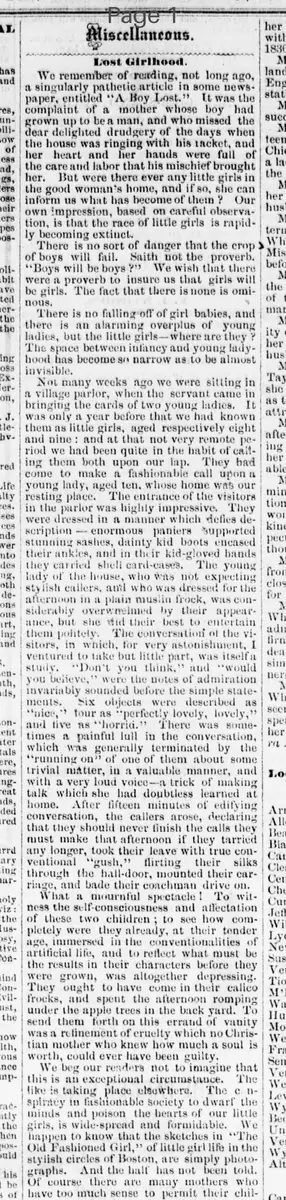
Lost Girlhood.
We remember of reading, not long ago, a singularly pathetic article in some newspaper, entitled "A Boy Lost." It was the complaint of a mother whose boy had grown up to be a man, and who missed the dear delighted drudgery of the days when the house was ringing with his racket, and her heart and her hands were full of the care and labor that his mischief brought her. But were there ever any little girls in the good woman's home, and if so, she can inform us what has become of them? Our own impression, based on careful observation, is that the race of little girls is rapidly becoming extinct.
There is no sort of danger that the crop of boys will fail. Saith not the proverb, "Boys will be boys?" We wish that there were a proverb to insure us that girls will be girls. The fact that there is none is ominous.
There is no falling off of girl babies, and there is an alarming overplus of young ladies, but the little girls-where are they? The space between infancy and young ladyhood has become so narrow as to be almost invisible.
Not many weeks ago we were sitting in a village parlor, when the servant came in bringing the cards of two young ladies. It was only a year before that we had known them as little girls, aged respectively eight and nine: and at that not very remote period we had been quite in the habit of calling them both upon our lap. They had come to make a fashionable call upon a young lady, aged ten, whose home was our resting place. The entrance of the visitors in the parlor was highly impressive. They were dressed in a manner which defies description - enormous paniers supported stunning sashes, dainty kid boots encased their ankles, and in their kid-gloved hands they carried shelly card-cases. The young lady of the house, who was not expecting stylish callers, and who was dressed for the afternoon in a plain muslin frock, was considerably overwhelmed by their appearance, but she did their best to entertain them politely. The conversation of the visitors, in which, for very astonishment, I ventured to take but little part, was itself a study. "Don't you think," and "would you believe," were the notes of admiration invariably sounded before the simple statements. Six objects were described as "nice," four as "perfectly lovely, lovely," and five as "horrid." There was sometimes a painful lull in the conversation, which was generally terminated by the "running on" of one of them about some trivial matter, in a valuable manner, and with a very loud voice-a trick of making talk which she had doubtless learned at home. After fifteen minutes of edifying conversation, the callers arose, declaring that they should never finish the calls they must make that afternoon if they tarried any longer, took their leave with true conventional "gush," flirting their silks through the hall-door, mounted their carriage, and bade their coachman drive on.
What a mournful spectacle! To witness the self-consciousness and affectation of these two children; to see how completely were they already, at their tender age, immersed in the conventionalities of artificial life, and to reflect what must be the results in their characters before they were grown, was altogether depressing.
They ought to have come in their calico frocks, and spent the afternoon romping under the apple trees in the back yard. To send them forth on this errand of vanity was a refinement of cruelty which no Christian mother who knew how much a soul is worth, could ever have been guilty.
We beg our readers not to imagine that this is an exceptional circumstance. The like is taking place elsewhere. The conspiracy in fashionable society to dwarf the minds and poison the hearts of our little girls, is wide-spread and formidable. We happen to know that the sketches in "The Old Fashioned Girl," of little girl life in the stylish circles of Boston, are simply photographs. And the half has not been told.
Of course there are many mothers who have too much sense to permit their children to be made the fools of fashion, but even these find it hard work sometimes to resist the frivolous influences which surround them.
The remedy for this evil must come from literature, from the pulpit, and from the resolute example of intelligent parents. Miss Alcott has done noble service already in picturing this folly, and displaying a more wholesome idea. Every preacher, and every leader of public opinion should raise his voice to denounce this conspiracy against girlhood. And above all, every mother whose brains are not already addled by the vanities of society, should set her face as a flint against the whole system of snares by which our little girls are drawn into the deceitful and dangerous paths of fashionable life.-Exchange.
What sub-type of article is it?
What themes does it cover?
What keywords are associated?
What entities or persons were involved?
Where did it happen?
Story Details
Key Persons
Location
Village Parlor, Boston
Event Date
Not Many Weeks Ago
Story Details
Essay observes the loss of little girls' innocence as they are rushed into fashionable adulthood, exemplified by two 8- and 9-year-old girls making a formal call dressed and acting like young ladies, critiquing societal pressures and calling for parental resistance inspired by Miss Alcott's work.