Thank you for visiting SNEWPapers!
Sign up free
The Wilmingtonian, And Delaware Advertiser
Wilmington, New Castle County, Delaware
What is this article about?
Extract from a merchant's letter dated Aug. 31 from Madrid details extreme poverty and misery in Spanish towns like Tolosa, Vittoria, and Burgos; strict police controls due to fear of Portugal's constitution; high living costs; and the deplorable, ill-equipped state of the Spanish army.
Clipping
OCR Quality
Full Text
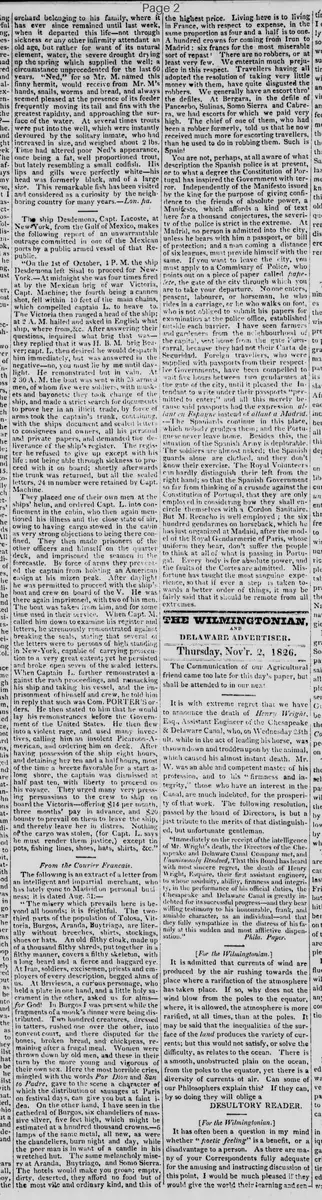
The following is an extract of a letter from an intelligent and impartial merchant, who has lately gone to Madrid on personal business; it is dated Aug. 31:--
"The misery which prevails here is beyond all bounds; it is frightful. The two-third parts of the population of Tolosa, Vittoria, Burgos, Aranda, Buytriago, are literally without breeches, shirts, stockings, shoes or hats. An old filthy cloak, made up of a thousand filthy shreds, put together in a filthy manner, covers a filthy skeleton, with a long beard and a fierce and haggard eye. At Irun, soldiers, excisemen, priests and employers of every description, begged alms of us. At Briviesca, a curious personage, who held a plate in one hand, and a little holy sacrament in the other, asked us for alms-- for God! In Burgos I was present while the fragments of a monk's dinner were being distributed. Two hundred creatures, dressed in tatters, rushed one over the other, into convent court, and there disputed for the bones, broken bread, and chickpeas, remaining after a frugal meal. Women were thrown down by old men, and these in their turn by the more young and vigorous of their own sex. Here the most horrible cries, mingled with the words Por Dios and San to Padre, gave to the scene a character of which the distribution of sausages at Paris on festival days, can give you but a faint idea. On the other hand, I have seen in the cathedral of Burgos, six chandeliers of massive silver, five feet high, which might be estimated at a hundred thousand crowns.- 6 lamps of the same metal, all new, as were the chandeliers, burn night and day, while the poor man is in want of a candle in his wretched hut. The same melancholy misery at Aranda, Buytriago, and Somo Sierra. The hotels would make you groan; empty, dirty, deserted, they afford no food but of the most vile and ordinary kind, and this of the highest price. Living here is to living in France, with respect to expense, in the same proportion as four and a half is to one. A hundred crowns for coming from Irun to Madrid: six francs for the most miserable sort of repast. There are no robbers, or at least very few. We entertain much prejudice in this respect. Travellers having all adopted the resolution of taking very little money with them, have quite disgusted the robbers. We generally have an escort thro' the defiles. At Bergara, in the defile of Pancorbo, Salinas, Somo Sierra and Cabrero, we had escorts for which we paid very high. The chief of one of them, who had been a robber formerly, told us that he now received much more for escorting travellers, than he used to do in robbing them. Such is Spain!
You are not, perhaps, at all aware of what description the Spanish police is at present, or to what a degree the Constitution of Portugal has inspired the Government with terror. Independently of the Manifesto issued by the king for the purpose of giving confidence to the friends of absolute power, a Manifesto, which affords a kind of text here for a thousand conjectures, the severity of the police is strict in the extreme. At Madrid, no person is admitted into the city, unless he bears with him a passport, or bill of protection; and a man coming a distance of six leagues, must provide himself with the same. If you want to leave the city, you must apply to a Commissary of Police, who points out on a piece of paper called fafelete, the gate of the city through which you are to take your departure. No one enters, peasant, labourer, or horseman, he who rides in a carriage, or he who walks on foot, who is not obliged to submit his papers for examination at the police office, established outside each barrier. I have seen farmers and gardeners from the neighbourhood of the capital, sent home from the gate Puencarral, because they had not their Carta de Seguridad. Foreign travellers, who were supplied with passports from their respective Governments, have been compelled to wait five hours between two gendarmes at the gate of the city, until it pleased the Intendant to write under their passports "permitted to enter:" and all this merely because said passports had the expression allant en Espagne instead of allant a Madrid.
-The Spaniards continue in this place, which nobody grudges them; and the Portuguese never leave home. Besides this, the situation of the Spanish Army is deplorable. The soldiers are almost naked; the Spanish guards alone are clothed, and they don't know their exercise. The Royal Volunteers can hardly distinguish their left from the right hand: so that the Spanish Government so far from thinking of a crusade against the Constitution of Portugal, that they are only employed in considering how they shall encircle themselves with a Cordon Sanitaire. But M. Recacho is well employed; the six hundred gendarmes on horseback, which he has just organized at Madrid, after the model of the Royal Gendarmerie of Paris, whose uniform they bear, don't suffer the people to think at all of what is passing in Portugal. Every body is for absolute power, and the faults of the Cortes are admitted. Misfortune has taught the most sanguine experience, so that if ever a step is taken towards a better order of things, it may be fairly said that it should be remote from all extremes."
What sub-type of article is it?
What keywords are associated?
What entities or persons were involved?
Where did it happen?
Foreign News Details
Primary Location
Madrid
Event Date
Aug. 31
Key Persons
Outcome
extreme poverty and misery prevail; strict police controls enforced; spanish army in deplorable state, unable to act against portugal's constitution.
Event Details
A merchant describes widespread famine and poverty in Spanish towns including Tolosa, Vittoria, Burgos, Aranda, Buytriago; begging by soldiers, priests; high prices and poor accommodations; minimal robbery due to escorts; severe police measures at Madrid inspired by fear of Portuguese constitution, requiring passports and inspections; deplorable condition of Spanish army, naked soldiers, poor training; organization of gendarmes to suppress thoughts of Portuguese events; support for absolute power.