Thank you for visiting SNEWPapers!
Sign up free
Editorial
February 25, 1834
The New Hampshire Gazette
Portsmouth, Rockingham County, New Hampshire
What is this article about?
Editorial opposes a proposed city government for Portsmouth, NH, arguing it would erode democracy by empowering an aristocracy, increase costs, and complicate governance. Prefers simple town meetings, citing Jefferson's critique of cities. (198 characters)
Clipping
OCR Quality
95%
Excellent
Full Text
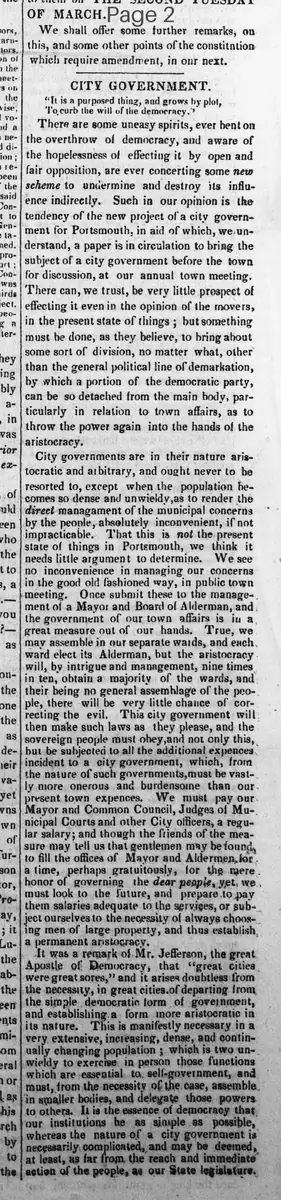
CITY GOVERNMENT.
"It is a purposed thing, and grows by plot, To curb the will of the democracy."
There are some uneasy spirits, ever bent on the overthrow of democracy, and aware of the hopelessness of effecting it by open and fair opposition, are ever concerting some new scheme to undermine and destroy its influence indirectly. Such in our opinion is the tendency of the new project of a city government for Portsmouth, in aid of which, we understand, a paper is in circulation to bring the subject of a city government before the town for discussion, at our annual town meeting.
There can, we trust, be very little prospect of effecting it even in the opinion of the movers, in the present state of things; but something must be done, as they believe, to bring about some sort of division, no matter what, other than the general political line of demarkation, by which a portion of the democratic party, particularly in relation to town affairs, as to throw the power again into the hands of the aristocracy.
City governments are in their nature aristocratic and arbitrary, and ought never to be resorted to, except when the population becomes so dense and unwieldy, as to render the direct management of the municipal concerns by the people, absolutely inconvenient, if not impracticable. That this is not the present state of things in Portsmouth, we think it needs little argument to determine. We see no inconvenience in managing our concerns in the good old fashioned way, in public town meeting. Once submit these to the management of a Mayor and Board of Aldermen, and the government of our town affairs is in a great measure out of our hands. True, we may assemble in our separate wards, and each ward elect its Alderman, but the aristocracy will, by intrigue and management, nine times in ten, obtain a majority of the wards, and their being no general assemblage of the people, there will be very little chance of correcting the evil. This city government will then make such laws as they please, and the sovereign people must obey, and not only this, but be subjected to all the additional expences incident to a city government, which, from the nature of such governments, must be vastly more onerous and burdensome than our present town expences. We must pay our Mayor and Common Council, Judges of Municipal Courts and other City officers, a regular salary; and though the friends of the measure may tell us that gentlemen may be found to fill the offices of Mayor and Aldermen, for a time, perhaps gratuitously, for the mere honor of governing the dear people, yet, we must look to the future, and prepare to pay them salaries adequate to the services, or subject ourselves to the necessity of always choosing men of large property, and thus establish a permanent aristocracy.
It was a remark of Mr. Jefferson, the great Apostle of Democracy, that "great cities were great sores," and it arises doubtless from the necessity, in great cities, of departing from the simple democratic form of government, and establishing a form more aristocratic in its nature. This is manifestly necessary in a very extensive, increasing, dense, and continually changing population; which is too unwieldy to exercise in person those functions which are essential to self-government, and must, from the necessity of the case, assemble in smaller bodies, and delegate those powers to others. It is the essence of democracy that our institutions be as simple as possible, whereas the nature of a city government is necessarily complicated, and may be deemed, at least, as far from the reach and immediate action of the people, as our State legislature.
"It is a purposed thing, and grows by plot, To curb the will of the democracy."
There are some uneasy spirits, ever bent on the overthrow of democracy, and aware of the hopelessness of effecting it by open and fair opposition, are ever concerting some new scheme to undermine and destroy its influence indirectly. Such in our opinion is the tendency of the new project of a city government for Portsmouth, in aid of which, we understand, a paper is in circulation to bring the subject of a city government before the town for discussion, at our annual town meeting.
There can, we trust, be very little prospect of effecting it even in the opinion of the movers, in the present state of things; but something must be done, as they believe, to bring about some sort of division, no matter what, other than the general political line of demarkation, by which a portion of the democratic party, particularly in relation to town affairs, as to throw the power again into the hands of the aristocracy.
City governments are in their nature aristocratic and arbitrary, and ought never to be resorted to, except when the population becomes so dense and unwieldy, as to render the direct management of the municipal concerns by the people, absolutely inconvenient, if not impracticable. That this is not the present state of things in Portsmouth, we think it needs little argument to determine. We see no inconvenience in managing our concerns in the good old fashioned way, in public town meeting. Once submit these to the management of a Mayor and Board of Aldermen, and the government of our town affairs is in a great measure out of our hands. True, we may assemble in our separate wards, and each ward elect its Alderman, but the aristocracy will, by intrigue and management, nine times in ten, obtain a majority of the wards, and their being no general assemblage of the people, there will be very little chance of correcting the evil. This city government will then make such laws as they please, and the sovereign people must obey, and not only this, but be subjected to all the additional expences incident to a city government, which, from the nature of such governments, must be vastly more onerous and burdensome than our present town expences. We must pay our Mayor and Common Council, Judges of Municipal Courts and other City officers, a regular salary; and though the friends of the measure may tell us that gentlemen may be found to fill the offices of Mayor and Aldermen, for a time, perhaps gratuitously, for the mere honor of governing the dear people, yet, we must look to the future, and prepare to pay them salaries adequate to the services, or subject ourselves to the necessity of always choosing men of large property, and thus establish a permanent aristocracy.
It was a remark of Mr. Jefferson, the great Apostle of Democracy, that "great cities were great sores," and it arises doubtless from the necessity, in great cities, of departing from the simple democratic form of government, and establishing a form more aristocratic in its nature. This is manifestly necessary in a very extensive, increasing, dense, and continually changing population; which is too unwieldy to exercise in person those functions which are essential to self-government, and must, from the necessity of the case, assemble in smaller bodies, and delegate those powers to others. It is the essence of democracy that our institutions be as simple as possible, whereas the nature of a city government is necessarily complicated, and may be deemed, at least, as far from the reach and immediate action of the people, as our State legislature.
What sub-type of article is it?
Constitutional
Partisan Politics
What keywords are associated?
City Government
Democracy
Aristocracy
Town Meetings
Portsmouth
Municipal Reform
What entities or persons were involved?
Mr. Jefferson
Democracy
Aristocracy
Portsmouth
Editorial Details
Primary Topic
Opposition To City Government In Portsmouth
Stance / Tone
Strongly Anti City Government, Pro Democratic Town Meetings
Key Figures
Mr. Jefferson
Democracy
Aristocracy
Portsmouth
Key Arguments
City Governments Are Aristocratic And Arbitrary, Unsuitable For Portsmouth's Population Size
Traditional Town Meetings Allow Direct Democratic Management
A Mayor And Board Of Aldermen Would Shift Power To The Aristocracy Through Intrigue
City Governments Impose Higher Expenses And Salaries For Officials
Jefferson Viewed Great Cities As Sores Due To Their Departure From Simple Democracy