Thank you for visiting SNEWPapers!
Sign up free
Gazette Of The United States, & Philadelphia Daily Advertiser
Philadelphia, Philadelphia County, Pennsylvania
What is this article about?
Imperial Aulic Decree to the Diet of Ratisbon declares that peace negotiations with France have failed due to French violations, including seizures of fortresses like Ehrenbreitstein and Mannheim, and aggressive actions in Switzerland and Italy, confirming a state of war exists between the Germanic Empire and France as of 1799.
Clipping
OCR Quality
Full Text
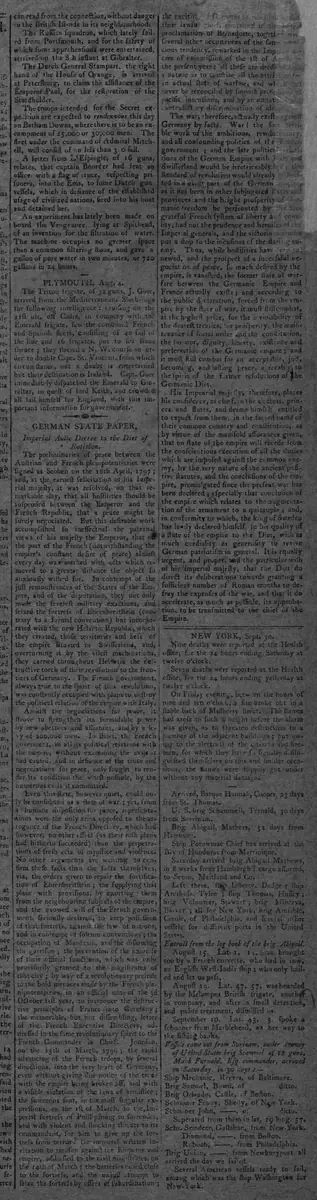
Imperial Aulic Decree to the Diet of
Ratisbon.
The preliminaries of peace between the
Austrian and French plenipotentiaries were
signed at Leoben on the 18th April, 1797;
and, at the earnest solicitation of his Impe-
rial majesty, it was resolved, on that re-
markable day, that all hostilities should be
suspended between the Emperor and the
French Republic, that a peace might be
surely negotiated. But this desirable work
accomplished so ineffectual the paternal
views of his majesty the Emperor, that on
the part of the French (notwithstanding the
empire's constant desire of peace) almost
every day was marked with acts which re-
moved to a greater distance the object so
anxiously wished for. In contempt of the
just remonstrances of the States of the Em-
pire, and of the deputation, they not only
made the severest military exactions, and
seized the fortress of Ehrenbreitstein (con-
trary to a formal convention) but incorpo-
rated with the new Helvetic Republic which
they created, those territories and fiefs of
the empire situated in Switzerland, and,
overturning it by the vilest machinations,
they carried throughout Helvetia the des-
tractive torch of their revolution to the fron-
tiers of Germany. The French government,
always true to the spirit of this revolution,
was constantly occupied with plans to destroy
the political relation of the empire with Italy.
Amidt the negociations for peace, it
strove to strengthen its formidable power
by new abettors and alliances, and by a le-
gion of 200,000 men. In short, the French
government, in all its political relations with
the empire, without examining the evils it
had caused, and in defiance of the truce and
negociations for peace, only ought to ren-
der its condition the worst possible, by the
numerous evils it committed.
Even this state, however quiet, could on-
ly be considered as a state of war ; yet, from
a humane disposition for peace, representa-
tions were the only arms opposed to the ar-
rogance of the French Directory, which had
however, no other effect (as their rash plans
had hitherto succeeded)than the perpetra-
tions of fresh acts of injustice and violence.
No other arguments are wanting to con-
form these facts than the facts themselves,
viz, the orders given to repair the fortifica-
tion of Ehrenbreitstein ; the supplying that
place with provisions, by extorting them
from the neighbouring subjects of the empire,
and the avowed will of the French govern-
ment, seriously declared, to keep possession
of that fortress, against the law of nations,
and in contempt of solemn conventions ; the
occupation of Mannheim, and the disarming
the garrison ; the prevention of the exercise
of their official functions, which was only
provisionally granted to the magistrates of
that city ; by way of a revolutionary prelude
to the bold menaces made by the French ple-
nipotentiaries, in an official note of the 3d
October last year, to introduce the des-
tractive principles of France into Germany ;
the memorable, but not disabling, letter
of the French Executive Directory, ad-
dressed in the same revolutionary spirit to the
French Commander in Chief. Jourdan,
on the 15th of March, 1799 ; the rapid
advancing of the French troops, by several
directions, into the very heart of Germany,
even without giving due notice of the truce
with the empire being broken off, and with
a visible violation of the laws of armistice ;
the summons sent, in the most singular ex-
pressions, on the 1st of March, to the Im-
perial fortress of Phillipsburg to surrender,
and with violent and shocking threats to its
commandant, for him to give up the for-
tress from terror? the immoral written in-
vitation to treason against the Emperor and
empire, addressed to the civil magistrates, on
the 14th of March ; the batteries raised close
to the fortress, and the unjust attempt to
seize the fortress by officers of subordination;
the exciting circulars in regard to their lawful chief, contained in the decree
of commission of the 1st of April 1. in
the present year; all these are deeds of such
a nature as to combine all the attributes of
an actual state of warfare, and which never be reconciled by more professions,
pacific intentions, and by an unilateral and
contradictory discrimination of ideas
The war, therefore, actually exists, against
Germany by facts, War! the most terri-
ble work of the ambitious, revolutionary,
and all confounding politics of the French
government ; and the late political-seata-
tions of the German Empire with Italy and
Switzerland would be irretrievably lost; the
standard of revolution would already be flying.
ted in a great part of the German empire
as it has been in other subjugated states and
provinces, and the bright prosperity of Ger-
manic freedom be persecuted by the ungrateful French system of liberty and equa-
lity, had not the prudence and heroism of the
Imperial generals, and the victorious armies
put a stop to the incursions of the daring en-
emy. Thus, while hostilities have been re-
newed, and the prospect of a successful ne-
gociation of peace, so much desired by the
empire, is vanished, this former state of war-
fare between the Germanic Empire and
France actually exists; and according to
the public declaration. forced from the em-
pire by the state of war, it must still combat,
at the highest price, for the inviolability of
the dearest treaties, for prosperity the main-
tenance of social order and the constitution,
the honour, dignity, liberty, existence and
preservation of the Germanic empire; and
it must still combat for an acceptable, just,
becoming, and lasting peace, agreeably to
the spirit of the former resolutions of the
Germanic Diet.
, His Imperial majesty, therefore, places
his confidence, as chief, in the electors. prin-
ces, and states, and deems himself entitled
to expect from them, in the sacred name of
their common country and constitution, as
by virtue of the manifold assurances given,
that no state of the empire will recede from
the conscientious execution of all the duties
which are imposed against the common ene-
my, by the very nature of the ancient posi-
tive statutes, and the conclusions of the em-
pire, promulgated since the present war has
been declared; especially that conclusion of
the empire which relates to the augmenta-
tion of the armament to a quintuple ; and,
in conformity to which, the king of Sweden
has lately declared himself, in his quality of
a state of the empire to the Diet, with as
much cordiality as generosity to revive
German patriotism in general. It is equally
urgent, and proper, and the particular wish
of his imperial majesty, that the Diet do
direct its deliberations towards granting a
sufficient number of Roman months to de-
fray the expenses of the war, and that it do
accelerate, as much as possible, its approba-
tion, to be transmitted to the chief of the
Empire.
What sub-type of article is it?
What keywords are associated?
What entities or persons were involved?
Where did it happen?
Foreign News Details
Primary Location
Ratisbon
Event Date
1st Of April In The Present Year
Key Persons
Outcome
state of war exists between the germanic empire and france; hostilities renewed; imperial armies stop french incursions
Event Details
Preliminaries of peace signed at Leoben on 18th April 1797, but French actions including seizure of Ehrenbreitstein, occupation of Mannheim, incorporation of Swiss territories into Helvetic Republic, threats to introduce revolutionary principles into Germany, and advances into Germany violate truce, confirming actual state of war.