Thank you for visiting SNEWPapers!
Sign up free
Editorial
October 3, 1777
The Virginia Gazette
Williamsburg, Virginia
What is this article about?
Thomas Paine's 'The American Crisis, Number IV' urges Americans to resist British General Howe's invasion after the Battle of Brandywine, emphasizing that the enemy's losses weaken them while patriots can reinforce, and calls for spirited defense of Philadelphia to secure victory in the Revolution.
Clipping
OCR Quality
98%
Excellent
Full Text
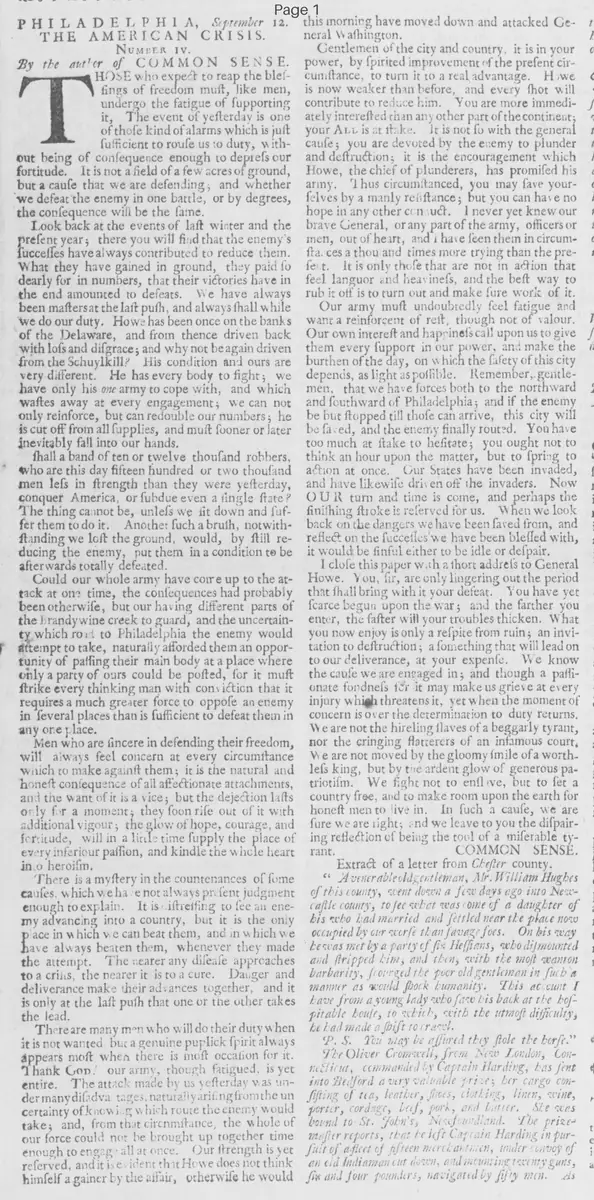
PHILADELPHIA, September 12.
THE AMERICAN CRISIS.
NUMBER IV.
By the author of COMMON SENSE.
Those who expect to reap the blessings of freedom must, like men, undergo the fatigue of supporting it. The event of yesterday is one of those kind of alarms which is just sufficient to rouse us to duty, without being of consequence enough to depress our fortitude. It is not a field of a few acres of ground, but a cause that we are defending; and whether we defeat the enemy in one battle, or by degrees, the consequence will be the same.
Look back at the events of last winter and the present year; there you will find that the enemy's successes have always contributed to reduce them. What they have gained in ground, they paid so dearly for in numbers, that their victories have in the end amounted to defeats. We have always been masters at the last push, and always shall while we do our duty. Howe has been once on the banks of the Delaware, and from thence driven back with loss and disgrace; and why not again driven from the Schuylkill? His condition and ours are very different. He has every body to fight; we have only his one army to cope with, and which wastes away at every engagement; we can not only reinforce, but can redouble our numbers; he is cut off from all supplies, and must sooner or later inevitably fall into our hands.
Shall a band of ten or twelve thousand robbers, who are this day fifteen hundred or two thousand men less in strength than they were yesterday, conquer America, or subdue even a single state? The thing cannot be, unless we sit down and suffer them to do it. Another such a brush, notwithstanding we lost the ground, would, by still reducing the enemy, put them in a condition to be afterwards totally defeated.
Could our whole army have come up to the attack at one time, the consequences had probably been otherwise, but our having different parts of the Brandywine creek to guard, and the uncertainty which road to Philadelphia the enemy would attempt to take, naturally afforded them an opportunity of passing their main body at a place where only a party of ours could be posted, for it must strike every thinking man with conviction that it requires a much greater force to oppose an enemy in several places than is sufficient to defeat them in any one place.
Men who are sincere in defending their freedom, will always feel concern at every circumstance which may make against them; it is the natural and honest consequence of all affectionate attachments, and the want of it is a vice; but the dejection lasts only for a moment; they soon rise out of it with additional vigour; the glow of hope, courage, and fortitude, will in a little time supply the place of every inferior passion, and kindle the whole heart in heroism.
There is a mystery in the countenances of some causes, which we have not always present judgment enough to explain. It is distressing to see an enemy advancing into a country, but it is the only place in which we can beat them, and in which we have always beaten them, whenever they made the attempt. The nearer any disease approaches to a crisis, the nearer it is to a cure. Danger and deliverance make their advances together, and it is only at the last push that one or the other takes the lead.
There are many men who will do their duty when it is not wanted; but a genuine public spirit always appears most when there is most occasion for it. Thank God, our army, though fatigued, is yet entire. The attack made by us yesterday was under many disadvantages, naturally arising from the uncertainty of knowing which route the enemy would take; and, from that circumstance, the whole of our force could not be brought up together time enough to engage all at once. Our strength is yet reserved, and it is evident that Howe does not think himself a gainer by the affair, otherwise he would this morning have moved down and attacked General Washington.
Gentlemen of the city and country, it is in your power, by spirited improvement of the present circumstance, to turn it to a real advantage. Howe is now weaker than before, and every shot will contribute to reduce him. You are more immediately interested than any other part of the continent; your ALL is at stake. It is not so with the general cause; you are devoted by the enemy to plunder and destruction; it is the encouragement which Howe, the chief of plunderers, has promised his army. Thus circumstanced, you may save yourselves by a manly resistance; but you can have no hope in any other conduct. I never yet knew our brave General, or any part of the army, officers or men, out of heart, and I have seen them in circumstances a thousand times more trying than the present. It is only those that are not in action that feel languor and heaviness, and the best way to rub it off is to turn out and make sure work of it.
Our army must undoubtedly feel fatigue and want a reinforcement of rest, though not of valour. Our own interest and happiness call upon us to give them every support in our power, and make the burden of the day, on which the safety of this city depends, as light as possible. Remember, gentlemen, that we have forces both to the northward and southward of Philadelphia; and if the enemy be but stopped till those can arrive, this city will be saved, and the enemy finally routed. You have too much at stake to hesitate; you ought not to think an hour upon the matter, but to spring to action at once. Our States have been invaded, and have likewise driven off the invaders. Now our turn and time is come, and perhaps the finishing stroke is reserved for us. When we look back on the dangers we have been saved from, and reflect on the successes we have been blessed with, it would be sinful either to be idle or despair.
I close this paper with a short address to General Howe. You, sir, are only lingering out the period that shall bring with it your defeat. You have yet scarce begun upon the war; and the farther you enter, the faster will your troubles thicken. What you now enjoy is only a respite from ruin; an invitation to destruction; a something that will lead on to our deliverance, at your expense. We know the cause we are engaged in; and though a passionate fondness for it may make us grieve at every injury which threatens it, yet when the moment of concern is over the determination to duty returns. We are not the hireling slaves of a beggarly tyrant, nor the cringing flatterers of an infamous court. We are not moved by the gloomy smile of a worthless king, but by the ardent glow of generous patriotism. We fight not to enslave, but to set a country free, and to make room upon the earth for honest men to live in. In such a cause, we are sure we are right; and we leave to you the despairing reflection of being the tool of a miserable tyrant.
COMMON SENSE.
THE AMERICAN CRISIS.
NUMBER IV.
By the author of COMMON SENSE.
Those who expect to reap the blessings of freedom must, like men, undergo the fatigue of supporting it. The event of yesterday is one of those kind of alarms which is just sufficient to rouse us to duty, without being of consequence enough to depress our fortitude. It is not a field of a few acres of ground, but a cause that we are defending; and whether we defeat the enemy in one battle, or by degrees, the consequence will be the same.
Look back at the events of last winter and the present year; there you will find that the enemy's successes have always contributed to reduce them. What they have gained in ground, they paid so dearly for in numbers, that their victories have in the end amounted to defeats. We have always been masters at the last push, and always shall while we do our duty. Howe has been once on the banks of the Delaware, and from thence driven back with loss and disgrace; and why not again driven from the Schuylkill? His condition and ours are very different. He has every body to fight; we have only his one army to cope with, and which wastes away at every engagement; we can not only reinforce, but can redouble our numbers; he is cut off from all supplies, and must sooner or later inevitably fall into our hands.
Shall a band of ten or twelve thousand robbers, who are this day fifteen hundred or two thousand men less in strength than they were yesterday, conquer America, or subdue even a single state? The thing cannot be, unless we sit down and suffer them to do it. Another such a brush, notwithstanding we lost the ground, would, by still reducing the enemy, put them in a condition to be afterwards totally defeated.
Could our whole army have come up to the attack at one time, the consequences had probably been otherwise, but our having different parts of the Brandywine creek to guard, and the uncertainty which road to Philadelphia the enemy would attempt to take, naturally afforded them an opportunity of passing their main body at a place where only a party of ours could be posted, for it must strike every thinking man with conviction that it requires a much greater force to oppose an enemy in several places than is sufficient to defeat them in any one place.
Men who are sincere in defending their freedom, will always feel concern at every circumstance which may make against them; it is the natural and honest consequence of all affectionate attachments, and the want of it is a vice; but the dejection lasts only for a moment; they soon rise out of it with additional vigour; the glow of hope, courage, and fortitude, will in a little time supply the place of every inferior passion, and kindle the whole heart in heroism.
There is a mystery in the countenances of some causes, which we have not always present judgment enough to explain. It is distressing to see an enemy advancing into a country, but it is the only place in which we can beat them, and in which we have always beaten them, whenever they made the attempt. The nearer any disease approaches to a crisis, the nearer it is to a cure. Danger and deliverance make their advances together, and it is only at the last push that one or the other takes the lead.
There are many men who will do their duty when it is not wanted; but a genuine public spirit always appears most when there is most occasion for it. Thank God, our army, though fatigued, is yet entire. The attack made by us yesterday was under many disadvantages, naturally arising from the uncertainty of knowing which route the enemy would take; and, from that circumstance, the whole of our force could not be brought up together time enough to engage all at once. Our strength is yet reserved, and it is evident that Howe does not think himself a gainer by the affair, otherwise he would this morning have moved down and attacked General Washington.
Gentlemen of the city and country, it is in your power, by spirited improvement of the present circumstance, to turn it to a real advantage. Howe is now weaker than before, and every shot will contribute to reduce him. You are more immediately interested than any other part of the continent; your ALL is at stake. It is not so with the general cause; you are devoted by the enemy to plunder and destruction; it is the encouragement which Howe, the chief of plunderers, has promised his army. Thus circumstanced, you may save yourselves by a manly resistance; but you can have no hope in any other conduct. I never yet knew our brave General, or any part of the army, officers or men, out of heart, and I have seen them in circumstances a thousand times more trying than the present. It is only those that are not in action that feel languor and heaviness, and the best way to rub it off is to turn out and make sure work of it.
Our army must undoubtedly feel fatigue and want a reinforcement of rest, though not of valour. Our own interest and happiness call upon us to give them every support in our power, and make the burden of the day, on which the safety of this city depends, as light as possible. Remember, gentlemen, that we have forces both to the northward and southward of Philadelphia; and if the enemy be but stopped till those can arrive, this city will be saved, and the enemy finally routed. You have too much at stake to hesitate; you ought not to think an hour upon the matter, but to spring to action at once. Our States have been invaded, and have likewise driven off the invaders. Now our turn and time is come, and perhaps the finishing stroke is reserved for us. When we look back on the dangers we have been saved from, and reflect on the successes we have been blessed with, it would be sinful either to be idle or despair.
I close this paper with a short address to General Howe. You, sir, are only lingering out the period that shall bring with it your defeat. You have yet scarce begun upon the war; and the farther you enter, the faster will your troubles thicken. What you now enjoy is only a respite from ruin; an invitation to destruction; a something that will lead on to our deliverance, at your expense. We know the cause we are engaged in; and though a passionate fondness for it may make us grieve at every injury which threatens it, yet when the moment of concern is over the determination to duty returns. We are not the hireling slaves of a beggarly tyrant, nor the cringing flatterers of an infamous court. We are not moved by the gloomy smile of a worthless king, but by the ardent glow of generous patriotism. We fight not to enslave, but to set a country free, and to make room upon the earth for honest men to live in. In such a cause, we are sure we are right; and we leave to you the despairing reflection of being the tool of a miserable tyrant.
COMMON SENSE.
What sub-type of article is it?
War Or Peace
Moral Or Religious
Partisan Politics
What keywords are associated?
American Crisis
Thomas Paine
Brandywine Battle
British Invasion
Philadelphia Defense
Patriotism
General Howe
What entities or persons were involved?
General Howe
General Washington
British Army
Editorial Details
Primary Topic
Motivation To Resist British After Brandywine Defeat
Stance / Tone
Patriotic Exhortation And Defiance
Key Figures
General Howe
General Washington
British Army
Key Arguments
Enemy's Gains Are Costly And Weaken Them Overall
American Forces Can Reinforce While British Cannot
Recent Defeat Is Temporary; Full Engagement Would Have Succeeded
Duty And Public Spirit Demand Resistance Now
Philadelphia's Defense Is Crucial To The Cause
Patriots Fight For Freedom Against Tyranny