Thank you for visiting SNEWPapers!
Sign up free
Kentucky Gazette
Lexington, Fayette County, Kentucky
What is this article about?
A couple near Coimbra, Portugal, murders a traveler seeking shelter during a storm, only to discover he was their long-lost son returning from Brazil with money. The crime is exposed ten days later by another traveler. Reported in the July 5 Revista as an example of depravity under religion.
Clipping
OCR Quality
Full Text
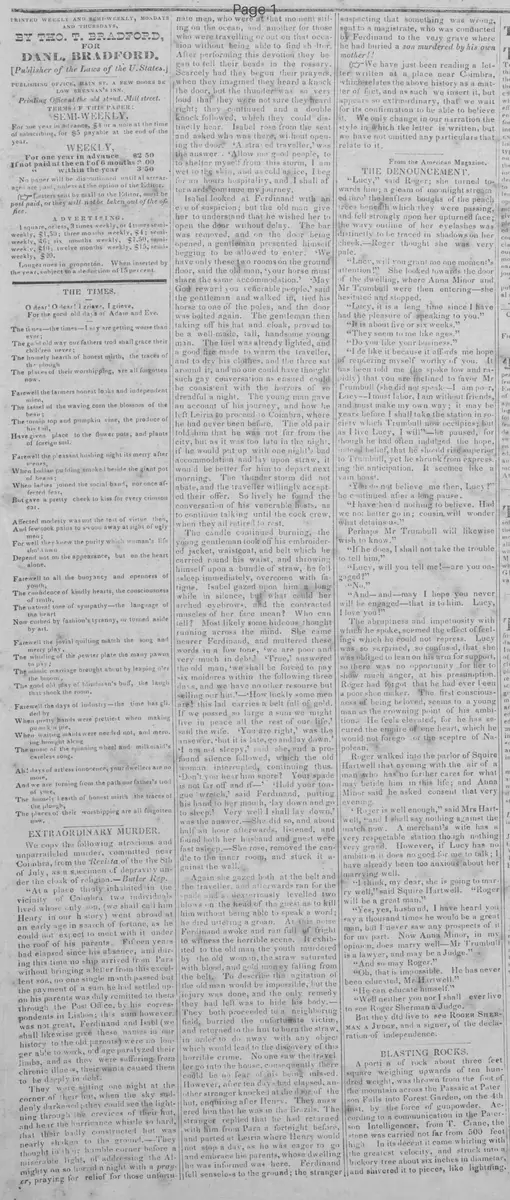
We copy the following atrocious and unparalleled murder, committed near Coimbra, from the Revista of the 5th of July, as a specimen of depravity under the cloak of religion.—Butler Rep.
"At a place thinly inhabited in the vicinity of Coimbra two individuals lived whose only son, (we shall call him Henry in our story) went abroad at an early age in search of fortune, as he could not expect to meet with it under the roof of his parents. Fifteen years had elapsed since his absence, and during this time no ship arrived from Para without bringing a letter from this excellent son, no one single month passed but the payment of a sum he had settled upon his parents was duly remitted to them through the Post Office, by his correspondents in Lisbon; this sum however was not great, Ferdinand and Isabel (we shall likewise give these names in our history to the old parents) were no longer able to work, old age paralyzed their limbs, and as they were suffering from chronic illness, their wants caused them to be deeply in debt.
They were sitting one night at the corner of their hut, when the sky suddenly darkened; they could see the lightning through the crevices of their hut, and hear the hurricane whistle so hard that their badly constructed hut was nearly shaken to the ground.—They thought in their humble corner before a miserable light, of addressing the Almighty on so horrid a night with a prayer for relief for those unfortunate men, who were at that moment sailing on the ocean, and another for those who were travelling or out on that occasion without being able to find shelter. After performing this devotion they began to tell their beads in the rosary.
Scarcely had they begun their prayers, when they imagined they heard a knock at the door, but the thunder was so very loud that they were not sure they heard right; they continued and a double knock followed, which they could distinctly hear. Isabel rose from the seat and asked who was there, without opening the door. 'A strayed traveller,' was the answer.. 'Allow me good people, to shelter myself from this storm, I am wet to the skin, and as cold as ice, I beg for an hours hospitality, and I shall afterwards continue my journey.'
Isabel looked at Ferdinand! with an eye of suspicion; but the old man gave her to understand that he wished her to open the door without delay. The bar was removed, and on the door being opened, a gentleman presented himself begging to be allowed to enter. We have only these two rooms on the ground floor, said the old man, 'your horse must share the same accommodation. May God reward you venerable people,' said the gentleman and walked in, tied his horse to one of the poles, and the door was bolted again. The gentleman then taking off his hat and cloak, proved to be a well-made, tall, handsome young man. The fuel was already lighted, and a good fire made to warm the traveller, and to dry his clothes, and the three sat around it, and no one could have thought such gay conversation as ensued could be consistent with the horrors of so dreadful a night. The young man gave an account of his journey, and how he left Leiria to proceed to Coimbra, where he had never been before. The old pair told him that he was not far from the city, but as it was too late in the night, if he would put up with one night's bad accommodation and lay upon straw, it would be better for him to depart next morning. The thunder storm did not abate, and the traveller willingly accepted their offer. So lively he found the conversation of his venerable hosts, as to continue talking until the cock crew, when they all retired to rest.
The candle continued burning, the young gentleman took off his embroidered jacket, waistcoat, and belt which he carried round his waist, and throwing himself upon a bundle of straw, he fell asleep immediately, overcome with fatigue. Isabel gazed upon him a long while in silence, but what could her arched eyebrows and the contracted muscles of her face mean? Who can tell? Most likely some hideous thought running across the mind. She came nearer Ferdinand, and muttered these words in a low tone, we are poor and very much in debt. "True,' answered the old man, 'we shall be forced to pay six moidores within the following three days, and we have no other resource but selling our hut.'—'How lucky some men are! this lad carries a belt full of gold. If we possessed so large a sum we might live in peace all the rest of our life,' said the wife. 'You are right,' was the answer, but it is late, go and lay down.' 'I am not sleepy,' said she, and a profound silence followed, which the old woman interrupted, continuing thus. 'Don't you hear him snore? Your spade is not far off and if—' " 'Hold your tongue wretch,' said Ferdinand, putting his hand to her mouth, lay down and go to sleep.' Very well I shall lay down,' was the answer.—She did so, and about half an hour afterwards. listened, and found both her husband and guest were fast asleep.—She rose, removed the candle to the inner room, and stuck it against the wall.
Again she gazed both at the belt and the traveller, and afterwards ran for the spade and so dexteriously levelled two blows on the head of the guest as to kill him without being able to speak a word; he died uttering a groan. At this noise Ferdinand awoke and ran full of fright to witness the horrible scene. It exhibited to the old man the youth murdered by the old woman, the straw saturated with blood, and gold money falling from the belt. To describe the agitation of the old man would be impossible, but the injury was done, and the only remedy they had left was to hide his body.— They both proceeded to a neighboring field, buried the unfortunate victim, and returned to the hut to burn the straw, in order to do away with any object which would lead to the discovery of this horrible crime. No one saw the traveller go into the house, consequently there could be no fear of his being missed. However, after ten days had elapsed, another stranger knocked at the door of the hut, enquiring after Henry. They answered him that he was in the Brazils. The stranger replied that he had returned with him from Para a fortnight before, and parted at Leiria where Henry would not stop a day, as he was eager to go and embrace his parents, whose dwelling he was informed was here. Ferdinand fell senseless to the ground; the stranger suspecting that something was wrong, sent to a magistrate, who was conducted by Ferdinand to the very grave where he had buried a son murdered by his own mother!!
We have just been reading a letter written at a place near Coimbra, which relates the above history as a matter of fact, and as such we insert it, but it appears so extraordinary, that we wait for its confirmation to be able to believe it. We only change in our narration the style in which the letter is written, but we have not omitted any particulars that relate to it."
What sub-type of article is it?
What keywords are associated?
What entities or persons were involved?
Where did it happen?
Foreign News Details
Primary Location
Vicinity Of Coimbra
Event Date
Circa Late June (Reported 5th Of July)
Key Persons
Outcome
son (henry) murdered by mother isabel with spade; body buried in neighboring field; crime discovered ten days later by stranger and magistrate.
Event Details
Impoverished elderly parents near Coimbra shelter a traveler during a storm, converse amiably, then the mother kills him with a spade for his gold belt while he sleeps. They bury the body, but ten days later a stranger reveals the victim was their son returning from Brazil.