Thank you for visiting SNEWPapers!
Sign up free
The Massachusetts Spy
Boston, Suffolk County, Massachusetts
What is this article about?
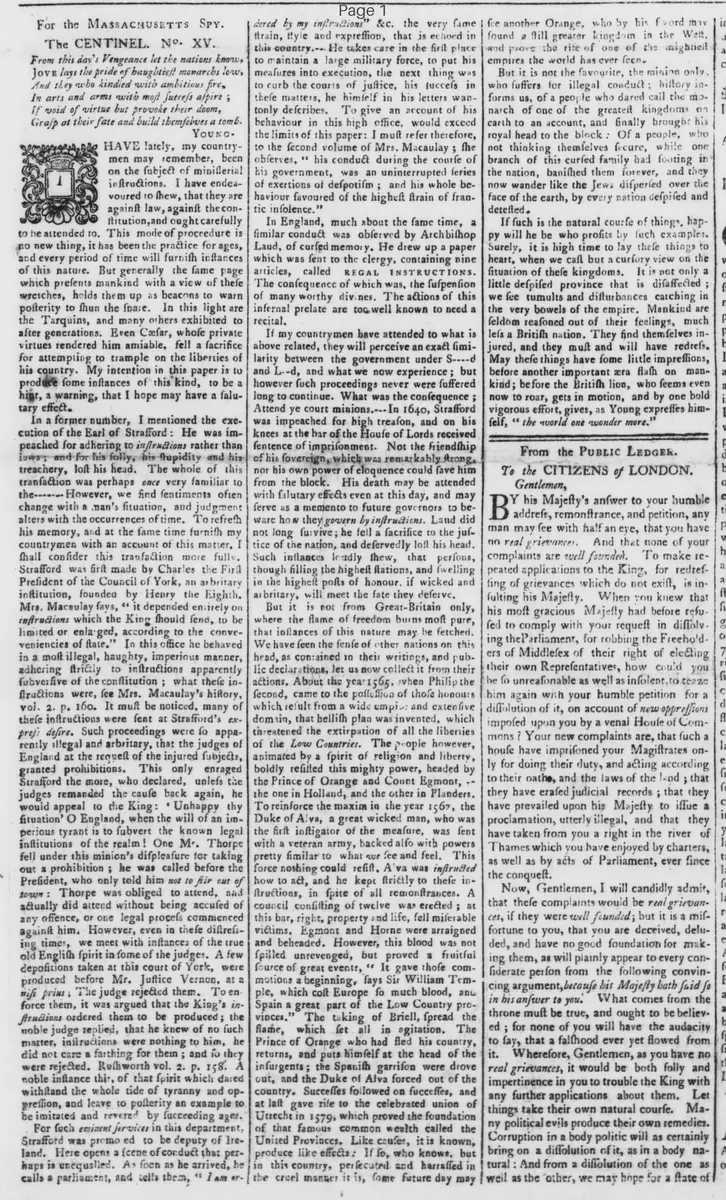
This editorial, 'The Centinel No. XV,' draws historical parallels from England (Strafford, Laud) and the Netherlands (Alva, Philip II) to warn against British officials in the colonies adhering to unlawful ministerial instructions, urging resistance to preserve constitutional liberties.
Merged-components note: Merging the image with the editorial component due to spatial overlap in bounding boxes and adjacent reading order, indicating the image is illustrative for the editorial content.
Clipping
OCR Quality
Full Text
The CENTINEL. NO. XV.
From this day's Vengeance let the nations know,
Jove lays the pride of haughtiest monarchs low,
And they who kindled with ambitious fire,
In arts and arms with most success aspire ;
If void of virtue but provoke their doom,
Grasp at their fate and build themselves a tomb.
YOUNG—
I HAVE lately, my countrymen may remember, been
on the subject of ministerial
instructions. I have endeavoured to shew, that they are
against law, against the con-
stitution, and ought carefully
to be attended to. This mode of procedure is
no new thing, it has been the practice for ages,
and every period of time will furnish instances
of this nature. But generally the same page
which presents mankind with a view of these
wretches, holds them up as beacons to warn
posterity to shun the snare. In this light are
the Tarquins, and many others exhibited to
after generations. Even Cæsar, whose private
virtues rendered him amiable, fell a sacrifice
for attempting to trample on the liberties of
his country. My intention in this paper is to
produce some instances of this kind, to be a
hint, a warning, that I hope may have a salutary effect.
In a former number, I mentioned the exe-
cution of the Earl of Strafford : He was im-
peached for adhering to instructions rather than
laws; and for his folly, his stupidity and his
treachery, lost his head. The whole of this
transaction was perhaps once very familiar to
the— so—However, we find sentiments often
change with a man's situation, and judgment
alters with the occurrences of time. To refresh
his memory, and at the same time furnish my
countrymen with an account of this matter, I
shall consider this transaction more fully.
Strafford was first made by Charles the First
President of the Council of York, an arbitrary
institution, founded by Henry the Eighth.
Mrs. Macaulay says, "it depended entirely on
instructions which the King should send, to be
limited or enlarged, according to the conve-
niencies of state." In this office he behaved
in a most illegal, haughty, imperious manner,
adhering strictly to instructions apparently
subversive of the constitution ; what these in-
structions were, see Mrs. Macaulay's history.
vol. 2. p. 160. It must be noticed, many of
these instructions were sent at Strafford's ex-
press desire. Such proceedings were so appa-
rently illegal and arbitrary, that the judges of
England at the request of the injured subjects,
granted prohibitions. This only enraged
Strafford the more, who declared, unless the
judges remanded the cause back again, he
would appeal to the King: Unhappy thy
situation O England, when the will of an im-
perious tyrant is to subvert the known legal
institutions of the realm! One Mr. Thorpe
fell under this minion's displeasure for taking
out a prohibition ; he was called before the
President, who only told him not to stir out of
town : Thorpe was obliged to attend, and
actually did attend without being accused of
any offence, or one legal process commenced
against him. However, even in these distressing times, we meet with instances of the true
old English spirit in some of the judges. A few
depositions taken at this court of York, were
produced before Mr. Justice Vernon, at a
nisi prius; The judge rejected them. To enforce them, it was argued that the King's in-
structions ordered them to be produced; the
noble judge replied, that he knew of no such
matter, instructions were nothing to him, he
did not care a farthing for them; and so they
were rejected. Rushworth vol. 2. p. 158. A
noble instance this, of that spirit which dared
withstand the whole tide of tyranny and op-
pression, and leave to posterity an example to
be imitated and revered by succeeding ages.
For such eminent services in this department,
Strafford was promoted to be deputy of Ire-
land. Here opens a scene of conduct that per-
haps is unequalled. As soon as he arrived, he
calls a parliament, and tells them,
"I am sec-
cured by my instructions" &c. the very same
strain, style and expression, that is echoed in
this country.—He takes care in the first place
to maintain a large military force, to put his
measures into execution, the next thing was
to curb the courts of justice, his success in
these matters, he himself in his letters wan-
tonly describes. To give an account of his
behaviour in this high office, would exceed
the limits of this paper: I must refer therefore,
to the second volume of Mrs. Macaulay ; she
observes, " his conduct during the course of
his government, was an uninterrupted series
of exertions of despotism ; and his whole be-
haviour favoured of the highest strain of fran-
tic insolence."
In England, much about the same time, a
similar conduct was observed by Archbishop
Laud, of cursed memory. He drew up a paper
which was sent to the clergy, containing nine
articles, called REGAL INSTRUCTIONS.
The consequence of which was, the suspension
of many worthy divines. The actions of this
infernal prelate are too well known to need a
recital.
If my countrymen have attended to what is
above related, they will perceive an exact simi-
larity between the government under S— —d
and L— —d, and what we now experience; but
however such proceedings never were suffered
long to continue. What was the consequence ;
Attend ye court minions.—In 1640, Strafford
was impeached for high treason, and on his
knees at the bar of the House of Lords received
sentence of imprisonment. Not the friendship
of his sovereign, which was remarkably strong,
nor his own power of eloquence could save him
from the block. His death may be attended
with salutary effects even at this day, and may
serve as a memento to future governors to be-
ware how they govern by instructions. Laud did
not long survive; he fell a sacrifice to the ju-
tice of the nation, and deservedly lost his head.
Such instances loudly shew, that persons,
though filling the highest stations, and swelling
in the highest posts of honour, if wicked and
arbitrary, will meet the fate they deserve.
But it is not from Great-Britain only,
where the flame of freedom burns most pure,
that instances of this nature may be fetched.
We have seen the sense of other nations on this
head, as contained in their writings, and pub-
lic declarations, let us now collect it from their
actions. About the year 1565. when Philip the
second, came to the possession of those honours
which result from a wide empire and extensive
domain, that hellish plan was invented, which
threatened the extirpation of all the liberties
of the Low Countries. The People however,
animated by a spirit of religion and liberty,
boldly resisted this mighty power, headed by
the Prince of Orange and Count Egmont, .
the one in Holland, and the other in Flanders.
To reinforce the maxim in the year 1567, the
Duke of Alva, a great wicked man, who was
the first instigator of the measure, was sent
with a veteran army, backed also with powers
pretty similar to what we see and feel. This
force nothing could resist. Alva was instructed
how to act, and he kept strictly to these in-
structions, in spite of all remonstrances. A
council consisting of twelve was erected; at
this bar, right, property and life, fell miserable
victims. Egmont and Horne were arraigned
and beheaded. However, this blood was not
spilled unrevenged, but proved a fruitful
source of great events, " It gave those com-
motions a beginning, says Sir William Tem-
ple, which cost Europe so much blood, and
Spain a great part of the Low Country pro-
vinces." The taking of Briell, spread the
flame, which set all in agitation. The
Prince of Orange who had fled his country,
returns, and puts himself at the head of the
insurgents; the Spanish garrison were drove
out, and the Duke of Alva forced out of the
country. Successes followed on successes, and
at last gave rise to the celebrated union of
Utrecht in 1579, which proved the foundation
of that famous common wealth called the
United Provinces. Like causes, it is known,
produce like effects: If so, who knows. but
in this country, persecuted and harassed in
the cruel manner it is, some future day may
see another Orange, who by his sword may
found a still greater kingdom in the West,
and prove the rise of one of the mightiest
empires the world has ever seen.
But it is not the favourite, the minion only.
who suffers for illegal conduct: history in-
forms us, of a people who dared call the mo-
narch of one of the greatest kingdoms o
earth to an account, and finally brought his
royal head to the block: Of a people, who
not thinking themselves secure, while one
branch of this cursed family had footing in
the nation. banished them forever, and they
now wander like the Jews dispersed over the
face of the earth, by every nation despised and
detested.
If such is the natural course of things, hap-
py will he be who profits by such examples.
Surely, it is high time to lay these things to
heart, when we cast but a cursory view on the
situation of these kingdoms. It is not only a
little despised province that is disaffected ;
we see tumults and disturbances catching in
the very bowels of the empire. Mankind are
seldom reasoned out of their feelings, much
less a British nation. They find themselves in-
jured, and they must and will have redress.
May these things have some little impressions,
before another important era flash on man-
kind: before the British lion, who seems even
now to roar, gets in motion, and by one bold
vigorous effort, gives, as Young expresses him-
self, " the world one wonder more."
What sub-type of article is it?
What keywords are associated?
What entities or persons were involved?
Editorial Details
Primary Topic
Historical Warnings Against Adhering To Ministerial Instructions Over Constitutional Law
Stance / Tone
Cautionary And Anti Tyrannical, Urging Resistance To Arbitrary Governance
Key Figures
Key Arguments