Thank you for visiting SNEWPapers!
Sign up free
Editorial
August 29, 1864
Evansville Daily Journal
Evansville, Vanderburgh County, Indiana
What is this article about?
The editorial defends moderate Republicans' pre-Fort Sumter opposition to coercing South Carolina, arguing it showed aversion to war, not provocation, and refutes Copperhead claims by emphasizing unified loyal support for the Union after the attack.
Clipping
OCR Quality
95%
Excellent
Full Text
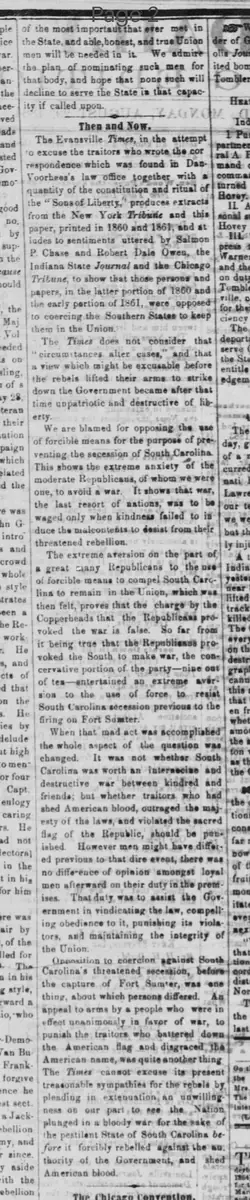
Then and Now.
The Evansville Times, in the attempt to excuse the traitors who wrote the correspondence which was found in Dan. Voorhees's law office together with a quantity of the constitution and ritual of the "Sons of Liberty," produces extracts from the New York Tribune and this paper, printed in 1860 and 1861, and alludes to sentiments uttered by Salmon P. Chase and Robert Dale Owen, the Indiana State Journal and the Chicago Tribune, to show that those persons and papers, in the latter portion of 1860 and the early portion of 1861, were opposed to coercing the Southern States to keep them in the Union.
The Times does not consider that "circumstances alter cases," and that a view which might be excusable before the rebels lifted their arms to strike down the Government became after that time unpatriotic and destructive of liberty.
We are blamed for opposing the use of forcible means for the purpose of preventing the secession of South Carolina. This shows the extreme anxiety of the moderate Republicans, of whom we were one, to avoid a war. It shows that war, the last resort of nations, was to be waged only when kindness failed to induce the malcontents to desist from their threatened rebellion.
The extreme aversion on the part of a great many Republicans to the use of forcible means to compel South Carolina to remain in the Union, which was then felt, proves that the charge by the Copperheads that the Republicans provoked the war is false. So far from it being true that the Republicans provoked the South to make war, the conservative portion of the party-nine tenths-entertained an extreme aversion to the use of force to resist South Carolina secession previous to the firing on Fort Sumter.
When that mad act was accomplished the whole aspect of the question was changed. It was not whether South Carolina was worth an internecine and destructive war between kindred and friends: but whether traitors who had shed American blood, outraged the majesty of the laws, and violated the sacred flag of the Republic, should be punished. However men might have differed previous to that dire event, there was no difference of opinion amongst loyal men afterward on their duty in the premises. That duty was to assist the Government in vindicating the law, compelling obedience to it, punishing its violators, and maintaining the integrity of the Union.
Opposition to coercion against South Carolina's threatened secession, before the capture of Fort Sumter, was one thing, about which persons differed. An appeal to arms by a people who were in effect unanimously in favor of war, to punish the traitors who battered down the American flag and disgraced the American name, was quite another thing The Times cannot excuse its present treasonable sympathies for the rebels by pleading in extenuation, an unwillingness on our part to see the Nation plunged in a bloody war for the sake of the pestilent State of South Carolina before it forcibly rebelled against the authority of the Government, and shed American blood.
The Evansville Times, in the attempt to excuse the traitors who wrote the correspondence which was found in Dan. Voorhees's law office together with a quantity of the constitution and ritual of the "Sons of Liberty," produces extracts from the New York Tribune and this paper, printed in 1860 and 1861, and alludes to sentiments uttered by Salmon P. Chase and Robert Dale Owen, the Indiana State Journal and the Chicago Tribune, to show that those persons and papers, in the latter portion of 1860 and the early portion of 1861, were opposed to coercing the Southern States to keep them in the Union.
The Times does not consider that "circumstances alter cases," and that a view which might be excusable before the rebels lifted their arms to strike down the Government became after that time unpatriotic and destructive of liberty.
We are blamed for opposing the use of forcible means for the purpose of preventing the secession of South Carolina. This shows the extreme anxiety of the moderate Republicans, of whom we were one, to avoid a war. It shows that war, the last resort of nations, was to be waged only when kindness failed to induce the malcontents to desist from their threatened rebellion.
The extreme aversion on the part of a great many Republicans to the use of forcible means to compel South Carolina to remain in the Union, which was then felt, proves that the charge by the Copperheads that the Republicans provoked the war is false. So far from it being true that the Republicans provoked the South to make war, the conservative portion of the party-nine tenths-entertained an extreme aversion to the use of force to resist South Carolina secession previous to the firing on Fort Sumter.
When that mad act was accomplished the whole aspect of the question was changed. It was not whether South Carolina was worth an internecine and destructive war between kindred and friends: but whether traitors who had shed American blood, outraged the majesty of the laws, and violated the sacred flag of the Republic, should be punished. However men might have differed previous to that dire event, there was no difference of opinion amongst loyal men afterward on their duty in the premises. That duty was to assist the Government in vindicating the law, compelling obedience to it, punishing its violators, and maintaining the integrity of the Union.
Opposition to coercion against South Carolina's threatened secession, before the capture of Fort Sumter, was one thing, about which persons differed. An appeal to arms by a people who were in effect unanimously in favor of war, to punish the traitors who battered down the American flag and disgraced the American name, was quite another thing The Times cannot excuse its present treasonable sympathies for the rebels by pleading in extenuation, an unwillingness on our part to see the Nation plunged in a bloody war for the sake of the pestilent State of South Carolina before it forcibly rebelled against the authority of the Government, and shed American blood.
What sub-type of article is it?
War Or Peace
Partisan Politics
Constitutional
What keywords are associated?
Civil War
Secession
Fort Sumter
Coercion
Republicans
Copperheads
Union Loyalty
Southern Rebellion
What entities or persons were involved?
Evansville Times
Dan. Voorhees
Sons Of Liberty
New York Tribune
Salmon P. Chase
Robert Dale Owen
Indiana State Journal
Chicago Tribune
Copperheads
Republicans
South Carolina
Editorial Details
Primary Topic
Defense Of Republican Opposition To Coercion Before Fort Sumter And Support For War Afterward
Stance / Tone
Strongly Pro Union And Anti Traitor, Refuting Accusations Of Disloyalty
Key Figures
Evansville Times
Dan. Voorhees
Sons Of Liberty
New York Tribune
Salmon P. Chase
Robert Dale Owen
Indiana State Journal
Chicago Tribune
Copperheads
Republicans
South Carolina
Key Arguments
Circumstances Alter Cases; Pre Fort Sumter Opposition To Coercion Was To Avoid War
Republicans Did Not Provoke The War; They Were Averse To Force Before Southern Aggression
After Fort Sumter, Duty Is To Support The Government In Punishing Traitors And Maintaining The Union
Times Cannot Excuse Its Treasonable Sympathies By Citing Past Republican Moderation