Thank you for visiting SNEWPapers!
Sign up free
Story
June 17, 1869
Gallipolis Journal
Gallipolis, Gallia County, Ohio
What is this article about?
Practical guide to sowing, cultivating, and harvesting corn for fodder in Northern regions, adaptable to the South, emphasizing timing, soil preparation, and storage to prevent spoilage. Presented as cost-effective hay substitute from Country Gentleman.
Clipping
OCR Quality
98%
Excellent
Full Text
Corn For Fodder.
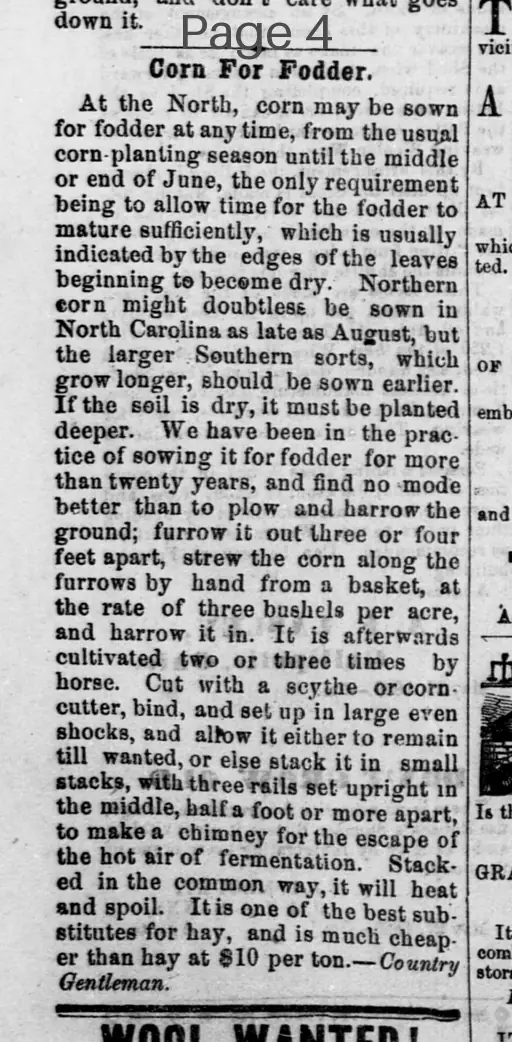
At the North, corn may be sown for fodder at any time, from the usual corn-planting season until the middle or end of June, the only requirement being to allow time for the fodder to mature sufficiently, which is usually indicated by the edges of the leaves beginning to become dry. Northern corn might doubtless be sown in North Carolina as late as August, but the larger Southern sorts, which grow longer, should be sown earlier. If the soil is dry, it must be planted deeper. We have been in the practice of sowing it for fodder for more than twenty years, and find no mode better than to plow and harrow the ground; furrow it out three or four feet apart, strew the corn along the furrows by hand from a basket, at the rate of three bushels per acre, and harrow it in. It is afterwards cultivated two or three times by horse. Cut with a scythe or corn cutter, bind, and set up in large even shocks, and allow it either to remain till wanted, or else stack it in small stacks, with three rails set upright in the middle, half a foot or more apart, to make a chimney for the escape of the hot air of fermentation. Stacked in the common way, it will heat and spoil. It is one of the best substitutes for hay, and is much cheaper than hay at $10 per ton.—Country Gentleman.
At the North, corn may be sown for fodder at any time, from the usual corn-planting season until the middle or end of June, the only requirement being to allow time for the fodder to mature sufficiently, which is usually indicated by the edges of the leaves beginning to become dry. Northern corn might doubtless be sown in North Carolina as late as August, but the larger Southern sorts, which grow longer, should be sown earlier. If the soil is dry, it must be planted deeper. We have been in the practice of sowing it for fodder for more than twenty years, and find no mode better than to plow and harrow the ground; furrow it out three or four feet apart, strew the corn along the furrows by hand from a basket, at the rate of three bushels per acre, and harrow it in. It is afterwards cultivated two or three times by horse. Cut with a scythe or corn cutter, bind, and set up in large even shocks, and allow it either to remain till wanted, or else stack it in small stacks, with three rails set upright in the middle, half a foot or more apart, to make a chimney for the escape of the hot air of fermentation. Stacked in the common way, it will heat and spoil. It is one of the best substitutes for hay, and is much cheaper than hay at $10 per ton.—Country Gentleman.
What sub-type of article is it?
Agricultural Instruction
Farming Guide
What keywords are associated?
Corn Fodder
Sowing Corn
Cultivation Method
Harvesting Fodder
Stacking Technique
Where did it happen?
North, North Carolina
Story Details
Location
North, North Carolina
Story Details
Instructions for sowing corn for fodder from planting season to June in the North, later in the South with adjustments; preparation by plowing, harrowing, furrowing; sowing three bushels per acre by hand; horse cultivation; cutting, binding, shocking or stacking with ventilation to avoid spoilage; cheaper than hay.