Thank you for visiting SNEWPapers!
Sign up free
Story
July 17, 1837
Morning Herald
New York, New York County, New York
What is this article about?
Critique of banking monopolists in New Orleans who gained control of multiple banks through stock manipulation, intrigue, and family ties, enforcing loyalty, punishing dissent, and leading to institutional corruption and insolvency.
Clipping
OCR Quality
95%
Excellent
Full Text
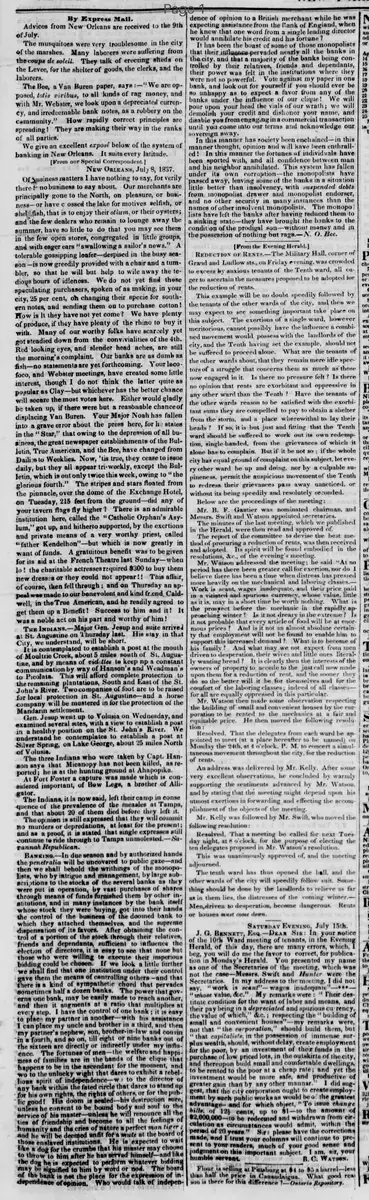
Banking.—In due season and by authorized hands the penetralia will be uncovered to public gaze—and then we shall behold the writhings of the monopolists, who by intrigue and management, by large subscriptions to the stocks of the several banks as they were put in operation, by vast purchases of shares through means of funds furnished them by other institutions, and in many instances by the bank itself whose stock they were buying, got into their hands the control of the business of the doomed bank to which they attached themselves, and the supreme dispensation of its favors. After obtaining the control of a portion of the stock through their relatives, friends and dependants, sufficient to influence the election of directors, it is easy to see that none but those who were willing to execute their imperious bidding could be chosen. If we look a little further we shall find that one institution under their control gave them the means of controlling others—and that there is a kind of sympathetic chord that pervades sometimes half a dozen banks. The power that governs one bank, may be easily made to reach another, and then it augments at a ratio that multiplies at every step to place my partner in another—with his assistance I can place my uncle and brother in a third, and then my partner's nephew, son, brother-in-law and cousin in a fourth, and so on, till eight or nine banks out of the sixteen are directly or indirectly under my influence. The fortunes of men—the welfare and happiness of families are in the hands of the clique that happens to be in the ascendant for the moment, and woe to the unlucky wight that dares to exhibit a rebellious spirit of independence—woe to the director of any bank within the fated circle that dares to stand up for his own rights, the rights of others, or for the public good! His doom is sealed—his destruction sure, unless he consent to be bound body and soul to the ties of friendship and become to all the feelings of service of his master—unless he will renounce all the humanity and the cries of nature a perfect man tiger; and he will be deemed unfit for a seat at the board of those enslaved institutions. He is expected to wait like a dog for the crumbs that his master may choose to throw to him after he has served himself—and like the dog he is expected to perform whatever bidding may be signified to him by word or nod. The board of the bank is not the place for the expression of independence of opinion. Who would talk of independence of opinion to a British merchant while he was expecting assistance from the Bank of England, when he knew that one word from a single leading director would annihilate his credit and his fortune?
It has been the boast of some of those monopolists that their influence pervaded nearly all the banks in the city, and that a majority of the banks being controlled by their relatives, friends and dependants, their power was felt in the institutions where they were not so powerful. Vote against my paper in one bank, and look out for yourself if you should ever be so unhappy as to expect a favor from any of the banks under the influence of our clique! We will pour upon your head the vials of our wrath; we will demolish your credit and dishonor your name, and disable you from engaging in a commercial transaction until you come into our terms and acknowledge our sovereign sway.
In this manner has society been enchained—in this manner thought, opinion and will have been enthralled! In this manner the fortunes of individuals have been sported with, and all confidence between man and his neighbor annihilated. This system has fallen under its own corruption—the monopolists have passed away, leaving some of the banks in a situation little better than insolvency, with suspended debts from monopolist drawer and monopolist endorser, and no other security in many instances than the names of other insolvent monopolists. The monopolists have left the banks after having reduced them to a sinking state—they have brought the banks to the condition of the prodigal son—without money and in the possession of nothing but rags.—N. O. Bee.
It has been the boast of some of those monopolists that their influence pervaded nearly all the banks in the city, and that a majority of the banks being controlled by their relatives, friends and dependants, their power was felt in the institutions where they were not so powerful. Vote against my paper in one bank, and look out for yourself if you should ever be so unhappy as to expect a favor from any of the banks under the influence of our clique! We will pour upon your head the vials of our wrath; we will demolish your credit and dishonor your name, and disable you from engaging in a commercial transaction until you come into our terms and acknowledge our sovereign sway.
In this manner has society been enchained—in this manner thought, opinion and will have been enthralled! In this manner the fortunes of individuals have been sported with, and all confidence between man and his neighbor annihilated. This system has fallen under its own corruption—the monopolists have passed away, leaving some of the banks in a situation little better than insolvency, with suspended debts from monopolist drawer and monopolist endorser, and no other security in many instances than the names of other insolvent monopolists. The monopolists have left the banks after having reduced them to a sinking state—they have brought the banks to the condition of the prodigal son—without money and in the possession of nothing but rags.—N. O. Bee.
What sub-type of article is it?
Deception Fraud
Crime Story
Historical Event
What themes does it cover?
Deception
Crime Punishment
Social Manners
What keywords are associated?
Banking Monopoly
Stock Manipulation
Financial Corruption
Insolvency
Clique Control
Where did it happen?
The City
Story Details
Location
The City
Story Details
Monopolists seize control of banks via stock purchases, family placements, and intimidation, dictating director elections and punishing independence, resulting in widespread corruption and eventual bank insolvency.