Thank you for visiting SNEWPapers!
Sign up free
The Arkansas Banner
Little Rock, Pulaski County, Arkansas
What is this article about?
The Boston Post analyzes British Tory press reactions to President Polk's 1845 inaugural address, highlighting criticism of U.S. claims to Texas and Oregon as republican triumphs over monarchical interests, predicting only verbal bluster rather than real conflict.
Clipping
OCR Quality
Full Text
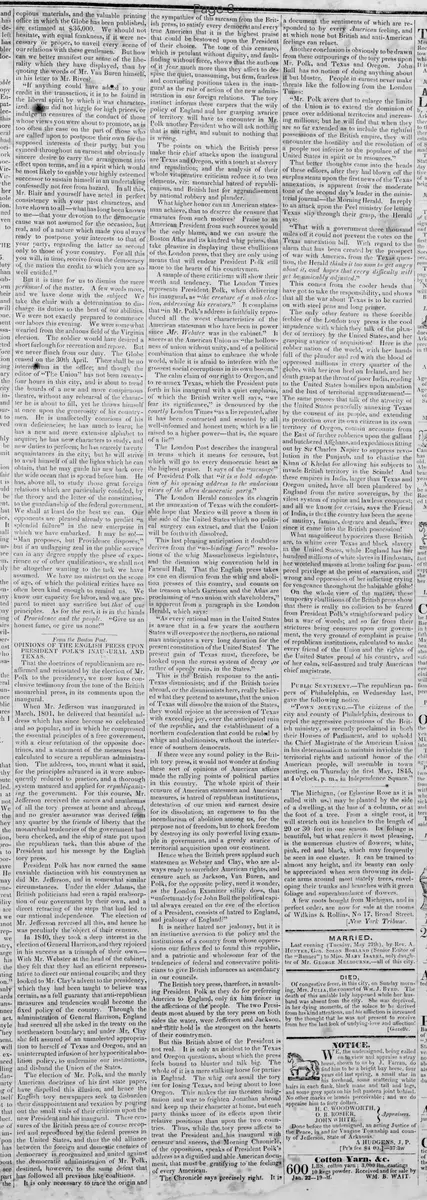
OPINIONS OF THE ENGLISH PRESS UPON PRESIDENT POLK'S INAUGURAL AND TEXAS.
That the doctrines of republicanism are re-affirmed and reinstated by the election of Mr. Polk to the presidency, we now have conclusive testimony from the tone of the British monarchical press, in its comments upon the inaugural.
When Mr. Jefferson was inaugurated in March, 1801, he delivered that beautiful address which has since become so celebrated and so popular, and in which he compressed the essential principles of a free government, with a clear refutation of the opposite doctrines, and a statement of the measures best calculated to secure a republican administration. The address, too, meant what it said, for the principles advanced in it were subsequently reduced to practice, and a thorough system matured and applied for republicanizing the government. For this course, Mr. Jefferson received the sneers and anathemas of all the tory presses at home and abroad; and no greater assurance was derived from any quarter by the friends of liberty that the monarchical tendencies of the government had been checked, and the ship of state put upon the republican tack, than this abuse of the President and his message by the English tory press.
President Polk has now earned the same enviable distinction with his countrymen as did Mr. Jefferson, and in somewhat similar circumstances. Under the elder Adams, the British politicians had seen a rapid reabsorption of our government by their own, and a direct retracing of the steps that had led to our national independence. The election of Mr. Jefferson reversed all this, and hence he was peculiarly the object of their censure.
In 1840, they took a deep interest in the election of General Harrison, and they rejoiced in his success as a triumph of their own. With Mr. Webster at the head of the cabinet, they felt that they had an efficient representative to direct our national councils; and they looked to Mr. Clay's advent to the presidency, which they had been taught to believe was certain, as a full guaranty that anti-republican measures and tendencies would become the fixed policy of the country. Through the administration of General Harrison, England had secured all she asked in the treaty on the northeastern boundary; and under Mr. Clay she felt assured of an unmolested appropriation to herself of Texas and Oregon, and an uninterrupted infusion of her hypocritical abolition policy, to undermine our institutions and disband the Union of the States.
The election of Mr. Polk, and the manly American doctrines of his first state paper have dispelled this illusion; and hence the English tory newspapers seek to disburden their disappointment and vexation by pouring out the small vials of their criticism upon the new President and his inaugural. These censures of the British press are of course recopied and reproduced by the federal presses in the United States, and thus the old alliance between the foreign and domestic enemies of democracy is reorganized and united against the democratic administration of Mr. Polk, destined, however, to the same defeat that has followed all previous like coalitions.
It is only necessary to trace the origin and the sympathies of this sarcasm from the British press, to satisfy every democrat and every true American that it is the highest praise that could be bestowed upon the President of their choice. The tone of this censure which is petulant without dignity, and fault-finding without force, shows that the authors of it fear much more than they affect to despise the quiet, unassuming, but firm, fearless and convincing positions taken in the inaugural as the rule of action of the new administration in our foreign relations. The tory instinct informs these carpers that the wily policy of England and her grasping avarice of territory will have to encounter in Mr. Polk another President who will ask nothing that is not right, and submit to nothing that is wrong.
The points on which the British press make their chief attacks upon the inaugural are Texas and Oregon, with a touch at slavery and repudiation; and the analysis of their whole vituperative criticism reduce it to two elements, viz: monarchical hatred of republicanism, and British lust for aggrandisement by national robbery and plunder.
What higher honor can an American statesman achieve, than to deserve the censure that emanates from such motives? Praise to an American President from such sources would be the only blame, and we can assure the Boston Atlas and its kindred whig prints, that take pleasure in displaying these ebullitions of the London press, that they are only using means that will endear President Polk still more to the hearts of his countrymen.
A sample of these criticisms will show their worth and tendency. The London Times represents President Polk, when delivering his inaugural, as "the creature of a mob election, addressing his creators." It complains that "in Mr. Polk's address is faithfully reproduced all the worst characteristics of the American statesmen who have been in power since Mr. Webster was in the cabinet." It sneers at the American Union as the hollowness of union without unity, and of a political combination that aims to embrace the whole world, while it is afraid to interfere with the grossest social corruptions in its own bosom."
The calm claim of our right to Oregon, and to re-annex Texas, which the President puts forth in his inaugural with a quiet emphasis, of which the British writer well says, "we fear its significance," is denounced by the courtly London Times "as a lie repeated, after it has been contradicted and scouted by all well-informed and honest men; which is a lie raised to a higher power—that is, the square of a lie!"
The London Post describes the inaugural in terms which it means for censure, but which will go to every democratic heart as the highest praise. It says of the "message" of President Polk that "it is a bold adaptation of his opening address to the audacious views of the ultra democratic party."
The London Herald consoles its chagrin at the annexation of Texas with the comfortable hope that Mexico will prove a thorn in the side of the United States which no political surgery can extract, and that the Union will be forthwith dissolved.
This last pleasing anticipation it doubtless derives from the "no-binding force" resolutions of the whig Massachusetts legislature, and the disunion whig convention held in Faneuil Hall. That the English press takes its cue on disunion from the whig and abolition presses of this country, and counts on the treason which Garrison and the Atlas are proclaiming of "no union with slaveholders," is apparent from a paragraph in the London Herald, which says:
"As every rational man in the United States is aware that in a few years the southern States will overpower the northern, no rational man anticipates a very long duration for the present constitution of the United States! The present gain of Texas must, therefore, be looked upon the surest system of decay, or rather of speedy ruin, in the States."
This is the British response to the anti-Texas disunionists: and if the British tories abroad, or the disunionists here, really believed what they pretend to assume, that the union of Texas will dissolve the union of the States, they would rejoice at the accession of Texas with exceeding joy, over the anticipated ruin of the republic, and the establishment of a northern confederation that could be ruled by whigs and abolitionists, without the interference of southern democrats.
If there were any sound policy in the British tory press, it would not wonder at finding these sort of opinions of American affairs made the rallying points of political parties in this country. The whole spirit of their censure of American statesmen and American measures, is hatred of republican institutions, detestation of our union and earnest desire for its dissolution; an eagerness to fan the incendiarism of abolition among us, for the purpose not of freedom, but to check freedom by destroying its only powerful living example in government, and a greedy avarice of territorial acquisition upon our continent.
Hence when the British press applaud such statesmen as Webster and Clay, who are always ready to surrender American rights, and censure such as Jackson, Van Buren, and Polk, for the opposite policy, need it wonder, as the London Examiner sillily does, that "unfortunately for John Bull the political capital always created on the eve of the election of a President, consists of hatred to England and jealousy of England?"
It is neither hatred nor jealousy, but it is an instinctive aversion to the policy and the institutions of a country from whose oppressions our fathers fled to found this republic, and a patriotic and wholesome fear of the tendencies of federal and conservative politicians to give British influences an ascendancy in our councils.
The British tory press, therefore, in assailing President Polk as they do for preferring America to England, only fix him firmer in the affections of the people. The two Presidents most abused by the tory press on both sides the water, were Jefferson and Jackson, and their hold is the strongest on the hearts of their countrymen.
But this British abuse of the President is not real. It is only an incident to the Texas and Oregon questions, about which the press feels bound to bluster and talk big. The whole of it is a mere stalking horse for parties in England. The whig outs assail the tory ins for losing Texas, and being about to lose Oregon. This makes the ins threaten indignation and war to frighten Jonathan abroad and keep up their character at home, but each party thinks more of its effects upon their relative positions than upon the two countries. Thus, while the tory press affects to treat the President and his inaugural with censure and sneers, the Morning Chronicle, of the opposition, speaks of President Polk's address as a dignified and able American document, that must be gratifying to the feelings of every American.
The Chronicle says precisely right. It is a document the sentiments of which are responded to by every American feeling, and at which none but British and anti-American feelings can reluct.
Another conclusion is obviously to be drawn from these outpourings of the tory press upon Mr. Polk, and Texas and Oregon. John Bull has no notion of doing anything about it but bluster. People in earnest never make threats like the following from the London Times:
"Mr. Polk avers that to enlarge the limits of the Union is to extend the dominion of peace over additional territories and increasing millions; but he will find that when they are so far extended as to include the rightful possessions of the British empire, they will encounter the hostility and the resolution of a people not inferior to the populace of the United States in spirit or in resources."
That better thoughts came into the heads of these editors, after they had blown off the surplus steam upon the first news of the Texas annexation, is apparent from the moderate tone of the second day's leader in the ministerial journal—the Morning Herald. In reply to an attack upon the Peel ministry for letting Texas slip through their grasp, the Herald says:
"That with a government three thousand miles off it could not prevent the votes on the Texas annexation bill. With regard to the alarm that has been created by the prospect of war with America, from the Texas question, the Herald thinks it too soon to get angry about it, and hopes that every difficulty will yet be amicably adjusted."
This comes from the cooler heads that have got to take the responsibility, and shows that all the war about Texas is to be carried on with steel pens and long primer.
The only other feature in these forcible feebles of the London tory press is the cool impudence with which they talk of the plunder of territory by the United States, and her grasping avarice of acquisition! Here is the robber nation of the world, with her hands full of the plunder and red with the blood of oppressed millions in every quarter of the globe, with her iron heel on Ireland, and her death grasp at the throat of poor India, reading to the United States homilies upon ambition and the lust of territorial aggrandizement!— The same presses that talk of the atrocity of the United States peacefully annexing Texas by the consent of its people, and extending its protection over its own citizens in its own territory of Oregon, contain accounts from the East of further robberies upon the gallant and butchered Afghans, and expeditions fitting out by Sir Charles Napier to suppress revolution in the Punjaub, and to chastise the Khan of Khelat for allowing his subjects to invade British territory in the Scinde! And these empires in India, larger than Texas and Oregon united, have all been plundered by England from the native sovereigns, by the vilest system of rapine and lawless conquest; and all we know for certain, says the Friend of India, is that the country has been the scene of mutiny, famine, disgrace and death, ever since it came into the British possession!
What magnificent hypocrites these British are, to whine over Texas and black slavery in the United States, while England has her hundred millions of white slaves in Hindostan, her wretched masses at home toiling for pampered privilege at the point of starvation, and wrong and oppression of her inflicting crying for vengeance throughout the habitable globe!
On the whole view of the matter, these temporary ebullitions of the British press show that there is really no collision to be feared from President Polk's straightforward policy but a war of words; and so far from their strictures being censures upon our government, the very ground of complaint is praise of republican institutions, calculated to make every friend of the Union and the rights of the United States proud of his country, and of her calm, self-assured and truly American chief magistrate.
What sub-type of article is it?
What keywords are associated?
Where did it happen?
Foreign News Details
Primary Location
England
Outcome
british press criticism of polk's inaugural leads to verbal bluster over texas annexation and oregon claims, but anticipates amicable adjustments without real conflict.
Event Details
The Boston Post reports on British Tory press reactions to President Polk's inaugural address, interpreting their criticisms of U.S. republican policies, Texas re-annexation, and Oregon claims as praise, stemming from monarchical hatred and territorial ambitions; contrasts with historical reactions to Jefferson and notes internal British political motivations behind the rhetoric.