Thank you for visiting SNEWPapers!
Sign up free
Editorial
September 30, 1809
The Delaware Gazette
Wilmington, New Castle County, Delaware
What is this article about?
An 1809 editorial in The Gazette urges Delaware citizens to vote for Republican candidates on October 3, criticizing Federalists as British-influenced aristocrats opposing the national government, and includes a quoted address promoting unity against foreign aggressions from England and France.
Clipping
OCR Quality
98%
Excellent
Full Text
The Gazette.
Wilmington, September 30, 1809.
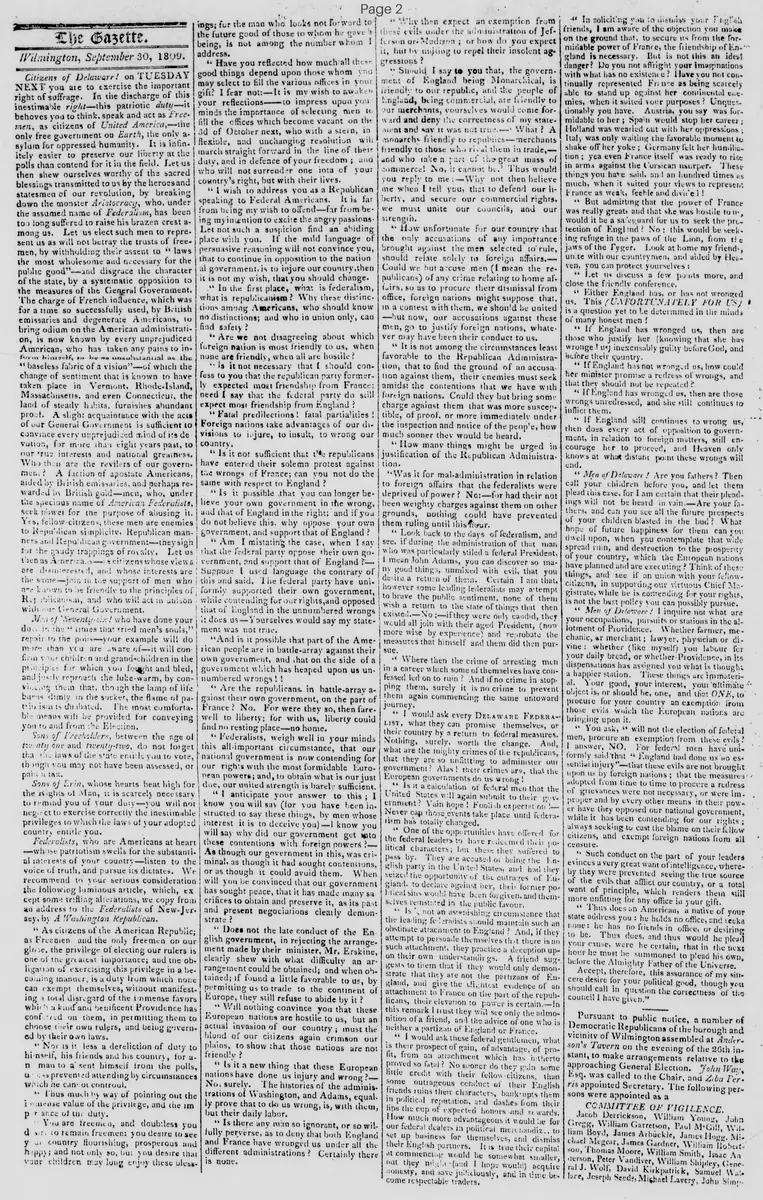
Citizens of Delaware! on TUESDAY NEXT you are to exercise the important right of suffrage. In the discharge of this inestimable right—this patriotic duty—it behoves you to think, speak and act as Free-men, as citizens of United America,—the only free government on Earth, the only asylum for oppressed humanity. It is infinitely easier to preserve our liberty at the polls than contend for it in the field. Let us then shew ourselves worthy of the sacred blessings transmitted to us by the heroes and statesmen of our revolution, by breaking down the monster Aristocracy, who, under the assumed name of Federalism, has been too long suffered to raise his brazen crest among us. Let us elect such men to represent us as will not betray the trusts of free-men, by withholding their assent to "laws the most wholesome and necessary for the public good"—and disgrace the character of the state, by a systematic opposition to the measures of the General Government.
The charge of French influence, which was for a time so successfully used, by British emissaries and degenerate Americans, to bring odium on the American administration, is now known by every unprejudiced American, who has taken any pains to inform himself, to be no less unsubstantial as the "baseless fabric of a vision"—of which the change of sentiment that is known to have taken place in Vermont, Rhode-Island, Massachusetts, and even Connecticut, the land of steady habits, furnishes abundant proof. A slight acquaintance with the acts of our General Government is sufficient to convince every unprejudiced mind of its devotion, for more than eight years past, to our true interests and national greatness.
Who then are the revilers of our government? A faction of apostate Americans, aided by British emissaries, and perhaps rewarded by British gold—men, who, under the specious name of American Federalists, seek power for the purpose of abusing it. Yes, fellow-citizens, these men are enemies to Republican simplicity. Republican manners and Republican government—they sigh for the gaudy trappings of royalty. Let us then as Americans—citizens whose views are disinterested, and whose interests are the same—join in the support of men who are known to be friendly to the principles of Republicanism, and who will act in unison with our General Government.
Ye of Seventy-six! who have done your duty in the "times that tried men's souls," repair to the polls—your example will do more than you are aware of—it will confirm your children and grand-children in the principles for which you fought and bled, and justly reproach the luke-warm, by convincing them that, though the lamp of life burns dimly in the socket, the flame of patriotism still is unabated. The most comfortable means will be provided for conveying you to and from the Election.
Sons of Freeholders, between the age of twenty one and twenty-two, do not forget that the laws of the state entitle you to vote, though you may not have been assessed, or paid a tax.
Sons of Erin, whose hearts beat high for the Rights of Man, it is scarcely necessary to remind you of your duty—you will not neglect to exercise correctly the inestimable privileges to which the laws of your adopted country entitle you.
Federalists, who are Americans at heart—whose patriotism swells for the substantial interests of your country—listen to the voice of truth, and pursue its dictates. We recommend to your serious consideration the following luminous article, which, except some trifling alterations, we copy from an address to the Federalists of New-Jersey, by A Washington Republican.
"As citizens of the American Republic; as Freemen, and the only freemen on our globe, the privilege of electing our rulers is one of the greatest importance; and the obligation of exercising this privilege in a becoming manner, is a duty from which none can exempt themselves, without manifesting a total disregard of the immense favors which a kind and beneficent Providence has conferred on them, in permitting them to choose their own rulers, and being governed by their own laws.
"Nor is it less a dereliction of duty to himself, his friends and his country, for a man to absent himself from the polls, unless prevented attending by circumstances which he cannot control.
"Thus much by way of pointing out the immense value of the privilege, and the importance of the duty. You are freemen, and doubtless you desire to remain freemen: you desire to see your country flourishing, prosperous and happy; and not only so, but you desire that your children may long enjoy these blessings; for the man who looks not forward to the future good of those to whom he gave being, is not among the number whom I address.
"Have you reflected how much all these good things depend upon those whom you may select to fill the various offices in your gift? I fear not:—It is my wish to awaken your reflections—to impress upon your minds the importance of selecting men to fill the offices which become vacant on the 3d of October next, who with a stern, inflexible, and unchanging resolution will march straight forward in the line of their duty, and in defence of your freedom: and who will not surrender one jota of your country's right, but with their lives.
"I wish to address you as a Republican speaking to Federal Americans. It is far from being my wish to offend—far from being my intention to excite the angry passions. Let not such a suspicion find an abiding place with you. If the mild language of persuasive reasoning will not convince you, that to continue in opposition to the national government, is to injure our country, then it is not my wish, that you should change.
"In the first place, what is federalism, what is republicanism? Why these distinctions among Americans, who should know no distinctions; and who in union only, can find safety?
"Are we not disagreeing about which foreign nation is most friendly to us, when none are friendly, when all are hostile?
"Is it not necessary that I should confess to you that the republican party formerly expected most friendship from France; need I say that the federal party do still expect most friendship from England?
"Fatal predilections! fatal partialities! Foreign nations take advantages of our divisions to injure, to insult, to wrong our country.
"Is it not sufficient that the republicans have entered their solemn protest against the wrongs of France; can you not do the same with respect to England?
"Is it possible that you can longer believe your own government in the wrong, and that of England in the right; and if you do not believe this, why oppose your own government, and support that of England?
"Am I mistating the case, when I say that the federal party oppose their own government, and support that of England?—Suppose I used language the contrary of this and said. The federal party have uniformly supported their own government, while contending for our rights, and opposed that of England in the unnumbered wrongs it does us—Yourselves would say my statement was not true.
"And is it possible that part of the American people are in battle-array against their own government, and that on the side of a government which has heaped upon us unnumbered wrongs!!
"Are the republicans in battle-array against their own government, on the part of France? No. For were they so, then farewell to liberty: for with us, liberty could find no resting place—no home.
"Federalists, weigh well in your minds this all-important circumstance, that our national government is now contending for our rights with the most formidable European powers; and, to obtain what is our just due, our united strength is barely sufficient.
"I anticipate your answer to this; I know you will say (for you have been instructed to say these things, by men whose interest it is to deceive you)—I know you will say why did our government get into these contentions with foreign powers?—As though our government in this, was criminal, as though it had sought contentions, or as though it could avoid them. When will you be convinced that our government has sought peace, that it has made many sacrifices to obtain and preserve it, as its past and present negociations clearly demonstrate?
"Does not the late conduct of the English government, in rejecting the arrangement made by their minister, Mr. Erskine, clearly shew with what difficulty an arrangement could be obtained: and when obtained; if found a little favorable to us, by permitting us to trade to the continent of Europe, they still refuse to abide by it?
"Will nothing convince you that these European nations are hostile to us, but an actual invasion of our country: must the blood of our citizens again crimson our plains, to show that those nations are not friendly?
"Is it a new thing that these European nations have done us injury and wrong? No, surely. The histories of the administrations of Washington, and Adams, equally prove that to do us wrong, is, with them, but their daily labor.
"Is there any man so ignorant, or so wilfully perverse, as to deny that both England and France have wronged us under all the different administrations? Certainly there is none.
"Why then expect an exemption from these evils under the administration of Jefferson or Madison: or how do you expect it, but by uniting to repel their insolent aggressions?
"Should I say to you that, the government of England being Monarchical, is friendly to our republic, and the people of England, being commercial, are friendly to our merchants, yourselves would come forward and deny the correctness of my statement and say it was not true.—What? A monarch friendly to republics—merchants friendly to those who rival them in trade,—and who take a part of the great mass of commerce! No, it cannot be.' Thus would you reply to me:—Why not then believe me when I tell you, that to defend our liberty, and secure our commercial rights, we must unite our councils, and our strength.
"How unfortunate for our country that the only accusations of any importance brought against the men selected to rule, should relate solely to foreign affairs.—Could we but accuse men (I mean the republicans) of any crime relating to home affairs, so as to procure their dismission from office, foreign nations might suppose that, in a contest with them, we should be united—but now, our accusations against these men, go to justify foreign nations, whatever may have been their conduct to us.
"It is not among the circumstances least favorable to the Republican Administration, that to find the ground of an accusation against them, their enemies must seek amidst the contentions that we have with foreign nations. Could they but bring some charge against them that was more susceptible of proof, or more immediately under the inspection and notice of the people, how much sooner they would be heard.
"How many things might be urged in justification of the Republican Administration.
"Was it for mal-administration in relation to foreign affairs that the federalists were deprived of power? No—for had there not been weighty charges against them on other grounds, nothing could have prevented them ruling until this hour.
"Look back to the days of federalism, and see, if during the administration of that man who was particularly stiled a federal President, I mean John Adams, you can discover so many good things, unmixed with evil, that you desire a return of them. Certain I am that, however some leading federalists may attempt to brave the public sentiment, none of them wish a return to the state of things that then existed.—No; if they were only candid, they would all join with their aged President, (now more wise by experience) and reprobate the measures that himself and them did then pursue.
Where then the crime of arresting men in a career which some of themselves have confessed led on to ruin? And if no crime in stopping them, surely it is no crime to prevent them again commencing the same untoward journey.
"I would ask every Delaware Federalist, what they can promise themselves, or their country by a return to federal measures. Nothing, surely, worth the change. And, what are the mighty crimes of the republicans, that they are so unfitting to administer our government? Alas! their crimes are, that the European governments do us wrong!
"Is it a calculation of federal men that the United States will again submit to their government? Vain hope! Foolish expectation!—Never can those events take place until federalism has totally changed.
"One of the opportunities have offered for the federal leaders to have redeemed their political characters: but these they suffered to pass by. They are accused of being the English party in the United States, and had they seized the opportunity of the outrages of England, to declare against her, their former political sins would have been forgiven, and themselves reinstated in the public favour.
"Is it not an astonishing circumstance that the leading federalists should maintain such an obstinate attachment to England? And, if they attempt to persuade themselves that there is no such attachment, they practice a deception upon their own understandings. A friend suggests to them that if they would only demonstrate that they are not the partizans of England, and give the slightest evidence of an attachment to France on the part of the republicans, their elevation to power is certain.—In this remark I trust they will see only the admonition of a friend, and the advice of one who is neither a partizan of England or France.
"I would ask these federal gentlemen, what is their prospect of gain, of advantage, of profit, from an attachment which has hitherto proved so fatal? No sooner do they gain some little credit with their fellow-citizens, than some outrageous conduct of their English friends ruins their characters, bankrupts them in political reputation, and dashes from their lips the cup of expected honors and rewards.
How much more advantageous it would be for our federal dealers in political merchandise, to set up business for themselves, and dismiss their English partners. It is true their capital at commencing would be somewhat smaller, but they might (and I hope would) acquire honesty, and save judiciously, and in time become respectable traders.
"In soliciting you to dismiss your English friends, I am aware of the objection you make on the ground that, to secure us from the formidable power of France, the friendship of England is necessary. But is not this an ideal danger? Do you not affright your imaginations with what has no existence? Have you not continually represented France as being scarcely able to stand up against her continental enemies, when it suited your purposes? Unquestionably you have. Austria, you say was formidable to her; Spain would stop her career: Holland was wearied out with her oppressions; Italy was only waiting the favorable moment to shake off her yoke; Germany felt her humiliation; yea even France itself was ready to rise in arms against the Corsican usurper. These things you have said, and an hundred times as much, when it suited your views to represent France as weak, feeble and divided!
"But admitting that the power of France was really great, and that she was hostile to us, would it be a safeguard for us to seek the protection of England? No: this would be seeking refuge in the paws of the Lion, from the jaws of the Tyger. Look at home my friend, unite with our countrymen, and aided by Heaven, you can protect yourselves:
"Let us discuss a few points more, and close the friendly conference.
"Either England has, or has not wronged us. This (UNFORTUNATELY FOR US) is a question yet to be determined in the minds of many honest men!
"If England has wronged us, then are those who justify her (knowing that she has wronged us) inexcusably guilty before God, and before their country.
"If England has not wronged us, how could her minister promise a redress of wrongs, and that they should not be repeated?
"If England has wronged us, then are those wrongs unredressed, and she still continues to inflict them.
"If England still continues to wrong us, then does every act of opposition to government, in relation to foreign matters, still encourage her to proceed, and Heaven only knows at what distant point these wrongs will end.
"Men of Delaware! Are you fathers? Then call your children before you, and let them plead this case, for I am certain that their pleadings will not be heard in vain.—Are your fathers, and can you see all the future prospects of your children blasted in the bud? What hope of future happiness for them can you dwell upon, when you contemplate that wide spread ruin, and destruction to the prosperity of your country, which the European nations have planned and are executing? Think of these things, and see if an union with your fellow-citizens, in supporting our virtuous Chief Magistrate, while he is contending for your rights, is not the best policy you can possibly pursue.
"Men of Delaware! I inquire not what are your occupations, pursuits or stations in the allotment of Providence. Whether farmer, mechanic, or merchant: lawyer, physician or divine: whether (like myself) you labour for your daily bread, or whether Providence, in its dispensations has assigned you what is thought a happier station. These things are immaterial. Your good, your interest, your ultimate object is, or should be, one, and thus ONE, to procure for your country an exemption from those evils which the European nations are bringing upon it.
"You ask, "will not the election of federal men, procure an exemption from these evils? I answer, No. For federal men have uniformly said that "England had done us no essential injury"—that these evils are not brought upon us by foreign nations; that the measures adopted from time to time to procure a redress of grievances were not necessary, or were improper and by every other means in their power have they opposed our national government, while it has been contending for our rights; always seeking to cast the blame on their fellow citizens, and exempt foreign nations from all censure.
"Such conduct on the part of your leaders evinces a very great want of intelligence, whereby they were prevented seeing the true source of the evils that afflict our country, or a total want of principle, which renders them still more unfitting for any office in your gift.
"Thus does an American, a native of your state address you: he holds no office, and seeks none: he has no friends in office, or desiring to be. Thus does, and thus would he plead your cause, were he certain, that in the next hour he must be summoned to plead his own, before the Almighty Father of the Universe.
Accept, therefore, this assurance of my sincere desire for your political good, though you should call in question the correctness of the council I have given."
Wilmington, September 30, 1809.
Citizens of Delaware! on TUESDAY NEXT you are to exercise the important right of suffrage. In the discharge of this inestimable right—this patriotic duty—it behoves you to think, speak and act as Free-men, as citizens of United America,—the only free government on Earth, the only asylum for oppressed humanity. It is infinitely easier to preserve our liberty at the polls than contend for it in the field. Let us then shew ourselves worthy of the sacred blessings transmitted to us by the heroes and statesmen of our revolution, by breaking down the monster Aristocracy, who, under the assumed name of Federalism, has been too long suffered to raise his brazen crest among us. Let us elect such men to represent us as will not betray the trusts of free-men, by withholding their assent to "laws the most wholesome and necessary for the public good"—and disgrace the character of the state, by a systematic opposition to the measures of the General Government.
The charge of French influence, which was for a time so successfully used, by British emissaries and degenerate Americans, to bring odium on the American administration, is now known by every unprejudiced American, who has taken any pains to inform himself, to be no less unsubstantial as the "baseless fabric of a vision"—of which the change of sentiment that is known to have taken place in Vermont, Rhode-Island, Massachusetts, and even Connecticut, the land of steady habits, furnishes abundant proof. A slight acquaintance with the acts of our General Government is sufficient to convince every unprejudiced mind of its devotion, for more than eight years past, to our true interests and national greatness.
Who then are the revilers of our government? A faction of apostate Americans, aided by British emissaries, and perhaps rewarded by British gold—men, who, under the specious name of American Federalists, seek power for the purpose of abusing it. Yes, fellow-citizens, these men are enemies to Republican simplicity. Republican manners and Republican government—they sigh for the gaudy trappings of royalty. Let us then as Americans—citizens whose views are disinterested, and whose interests are the same—join in the support of men who are known to be friendly to the principles of Republicanism, and who will act in unison with our General Government.
Ye of Seventy-six! who have done your duty in the "times that tried men's souls," repair to the polls—your example will do more than you are aware of—it will confirm your children and grand-children in the principles for which you fought and bled, and justly reproach the luke-warm, by convincing them that, though the lamp of life burns dimly in the socket, the flame of patriotism still is unabated. The most comfortable means will be provided for conveying you to and from the Election.
Sons of Freeholders, between the age of twenty one and twenty-two, do not forget that the laws of the state entitle you to vote, though you may not have been assessed, or paid a tax.
Sons of Erin, whose hearts beat high for the Rights of Man, it is scarcely necessary to remind you of your duty—you will not neglect to exercise correctly the inestimable privileges to which the laws of your adopted country entitle you.
Federalists, who are Americans at heart—whose patriotism swells for the substantial interests of your country—listen to the voice of truth, and pursue its dictates. We recommend to your serious consideration the following luminous article, which, except some trifling alterations, we copy from an address to the Federalists of New-Jersey, by A Washington Republican.
"As citizens of the American Republic; as Freemen, and the only freemen on our globe, the privilege of electing our rulers is one of the greatest importance; and the obligation of exercising this privilege in a becoming manner, is a duty from which none can exempt themselves, without manifesting a total disregard of the immense favors which a kind and beneficent Providence has conferred on them, in permitting them to choose their own rulers, and being governed by their own laws.
"Nor is it less a dereliction of duty to himself, his friends and his country, for a man to absent himself from the polls, unless prevented attending by circumstances which he cannot control.
"Thus much by way of pointing out the immense value of the privilege, and the importance of the duty. You are freemen, and doubtless you desire to remain freemen: you desire to see your country flourishing, prosperous and happy; and not only so, but you desire that your children may long enjoy these blessings; for the man who looks not forward to the future good of those to whom he gave being, is not among the number whom I address.
"Have you reflected how much all these good things depend upon those whom you may select to fill the various offices in your gift? I fear not:—It is my wish to awaken your reflections—to impress upon your minds the importance of selecting men to fill the offices which become vacant on the 3d of October next, who with a stern, inflexible, and unchanging resolution will march straight forward in the line of their duty, and in defence of your freedom: and who will not surrender one jota of your country's right, but with their lives.
"I wish to address you as a Republican speaking to Federal Americans. It is far from being my wish to offend—far from being my intention to excite the angry passions. Let not such a suspicion find an abiding place with you. If the mild language of persuasive reasoning will not convince you, that to continue in opposition to the national government, is to injure our country, then it is not my wish, that you should change.
"In the first place, what is federalism, what is republicanism? Why these distinctions among Americans, who should know no distinctions; and who in union only, can find safety?
"Are we not disagreeing about which foreign nation is most friendly to us, when none are friendly, when all are hostile?
"Is it not necessary that I should confess to you that the republican party formerly expected most friendship from France; need I say that the federal party do still expect most friendship from England?
"Fatal predilections! fatal partialities! Foreign nations take advantages of our divisions to injure, to insult, to wrong our country.
"Is it not sufficient that the republicans have entered their solemn protest against the wrongs of France; can you not do the same with respect to England?
"Is it possible that you can longer believe your own government in the wrong, and that of England in the right; and if you do not believe this, why oppose your own government, and support that of England?
"Am I mistating the case, when I say that the federal party oppose their own government, and support that of England?—Suppose I used language the contrary of this and said. The federal party have uniformly supported their own government, while contending for our rights, and opposed that of England in the unnumbered wrongs it does us—Yourselves would say my statement was not true.
"And is it possible that part of the American people are in battle-array against their own government, and that on the side of a government which has heaped upon us unnumbered wrongs!!
"Are the republicans in battle-array against their own government, on the part of France? No. For were they so, then farewell to liberty: for with us, liberty could find no resting place—no home.
"Federalists, weigh well in your minds this all-important circumstance, that our national government is now contending for our rights with the most formidable European powers; and, to obtain what is our just due, our united strength is barely sufficient.
"I anticipate your answer to this; I know you will say (for you have been instructed to say these things, by men whose interest it is to deceive you)—I know you will say why did our government get into these contentions with foreign powers?—As though our government in this, was criminal, as though it had sought contentions, or as though it could avoid them. When will you be convinced that our government has sought peace, that it has made many sacrifices to obtain and preserve it, as its past and present negociations clearly demonstrate?
"Does not the late conduct of the English government, in rejecting the arrangement made by their minister, Mr. Erskine, clearly shew with what difficulty an arrangement could be obtained: and when obtained; if found a little favorable to us, by permitting us to trade to the continent of Europe, they still refuse to abide by it?
"Will nothing convince you that these European nations are hostile to us, but an actual invasion of our country: must the blood of our citizens again crimson our plains, to show that those nations are not friendly?
"Is it a new thing that these European nations have done us injury and wrong? No, surely. The histories of the administrations of Washington, and Adams, equally prove that to do us wrong, is, with them, but their daily labor.
"Is there any man so ignorant, or so wilfully perverse, as to deny that both England and France have wronged us under all the different administrations? Certainly there is none.
"Why then expect an exemption from these evils under the administration of Jefferson or Madison: or how do you expect it, but by uniting to repel their insolent aggressions?
"Should I say to you that, the government of England being Monarchical, is friendly to our republic, and the people of England, being commercial, are friendly to our merchants, yourselves would come forward and deny the correctness of my statement and say it was not true.—What? A monarch friendly to republics—merchants friendly to those who rival them in trade,—and who take a part of the great mass of commerce! No, it cannot be.' Thus would you reply to me:—Why not then believe me when I tell you, that to defend our liberty, and secure our commercial rights, we must unite our councils, and our strength.
"How unfortunate for our country that the only accusations of any importance brought against the men selected to rule, should relate solely to foreign affairs.—Could we but accuse men (I mean the republicans) of any crime relating to home affairs, so as to procure their dismission from office, foreign nations might suppose that, in a contest with them, we should be united—but now, our accusations against these men, go to justify foreign nations, whatever may have been their conduct to us.
"It is not among the circumstances least favorable to the Republican Administration, that to find the ground of an accusation against them, their enemies must seek amidst the contentions that we have with foreign nations. Could they but bring some charge against them that was more susceptible of proof, or more immediately under the inspection and notice of the people, how much sooner they would be heard.
"How many things might be urged in justification of the Republican Administration.
"Was it for mal-administration in relation to foreign affairs that the federalists were deprived of power? No—for had there not been weighty charges against them on other grounds, nothing could have prevented them ruling until this hour.
"Look back to the days of federalism, and see, if during the administration of that man who was particularly stiled a federal President, I mean John Adams, you can discover so many good things, unmixed with evil, that you desire a return of them. Certain I am that, however some leading federalists may attempt to brave the public sentiment, none of them wish a return to the state of things that then existed.—No; if they were only candid, they would all join with their aged President, (now more wise by experience) and reprobate the measures that himself and them did then pursue.
Where then the crime of arresting men in a career which some of themselves have confessed led on to ruin? And if no crime in stopping them, surely it is no crime to prevent them again commencing the same untoward journey.
"I would ask every Delaware Federalist, what they can promise themselves, or their country by a return to federal measures. Nothing, surely, worth the change. And, what are the mighty crimes of the republicans, that they are so unfitting to administer our government? Alas! their crimes are, that the European governments do us wrong!
"Is it a calculation of federal men that the United States will again submit to their government? Vain hope! Foolish expectation!—Never can those events take place until federalism has totally changed.
"One of the opportunities have offered for the federal leaders to have redeemed their political characters: but these they suffered to pass by. They are accused of being the English party in the United States, and had they seized the opportunity of the outrages of England, to declare against her, their former political sins would have been forgiven, and themselves reinstated in the public favour.
"Is it not an astonishing circumstance that the leading federalists should maintain such an obstinate attachment to England? And, if they attempt to persuade themselves that there is no such attachment, they practice a deception upon their own understandings. A friend suggests to them that if they would only demonstrate that they are not the partizans of England, and give the slightest evidence of an attachment to France on the part of the republicans, their elevation to power is certain.—In this remark I trust they will see only the admonition of a friend, and the advice of one who is neither a partizan of England or France.
"I would ask these federal gentlemen, what is their prospect of gain, of advantage, of profit, from an attachment which has hitherto proved so fatal? No sooner do they gain some little credit with their fellow-citizens, than some outrageous conduct of their English friends ruins their characters, bankrupts them in political reputation, and dashes from their lips the cup of expected honors and rewards.
How much more advantageous it would be for our federal dealers in political merchandise, to set up business for themselves, and dismiss their English partners. It is true their capital at commencing would be somewhat smaller, but they might (and I hope would) acquire honesty, and save judiciously, and in time become respectable traders.
"In soliciting you to dismiss your English friends, I am aware of the objection you make on the ground that, to secure us from the formidable power of France, the friendship of England is necessary. But is not this an ideal danger? Do you not affright your imaginations with what has no existence? Have you not continually represented France as being scarcely able to stand up against her continental enemies, when it suited your purposes? Unquestionably you have. Austria, you say was formidable to her; Spain would stop her career: Holland was wearied out with her oppressions; Italy was only waiting the favorable moment to shake off her yoke; Germany felt her humiliation; yea even France itself was ready to rise in arms against the Corsican usurper. These things you have said, and an hundred times as much, when it suited your views to represent France as weak, feeble and divided!
"But admitting that the power of France was really great, and that she was hostile to us, would it be a safeguard for us to seek the protection of England? No: this would be seeking refuge in the paws of the Lion, from the jaws of the Tyger. Look at home my friend, unite with our countrymen, and aided by Heaven, you can protect yourselves:
"Let us discuss a few points more, and close the friendly conference.
"Either England has, or has not wronged us. This (UNFORTUNATELY FOR US) is a question yet to be determined in the minds of many honest men!
"If England has wronged us, then are those who justify her (knowing that she has wronged us) inexcusably guilty before God, and before their country.
"If England has not wronged us, how could her minister promise a redress of wrongs, and that they should not be repeated?
"If England has wronged us, then are those wrongs unredressed, and she still continues to inflict them.
"If England still continues to wrong us, then does every act of opposition to government, in relation to foreign matters, still encourage her to proceed, and Heaven only knows at what distant point these wrongs will end.
"Men of Delaware! Are you fathers? Then call your children before you, and let them plead this case, for I am certain that their pleadings will not be heard in vain.—Are your fathers, and can you see all the future prospects of your children blasted in the bud? What hope of future happiness for them can you dwell upon, when you contemplate that wide spread ruin, and destruction to the prosperity of your country, which the European nations have planned and are executing? Think of these things, and see if an union with your fellow-citizens, in supporting our virtuous Chief Magistrate, while he is contending for your rights, is not the best policy you can possibly pursue.
"Men of Delaware! I inquire not what are your occupations, pursuits or stations in the allotment of Providence. Whether farmer, mechanic, or merchant: lawyer, physician or divine: whether (like myself) you labour for your daily bread, or whether Providence, in its dispensations has assigned you what is thought a happier station. These things are immaterial. Your good, your interest, your ultimate object is, or should be, one, and thus ONE, to procure for your country an exemption from those evils which the European nations are bringing upon it.
"You ask, "will not the election of federal men, procure an exemption from these evils? I answer, No. For federal men have uniformly said that "England had done us no essential injury"—that these evils are not brought upon us by foreign nations; that the measures adopted from time to time to procure a redress of grievances were not necessary, or were improper and by every other means in their power have they opposed our national government, while it has been contending for our rights; always seeking to cast the blame on their fellow citizens, and exempt foreign nations from all censure.
"Such conduct on the part of your leaders evinces a very great want of intelligence, whereby they were prevented seeing the true source of the evils that afflict our country, or a total want of principle, which renders them still more unfitting for any office in your gift.
"Thus does an American, a native of your state address you: he holds no office, and seeks none: he has no friends in office, or desiring to be. Thus does, and thus would he plead your cause, were he certain, that in the next hour he must be summoned to plead his own, before the Almighty Father of the Universe.
Accept, therefore, this assurance of my sincere desire for your political good, though you should call in question the correctness of the council I have given."
What sub-type of article is it?
Partisan Politics
Suffrage
Foreign Affairs
What keywords are associated?
Delaware Election
Republican Support
Anti Federalism
British Influence
Voter Duty
Foreign Aggressions
Political Unity
Suffrage Rights
What entities or persons were involved?
Federalists
Republicans
British Emissaries
General Government
Jefferson
Madison
John Adams
Mr. Erskine
A Washington Republican
Editorial Details
Primary Topic
Urging Delaware Voters To Support Republicans Against Federalists Influenced By Britain
Stance / Tone
Strongly Pro Republican, Anti Federalist, Patriotic Exhortation To Unity And Defense Against Foreign Aggressions
Key Figures
Federalists
Republicans
British Emissaries
General Government
Jefferson
Madison
John Adams
Mr. Erskine
A Washington Republican
Key Arguments
Exercise Suffrage To Preserve Liberty And Break Down Federalist Aristocracy
Federalists Are British Aided Enemies Of Republican Government
National Government Devoted To American Interests For Eight Years
Oppose Federalists Who Seek Power To Abuse It And Favor Royalty
Urge Veterans Of 1776, Young Freeholders, And Irish Immigrants To Vote
Federalists Oppose Own Government And Support England Despite Its Wrongs
Republicans Protest French Wrongs; Federalists Should Do Same For England
United Strength Needed To Contend With European Powers For Rights
Past Federal Administrations Under Adams Led To Ruinous Measures
Election Of Republicans Essential To Exempt Country From European Evils