Thank you for visiting SNEWPapers!
Sign up free
Gazette Of The United States
New York, New York County, New York
What is this article about?
Reports confirm the death of French revolutionary leader M. Mirabeau on April 2, 1791, in Paris at age 42 after a short illness. Details his final moments, political legacy, rumored poisoning disproved by autopsy, and impact on the National Assembly and Orleans party.
Merged-components note: Continuation of the detailed article on the death of M. Mirabeau and related reflections.
Clippings
1 of 2
OCR Quality
Full Text
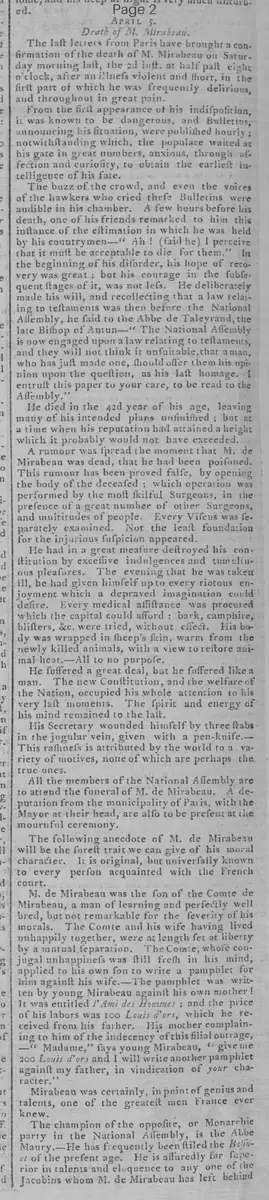
Death of M. Mirabeau.
The last letters from Paris have brought a confirmation of the death of M. Mirabeau on Saturday morning last, the 2d instant, at half past eight o'clock, after an illness violent and short, in the first part of which he was frequently delirious, and throughout in great pain.
From the first appearance of his indisposition, it was known to be dangerous, and Bulletins, announcing his situation, were published hourly; notwithstanding which, the populace waited at his gate in great numbers, anxious, through affection and curiosity, to obtain the earliest intelligence of his fate.
The buzz of the crowd, and even the voices of the hawkers who cried these Bulletins were audible in his chamber. A few hours before his death, one of his friends remarked to him this instance of the estimation in which he was held by his countrymen—"Ah! (said he) I perceive that it must be acceptable to die for them." In the beginning of his disorder, his hope of recovery was great; but his courage in the subsequent stages of it, was not less. He deliberately made his will, and recollecting that a law relating to testaments was then before the National Assembly, he said to the Abbe de Taleyrand, the late Bishop of Autun—"The National Assembly is now engaged upon a law relating to testaments, and they will not think it unsuitable, that a man, who has just made one, should offer them his opinion upon the question, as his last homage. I entrust this paper to your care, to be read to the Assembly."
He died in the 42d year of his age, leaving many of his intended plans unfinished; but at a time when his reputation had attained a height which it probably would not have exceeded.
A rumour was spread the moment that M. de Mirabeau was dead, that he had been poisoned. This rumour has been proved false, by opening the body of the deceased; which operation was performed by the most skillful Surgeons, in the presence of a great number of other Surgeons, and multitudes of people. Every viscus was separately examined. Not the least foundation for the injurious suspicion appeared.
He had in a great measure destroyed his constitution by excessive indulgences and tumultuous pleasures. The evening that he was taken ill, he had given himself up to every riotous enjoyment which a depraved imagination could desire. Every medical assistance was procured which the capital could afford: bark, camphor, blisters, &c. were tried, without effect. His body was wrapped in sheep's skin, warm from the newly killed animals, with a view to restore animal heat.—All to no purpose.
He suffered a great deal, but he suffered like a man. The new Constitution, and the welfare of the Nation, occupied his whole attention to his very last moments. The spirit and energy of his mind remained to the last.
His Secretary wounded himself by three stabs in the jugular vein, given with a pen-knife.—This rashness is attributed by the world to a variety of motives, none of which are perhaps the true ones.
All the members of the National Assembly are to attend the funeral of M. de Mirabeau. A deputation from the municipality of Paris, with the Mayor at their head, are also to be present at the mournful ceremony.
The following anecdote of M. de Mirabeau will be the surest trait we can give of his moral character. It is original, but universally known to every person acquainted with the French court.
M. de Mirabeau was the son of the Comte de Mirabeau, a man of learning and perfectly well bred, but not remarkable for the severity of his morals. The Comte and his wife having lived unhappily together, were at length set at liberty by a mutual separation. The Comte, whose conjugal unhappiness was still fresh in his mind, applied to his own son to write a pamphlet for him against his wife.—The pamphlet was written by young Mirabeau against his own mother! It was entitled L'Ami des Hommes; and the price of his labors was 100 Louis d'ors, which he received from his father. His mother complaining to him of the indecency of this filial outrage,—"Madame," says young Mirabeau, "give me 200 Louis d'ors and I will write another pamphlet against my father, in vindication of your character."
Mirabeau was certainly, in point of genius and talents, one of the greatest men France ever knew.
The champion of the opposite, or Monarchic party in the National Assembly, is the Abbe Maury.—He has frequently been styled the Bossuet of the present age. He is assuredly far superior in talents and eloquence to any one of the Jacobins whom M. de Mirabeau has left behind.
him ; he may, therefore, be expected to make proselytes to his cause, provided conviction were sufficient to ensure a reformation.
M. de Mirabeau was the author of several works which are held in high estimation ; among others Memoirs Secrets de la Garde de Berlin, Sur l' Agiotage, &c. &c. The Courrier de Provence was also published under his direction. He was assuredly the prop and pillar of the Duke of Orleans's party, and of the Jacobin's club, which may be considered as the privy council of the French nation.
How many reflections does the death of this M. de Mirabeau occasion ! He has experienced the turbulence of mad ambition ; he has been the admiration of some, the envy of others, and the scourge of many ; he has strutted his short hour on the stage, and while he was dreaming of imperial power, the grave yawns beneath his feet, and he sinks into it a lump of clay ! Ye sons of ambition ! You are all walking over your graves! —While you are gazing on thrones and sceptres, you tumble at noonday, and lose your honors in the dust !
Mirabeau, at a very early period of life, acquired a very extensive reputation, by the brilliancy of his wit, and still more by the solidity and extent of his mental acquirements. His penetration was acute, his talents were various and versatile ; and his knowledge of men and manners remarkably extensive. When he was of an age at which many are still novices at school, one of the first characters in France, who had with wonder witnessed the vast compass of his understanding, in a letter to a friend styles him a Phenomenon!
He was one of those few, who are able to unite, with a life of dissipation, literary pursuits, and deep researches into the nature of government, the law of nations, and the relative interests of the powers of Europe. His ambition prompted him, at the era of the revolution, and his superior abilities enabled him, to take the lead in the framing of the new Constitution, and in overturning the old system.
He was the Ulysses, and M. de la Fayette was the Ajax. The views of both were unlimited power ; the pretexts or ostensible motives of both were patriotism and the securing of equal and universal liberty to all mankind. The Dupes of both were a great majority in the Senate and in the Municipality of Paris, and the millions of the provinces. [Extensive indeed !]
The Orleans party has suffered an irreparable loss by the death of Mirabeau. This party was in a fair way of triumphing over all others, and of establishing pure republicanism, which would shortly have degenerated, as it was intended, into renovated despotism under a new head, decorated with a new name.
M. de Mirabeau and M. de la Fayette had been for some time secret but inveterate enemies ; but the imperative boast of Cicero—cedant arma togae—would have been realized, had M. de Mirabeau lived a little longer.
Allowing M de la Fayette, which is a doubtful claim, to be Armis Praepotens, it might with more truth have been said of his antagonist tantum valet ipse loquendo.
What sub-type of article is it?
What keywords are associated?
What entities or persons were involved?
Where did it happen?
Foreign News Details
Primary Location
Paris
Event Date
The 2d Instant
Key Persons
Outcome
death of m. mirabeau at age 42; rumor of poisoning disproved by autopsy; significant loss to orleans party and national assembly; funeral to be attended by assembly members and paris municipality.
Event Details
M. Mirabeau died on April 2 after a short, violent illness marked by delirium and pain. Crowds gathered for hourly bulletins. He made his will and entrusted a paper on testaments to Abbe de Taleyrand. Autopsy confirmed natural causes due to prior excesses. His secretary attempted suicide. The report includes anecdotes of his character, writings, political role in the revolution, rivalry with Lafayette, and reflections on his ambition and legacy.