Thank you for visiting SNEWPapers!
Sign up free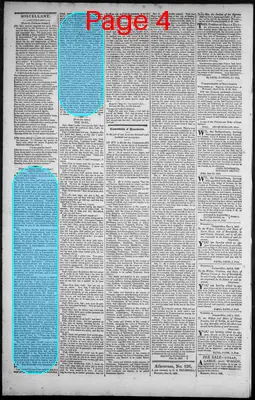
Letter to Editor
July 10, 1822
The Massachusetts Spy
Worcester, Worcester County, Massachusetts
What is this article about?
A Bostonian writer humorously laments rapid innovations in agriculture, mechanics, and society, climaxing in his embarrassing failure to perform a modern quadrille after years abroad, contrasting old and new dancing styles.
Clipping
OCR Quality
98%
Excellent
Full Text
[From the Boston Daily Advertiser.]
INNOVATION.
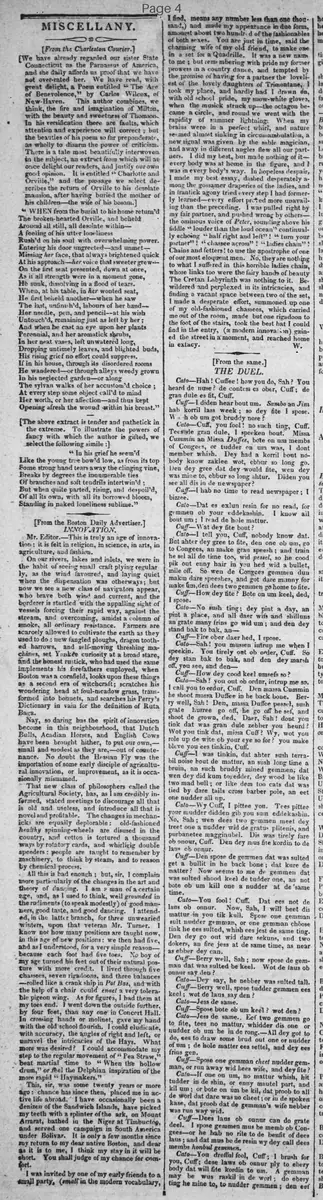
Mr. Editor.—This is truly an age of innovation: it is felt in religion, in science, in arts, in agriculture, and fashion. On our rivers, lakes and inlets, we were in the habit of seeing small craft plying regularly, as the wind favoured, and laying quiet when the dispensation was otherwise; but now we see a new class of navigators appear, who brave both wind and current, and the borderer is startled with the appalling sight of vessels forcing their rapid way, against the stream, and overcoming, amidst a column of smoke, all ordinary resistance. Farmers are scarcely allowed to cultivate the earth as they used to do: new fangled ploughs, dragon tooth-ed harrows, and self-moving threshing machines, set Yankee curiosity at a broad stare, and the honest rustick, who had used the same implements his forefathers employed, when Boston was a cornfield, looks upon these things as a second era of witchcraft; scratches his wondering head at foul-meadow grass, transformed into bonnets, and searches his Perry's Dictionary in vain for the definition of Ruta Baga. Nay, so daring has the spirit of innovation become in this neighbourhood, that Dutch Bulls, Acadian Horses, and English Cows have been brought hither, to put our own,—small and modest as they are, out of countenance. No doubt the Hessian Fly was the importation of some early disciple of agricultural innovation, or improvement, as it is occasionally misnamed.—That new class of philosophers called the Agricultural Society, has, as I am credibly informed, stated meetings to discourage all that is old and useless, and introduce all that is novel and profitable. The changes in mechanics are equally deplorable: old-fashioned healthy spinning-wheels are disused in the country, and cotton is tortured a thousand ways by rotatory cards, and whirligig double speeders: people are taught to remember by machinery, to think by steam, and to reason by chemical process. All this is bad enough; but, sir, I complain more particularly of the changes in the art and theory of dancing. I am a man of a certain age, and, as I used to think, well grounded in the rudiments (to speak modestly) of good manners, good taste, and good dancing. I attended, in the latter branch, for three unwearied winters, upon that veteran Mr. Turner. I know not how many positions are taught now, in this age of new positions: we then had five, and as I understood, for a very simple reason—because each foot had five toes. No boy of my age turned his feet out of their natural posture with more credit. I lived through five chassees, seven rigadoons, and three balances—rolled like a crank ship in Pot Bas, and with the help of a chair could enact a very tolerable pigeon wing. As for figures, I had them at my toes end. I went down the outside further, by four feet, than any one in Concert Hall. In crossing hands or molinet, gave my hand with the old school flourish. I could elucidate, with accuracy, the angles of right and left, or unravel the intricacies of the Hays. What more was desired? I could accommodate my step to the regular movement of "Pea Straw," beat martial time to "When the hollow drum," or feel the Delphian inspiration of the more rapid "Haymakers." This, sir, was some twenty years or more ago: chance has since then, placed me in active life abroad. I have occasionally been a denizen of the Sandwich Islands, have picked my teeth with a splinter of the ark, on Mount Ararat, bathed in the Niger at Timbuctoo, and served one campaign in South America under Bolivar. It is only a few months since my return to my dear native Boston, and dear as it is to me, I think my stay in it will be short. You shall judge of my chance or comfort. I was invited by one of my early friends to a small party, (small in the modern vocabulary, I find, means any number less than one thousand,) and made my appearance in due form, amongst about two hundred of the fashionables of both sexes. "You are just in time," said the charming wife of my old friend, "to make one in a set for a Quadrille." It was a new name to me; but remembering with pride my former prowess in a country dance, and tempted by the promise of having for a partner the loveliest of the lovely daughters of Trimontane, I took my place, and hardly had I drawn on, with old school pride, my snow-white gloves, when the music struck up—the octagon became a circle, and round we went with the rapidity of summer lightning. When my brains were in a perfect whirl, and nature seemed almost sinking in circumambulation, a new signal was given by the sable magician, and away in different angles flew all our partners. I did my best, but made nothing of it—every body was at home in the figure, and I was in every body's way. In hopeless despair, I made my best essay, dashed desperately among the gossamer draperies of the ladies, and in frantic agony tried every step I had formerly learned—every effort proved more unavailing than the preceding. I was pulled right by my fair partner, and pushed wrong by others—the ominous voice of Peter, sounding above his fiddle "louder than the loud ocean" continually echoing "half right and left!" "turn your partner!" "chassez across!" "ladies chain"! Chains and fetters! to use the apostrophe of one of our most eloquent men. No, they are nothing to what I suffered in this horrible ladies chain, whose links too were the fairy hands of beauty. The Cretan Labyrinth was nothing to it. Bewildered and perplexed in its intricacies, and finding a vacant space between two of the set, I made a desperate effort, summoned up one of my old-fashioned chassees, which carried me out of the room, made but one rigadoon to the foot of the stairs, took the best hat I could find in the entry, (a modern innovation) gained the street in a moment, and reached home in extacy.
W.
INNOVATION.
Mr. Editor.—This is truly an age of innovation: it is felt in religion, in science, in arts, in agriculture, and fashion. On our rivers, lakes and inlets, we were in the habit of seeing small craft plying regularly, as the wind favoured, and laying quiet when the dispensation was otherwise; but now we see a new class of navigators appear, who brave both wind and current, and the borderer is startled with the appalling sight of vessels forcing their rapid way, against the stream, and overcoming, amidst a column of smoke, all ordinary resistance. Farmers are scarcely allowed to cultivate the earth as they used to do: new fangled ploughs, dragon tooth-ed harrows, and self-moving threshing machines, set Yankee curiosity at a broad stare, and the honest rustick, who had used the same implements his forefathers employed, when Boston was a cornfield, looks upon these things as a second era of witchcraft; scratches his wondering head at foul-meadow grass, transformed into bonnets, and searches his Perry's Dictionary in vain for the definition of Ruta Baga. Nay, so daring has the spirit of innovation become in this neighbourhood, that Dutch Bulls, Acadian Horses, and English Cows have been brought hither, to put our own,—small and modest as they are, out of countenance. No doubt the Hessian Fly was the importation of some early disciple of agricultural innovation, or improvement, as it is occasionally misnamed.—That new class of philosophers called the Agricultural Society, has, as I am credibly informed, stated meetings to discourage all that is old and useless, and introduce all that is novel and profitable. The changes in mechanics are equally deplorable: old-fashioned healthy spinning-wheels are disused in the country, and cotton is tortured a thousand ways by rotatory cards, and whirligig double speeders: people are taught to remember by machinery, to think by steam, and to reason by chemical process. All this is bad enough; but, sir, I complain more particularly of the changes in the art and theory of dancing. I am a man of a certain age, and, as I used to think, well grounded in the rudiments (to speak modestly) of good manners, good taste, and good dancing. I attended, in the latter branch, for three unwearied winters, upon that veteran Mr. Turner. I know not how many positions are taught now, in this age of new positions: we then had five, and as I understood, for a very simple reason—because each foot had five toes. No boy of my age turned his feet out of their natural posture with more credit. I lived through five chassees, seven rigadoons, and three balances—rolled like a crank ship in Pot Bas, and with the help of a chair could enact a very tolerable pigeon wing. As for figures, I had them at my toes end. I went down the outside further, by four feet, than any one in Concert Hall. In crossing hands or molinet, gave my hand with the old school flourish. I could elucidate, with accuracy, the angles of right and left, or unravel the intricacies of the Hays. What more was desired? I could accommodate my step to the regular movement of "Pea Straw," beat martial time to "When the hollow drum," or feel the Delphian inspiration of the more rapid "Haymakers." This, sir, was some twenty years or more ago: chance has since then, placed me in active life abroad. I have occasionally been a denizen of the Sandwich Islands, have picked my teeth with a splinter of the ark, on Mount Ararat, bathed in the Niger at Timbuctoo, and served one campaign in South America under Bolivar. It is only a few months since my return to my dear native Boston, and dear as it is to me, I think my stay in it will be short. You shall judge of my chance or comfort. I was invited by one of my early friends to a small party, (small in the modern vocabulary, I find, means any number less than one thousand,) and made my appearance in due form, amongst about two hundred of the fashionables of both sexes. "You are just in time," said the charming wife of my old friend, "to make one in a set for a Quadrille." It was a new name to me; but remembering with pride my former prowess in a country dance, and tempted by the promise of having for a partner the loveliest of the lovely daughters of Trimontane, I took my place, and hardly had I drawn on, with old school pride, my snow-white gloves, when the music struck up—the octagon became a circle, and round we went with the rapidity of summer lightning. When my brains were in a perfect whirl, and nature seemed almost sinking in circumambulation, a new signal was given by the sable magician, and away in different angles flew all our partners. I did my best, but made nothing of it—every body was at home in the figure, and I was in every body's way. In hopeless despair, I made my best essay, dashed desperately among the gossamer draperies of the ladies, and in frantic agony tried every step I had formerly learned—every effort proved more unavailing than the preceding. I was pulled right by my fair partner, and pushed wrong by others—the ominous voice of Peter, sounding above his fiddle "louder than the loud ocean" continually echoing "half right and left!" "turn your partner!" "chassez across!" "ladies chain"! Chains and fetters! to use the apostrophe of one of our most eloquent men. No, they are nothing to what I suffered in this horrible ladies chain, whose links too were the fairy hands of beauty. The Cretan Labyrinth was nothing to it. Bewildered and perplexed in its intricacies, and finding a vacant space between two of the set, I made a desperate effort, summoned up one of my old-fashioned chassees, which carried me out of the room, made but one rigadoon to the foot of the stairs, took the best hat I could find in the entry, (a modern innovation) gained the street in a moment, and reached home in extacy.
W.
What sub-type of article is it?
Comedic
Reflective
Satirical
What themes does it cover?
Agriculture
Social Issues
Science Nature
What keywords are associated?
Innovation
Agriculture
Dancing
Quadrille
Social Change
Boston
Steam Power
What entities or persons were involved?
W.
Mr. Editor
Letter to Editor Details
Author
W.
Recipient
Mr. Editor
Main Argument
the writer decries the rapid pace of innovation across society, particularly in agriculture and mechanics, but most intensely in dancing, where modern quadrilles render his outdated skills useless and embarrassing after years abroad.
Notable Details
References Old Dances Like Chasse, Rigadoon, And Pigeon Wing
Describes Travels To Sandwich Islands, Mount Ararat, Timbuctoo, And South America Under Bolivar
Critiques Agricultural Innovations Such As New Ploughs, Harrows, Threshing Machines, And Ruta Baga
Humorous Failed Attempt At Quadrille Leading To Chaotic Exit