Thank you for visiting SNEWPapers!
Sign up free
Story
November 17, 1852
Weekly North Carolina Standard
Raleigh, Wake County, North Carolina
What is this article about?
Editorial from the New York Tribune on the Whig party's defeat in the 1852 election, attributed to internal treachery against William H. Seward and 'Sewardism' over slavery issues; announces forthcoming publication of Seward's collected works.
Clipping
OCR Quality
95%
Excellent
Full Text
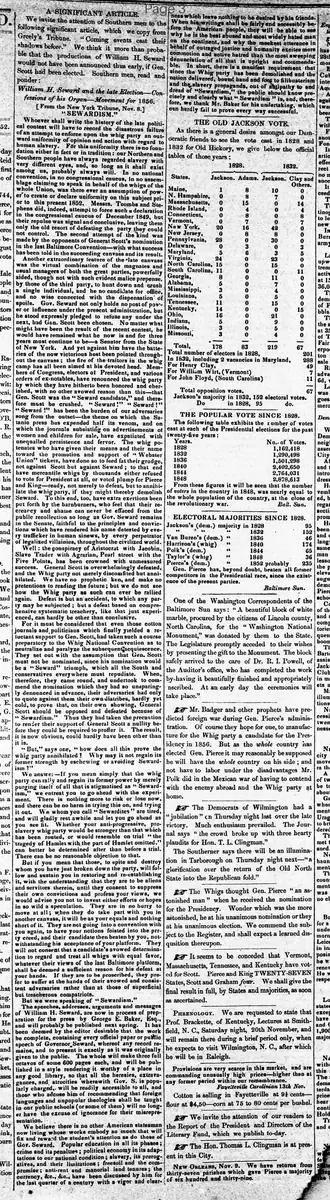
We invite the attention of Southern men to the following significant article, which we copy from Greeley's Tribune. "Coming events, cast their shadows before." We think it more than probable that the productions of William H. Seward would not have been announced thus early, if Gen. Scott had been elected. Southern men, read and ponder
William H. Seward and the late Election—Confessions of his Organ—Movement for 1856.
[From the New York Tribune, Nov. 8.]
"SEWARDISM."
Whoever shall write the history of the late political contest will have to record the disastrous failure of an attempt to enforce upon the whig party an outward uniformity of opinion and action with regard to human slavery. For this uniformity there is no foundation either in fact or in tradition: our Northern and Southern people have always regarded slavery with very different eyes, and, so long as it shall exist among us, probably always will. In no national convention, in no congressional caucus, in no assemblage claiming to speak in behalf of the whigs of the whole Union, was there ever an assumption of power to create or declare uniformity on this subject prior to this present 1852. Messrs. Toombs and Stephens did, indeed, attempt to force such a declaration in the congressional caucus of December 1849, but their repulse was signal and conclusive, leaving them only the old resort of defeating the party they could not control. The second attempt of the kind was made by the opponents of General Scott's nomination in the last Baltimore Convention—with what success has been told in the succeeding canvass and its result.
Another extraordinary feature of the late canvass was the virtual combination of the magnates and usual managers of both the great parties, powerfully aided, though not with such evident malice prepense, by those of the third party, to hunt down and crush a single individual, and he no candidate for office, and no wise connected with the dispensation of spoils. Gov. Seward not only holds no post of power or influence under the present administration, but he stood expressly pledged to refuse any under the next, had Gen. Scott been chosen. No matter what might have been the result of the recent contest, he would have remained what he now is and for three years must continue to be—a Senator from the State of New York. And yet against him have the batteries of the now victorious host been pointed throughout the canvass; the fire of the traitors in the whig camp has all been aimed at his devoted head. Members of Congress, electors of President, and various orders of ex-notables, have renounced the whig party by which they have hitherto been honored and cherished, with no other avowed reason than this—that Gen. Scott was the "Seward candidate," and therefore must be crushed. "Seward!" "Seward!" "Seward!" has been the burden of our adversaries' song from the outset—the theme on which the Satanic press has expended half its venom, and on which the journals subsisting on advertisements of women and children for sale, have expatiated with unequalled persistence and fervor. The whig potentates who have given their means and their name toward the promotion and support of "Webster Union" tickets, have done so to feed fat their grudge, not against Scott but against Seward; to that end have mercantile whigs by thousands either refused to vote for President at all, or voted plump for Pierce and King—ready, not merely to defeat, but to annihilate the whig party, if they might thereby demolish Seward. To this end, too, have extra exertions been put forth by the barnburners, who feel that their recreancy and shame can never be effaced from the public recollection so long as Gov. Seward remains in the Senate, faithful to the principles and convictions which have rendered his name detested by every trafficker in human sinews, by every perpetrator of legalized villainies, throughout the civilized world.
Well: the conspiracy of Aristocrat with Jacobin, Slave Trader with Agrarian, Pearl street with the Five Points, has been crowned with unmeasured success. General Scott is overwhelmingly defeated, and the Whig party not merely discomfited but annihilated. We have no prophetic ken, and make no pretensions to reading the future; but we do not see how the Whig party as such can ever be rallied again. Defeat is but an accident, to which any party may be subjected; but a defeat based on comprehensive systematic treachery, like that just experienced, can hardly be other than conclusive.
For it must be considered that even those cotton journals and politicians which finally yielded a reluctant support to Gen. Scott, had taken such a course preparatory to the Whig National Convention as to neutralize and paralyze the subsequent acquiescence. They set out with the assumption that Gen. Scott must not be nominated, since his nomination would be a "Seward" triumph, which all the South and conservatives everywhere must repudiate. When, therefore, they came round, and undertook to commend the nomination which they had so unsparingly denounced in advance, their adversaries had only to quote against them their own diatribes, hardly yet cold, to prove that, on their own showing, General Scott should be opposed and defeated because of "Sewardism." Thus they had taken the precaution to render their support of General Scott a nullity before they could be required to proffer it. The result, it is now obvious, could hardly have been other than it is.
"But," says one, "how does all this prove the whig party annihilated? Why may it not regain its former strength by eschewing or avoiding Seward-ism?"
We answer—If you mean simply that the whig party can rally and regain its former power by merely purging itself of all that is stigmatised as "Sewardism," we entreat you to go ahead with the experiment. There is nothing more to risk or lose now, and there can be no harm in trying this on, and trying it out. We whom you call "Sewardites" are tired, and will gladly rest awhile and let you go ahead as you see fit. Whether your anti-progressive, pro-slavery whig party would be stronger than that which has been routed, or would resemble on trial the tragedy of Hamlet with the part of Hamlet omitted, can better be determined after than before a trial. There can be no reasonable objection to that.
But if you mean that those, to spite and destroy whom you have just broken down the party, will follow and sustain you in restoring and re-establishing it, with the understanding that they are to be aliens and servitors therein, until they consent to suppress their own convictions and profess your views, we would advise you not to invest either efforts or hopes in so wild a speculation. They are in no hurry to move at all; when they do take part with you in another canvass, it will be as your equals and nothing short of it. They are not going into a convention with you again, to have your notions foisted into the party creed, and their candidate then beaten by you, notwithstanding his acceptance of your platform. They will not consent that a candidate's avowed determination to regard and treat all whigs with equal favor, whatever their views of the last Baltimore platform, shall be deemed a sufficient reason for his defeat at your hands. If they are to be proscribed, they prefer to suffer at the hands of their avowed and consistent adversaries rather than at those of superficial but treacherous compatriots.
But we were speaking of "Sewardism."
The speeches, addresses, arguments and messages of William H. Seward, are now in process of preparation for the press by George E. Baker, Esq., and will probably be published next spring. It has been deemed by the editor desirable that the work be complete, containing every official paper or public speech of Governor Seward, whereof any record remains, and to present it exactly as it was originally given to the public. The whole will make three full octavos of some 600 pages each, and will be published in a style rendering it worthy of a place in any good library, so that all the heresies, extravagances, and atrocities wherewith Gov. S. is popularly charged, will be readily accessible to all, and those who accuse him of recommending that foreign languages and unpopular theologies shall be taught in our public schools (or some of them) will no longer have the excuse of ignorance for their misrepresentation.
We believe there is no other American statesman now living whose works embody so much that will fix and reward the student's attention as do those of Gov. Seward. Popular education in all its phases; crime and its penalties; political economy in its adaptations to our national condition; slavery, its prerogatives, and their limitations; free soil and the compromise; anti-rent and manorial land tenures; the currency, &c., &c., have been discussed by him for the last quarter of a century with a vigor and clearness which leave nothing to be desired by his friends.
When his writings shall be fairly and accessibly before the American people, they will be able to see why he is the best abused and most widely hated man on the continent, and why the meekest utterance in behalf of outraged justice and humanity excites more commotion and active hatred than the most sweeping denunciation of all that is upright and commendable. In short, there is a manifest requirement that since the Whig party has been demolished and the nation delivered, bound hand and foot to filibusterism and the slavery propaganda, out of antipathy to and dread of "Sewardism," the public should know precisely and clearly what "Sewardism" is, and, therefore, we thank Mr. Baker for his undertaking, which can hardly fail to prove every way successful.
William H. Seward and the late Election—Confessions of his Organ—Movement for 1856.
[From the New York Tribune, Nov. 8.]
"SEWARDISM."
Whoever shall write the history of the late political contest will have to record the disastrous failure of an attempt to enforce upon the whig party an outward uniformity of opinion and action with regard to human slavery. For this uniformity there is no foundation either in fact or in tradition: our Northern and Southern people have always regarded slavery with very different eyes, and, so long as it shall exist among us, probably always will. In no national convention, in no congressional caucus, in no assemblage claiming to speak in behalf of the whigs of the whole Union, was there ever an assumption of power to create or declare uniformity on this subject prior to this present 1852. Messrs. Toombs and Stephens did, indeed, attempt to force such a declaration in the congressional caucus of December 1849, but their repulse was signal and conclusive, leaving them only the old resort of defeating the party they could not control. The second attempt of the kind was made by the opponents of General Scott's nomination in the last Baltimore Convention—with what success has been told in the succeeding canvass and its result.
Another extraordinary feature of the late canvass was the virtual combination of the magnates and usual managers of both the great parties, powerfully aided, though not with such evident malice prepense, by those of the third party, to hunt down and crush a single individual, and he no candidate for office, and no wise connected with the dispensation of spoils. Gov. Seward not only holds no post of power or influence under the present administration, but he stood expressly pledged to refuse any under the next, had Gen. Scott been chosen. No matter what might have been the result of the recent contest, he would have remained what he now is and for three years must continue to be—a Senator from the State of New York. And yet against him have the batteries of the now victorious host been pointed throughout the canvass; the fire of the traitors in the whig camp has all been aimed at his devoted head. Members of Congress, electors of President, and various orders of ex-notables, have renounced the whig party by which they have hitherto been honored and cherished, with no other avowed reason than this—that Gen. Scott was the "Seward candidate," and therefore must be crushed. "Seward!" "Seward!" "Seward!" has been the burden of our adversaries' song from the outset—the theme on which the Satanic press has expended half its venom, and on which the journals subsisting on advertisements of women and children for sale, have expatiated with unequalled persistence and fervor. The whig potentates who have given their means and their name toward the promotion and support of "Webster Union" tickets, have done so to feed fat their grudge, not against Scott but against Seward; to that end have mercantile whigs by thousands either refused to vote for President at all, or voted plump for Pierce and King—ready, not merely to defeat, but to annihilate the whig party, if they might thereby demolish Seward. To this end, too, have extra exertions been put forth by the barnburners, who feel that their recreancy and shame can never be effaced from the public recollection so long as Gov. Seward remains in the Senate, faithful to the principles and convictions which have rendered his name detested by every trafficker in human sinews, by every perpetrator of legalized villainies, throughout the civilized world.
Well: the conspiracy of Aristocrat with Jacobin, Slave Trader with Agrarian, Pearl street with the Five Points, has been crowned with unmeasured success. General Scott is overwhelmingly defeated, and the Whig party not merely discomfited but annihilated. We have no prophetic ken, and make no pretensions to reading the future; but we do not see how the Whig party as such can ever be rallied again. Defeat is but an accident, to which any party may be subjected; but a defeat based on comprehensive systematic treachery, like that just experienced, can hardly be other than conclusive.
For it must be considered that even those cotton journals and politicians which finally yielded a reluctant support to Gen. Scott, had taken such a course preparatory to the Whig National Convention as to neutralize and paralyze the subsequent acquiescence. They set out with the assumption that Gen. Scott must not be nominated, since his nomination would be a "Seward" triumph, which all the South and conservatives everywhere must repudiate. When, therefore, they came round, and undertook to commend the nomination which they had so unsparingly denounced in advance, their adversaries had only to quote against them their own diatribes, hardly yet cold, to prove that, on their own showing, General Scott should be opposed and defeated because of "Sewardism." Thus they had taken the precaution to render their support of General Scott a nullity before they could be required to proffer it. The result, it is now obvious, could hardly have been other than it is.
"But," says one, "how does all this prove the whig party annihilated? Why may it not regain its former strength by eschewing or avoiding Seward-ism?"
We answer—If you mean simply that the whig party can rally and regain its former power by merely purging itself of all that is stigmatised as "Sewardism," we entreat you to go ahead with the experiment. There is nothing more to risk or lose now, and there can be no harm in trying this on, and trying it out. We whom you call "Sewardites" are tired, and will gladly rest awhile and let you go ahead as you see fit. Whether your anti-progressive, pro-slavery whig party would be stronger than that which has been routed, or would resemble on trial the tragedy of Hamlet with the part of Hamlet omitted, can better be determined after than before a trial. There can be no reasonable objection to that.
But if you mean that those, to spite and destroy whom you have just broken down the party, will follow and sustain you in restoring and re-establishing it, with the understanding that they are to be aliens and servitors therein, until they consent to suppress their own convictions and profess your views, we would advise you not to invest either efforts or hopes in so wild a speculation. They are in no hurry to move at all; when they do take part with you in another canvass, it will be as your equals and nothing short of it. They are not going into a convention with you again, to have your notions foisted into the party creed, and their candidate then beaten by you, notwithstanding his acceptance of your platform. They will not consent that a candidate's avowed determination to regard and treat all whigs with equal favor, whatever their views of the last Baltimore platform, shall be deemed a sufficient reason for his defeat at your hands. If they are to be proscribed, they prefer to suffer at the hands of their avowed and consistent adversaries rather than at those of superficial but treacherous compatriots.
But we were speaking of "Sewardism."
The speeches, addresses, arguments and messages of William H. Seward, are now in process of preparation for the press by George E. Baker, Esq., and will probably be published next spring. It has been deemed by the editor desirable that the work be complete, containing every official paper or public speech of Governor Seward, whereof any record remains, and to present it exactly as it was originally given to the public. The whole will make three full octavos of some 600 pages each, and will be published in a style rendering it worthy of a place in any good library, so that all the heresies, extravagances, and atrocities wherewith Gov. S. is popularly charged, will be readily accessible to all, and those who accuse him of recommending that foreign languages and unpopular theologies shall be taught in our public schools (or some of them) will no longer have the excuse of ignorance for their misrepresentation.
We believe there is no other American statesman now living whose works embody so much that will fix and reward the student's attention as do those of Gov. Seward. Popular education in all its phases; crime and its penalties; political economy in its adaptations to our national condition; slavery, its prerogatives, and their limitations; free soil and the compromise; anti-rent and manorial land tenures; the currency, &c., &c., have been discussed by him for the last quarter of a century with a vigor and clearness which leave nothing to be desired by his friends.
When his writings shall be fairly and accessibly before the American people, they will be able to see why he is the best abused and most widely hated man on the continent, and why the meekest utterance in behalf of outraged justice and humanity excites more commotion and active hatred than the most sweeping denunciation of all that is upright and commendable. In short, there is a manifest requirement that since the Whig party has been demolished and the nation delivered, bound hand and foot to filibusterism and the slavery propaganda, out of antipathy to and dread of "Sewardism," the public should know precisely and clearly what "Sewardism" is, and, therefore, we thank Mr. Baker for his undertaking, which can hardly fail to prove every way successful.
What sub-type of article is it?
Historical Event
Tragedy
What themes does it cover?
Deception
Justice
Tragedy
What keywords are associated?
Whig Party Defeat
Sewardism
1852 Election
Slavery Politics
Political Treachery
Seward Speeches
What entities or persons were involved?
William H. Seward
Gen. Scott
Pierce
King
Toombs
Stephens
George E. Baker
Where did it happen?
United States
Story Details
Key Persons
William H. Seward
Gen. Scott
Pierce
King
Toombs
Stephens
George E. Baker
Location
United States
Event Date
1852
Story Details
The Whig party's defeat in the 1852 election stems from internal treachery and opposition to 'Sewardism,' focusing on anti-slavery views; a conspiracy across parties targeted Seward, leading to Scott's loss and the party's annihilation; Seward's collected works are to be published to clarify his positions.