Thank you for visiting SNEWPapers!
Sign up free
Editorial
August 2, 1889
Griggs Courier
Cooperstown, Griggs County, North Dakota
What is this article about?
An editorial reflecting on the distinction between motion and true progress, emphasizing the need for directed, cautious action in spiritual and worldly endeavors to avoid retrograde or harmful paths.
Clipping
OCR Quality
98%
Excellent
Full Text
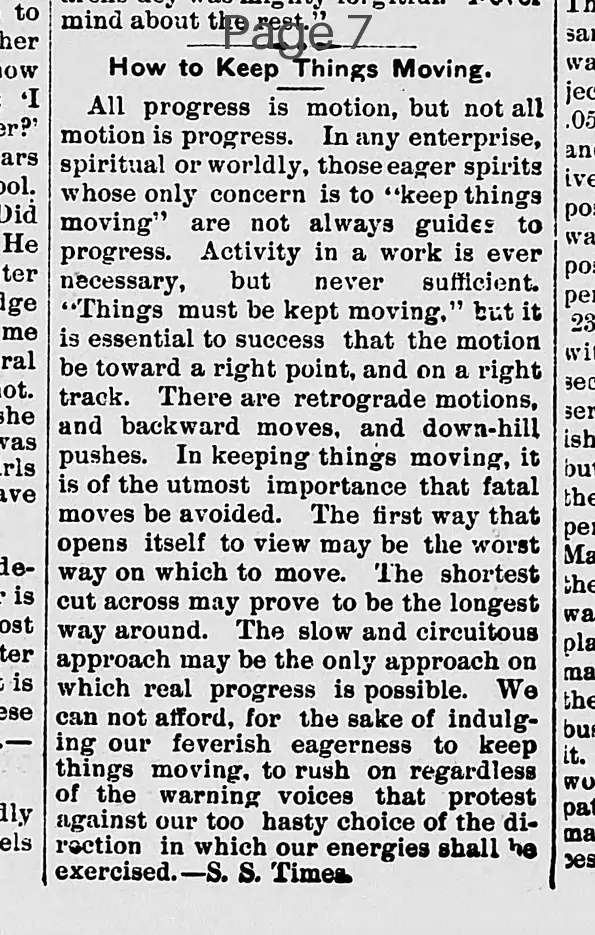
How to Keep Things Moving.
All progress is motion, but not all motion is progress. In any enterprise, spiritual or worldly, those eager spirits whose only concern is to "keep things moving" are not always guides to progress. Activity in a work is ever necessary, but never sufficient.
"Things must be kept moving," but it is essential to success that the motion be toward a right point, and on a right track. There are retrograde motions, and backward moves, and down-hill pushes. In keeping things moving, it is of the utmost importance that fatal moves be avoided. The first way that opens itself to view may be the worst way on which to move. The shortest cut across may prove to be the longest way around. The slow and circuitous approach may be the only approach on which real progress is possible. We cannot afford, for the sake of indulging our feverish eagerness to keep things moving, to rush on regardless of the warning voices that protest against our too hasty choice of the direction in which our energies shall be exercised.—S. S. Times
All progress is motion, but not all motion is progress. In any enterprise, spiritual or worldly, those eager spirits whose only concern is to "keep things moving" are not always guides to progress. Activity in a work is ever necessary, but never sufficient.
"Things must be kept moving," but it is essential to success that the motion be toward a right point, and on a right track. There are retrograde motions, and backward moves, and down-hill pushes. In keeping things moving, it is of the utmost importance that fatal moves be avoided. The first way that opens itself to view may be the worst way on which to move. The shortest cut across may prove to be the longest way around. The slow and circuitous approach may be the only approach on which real progress is possible. We cannot afford, for the sake of indulging our feverish eagerness to keep things moving, to rush on regardless of the warning voices that protest against our too hasty choice of the direction in which our energies shall be exercised.—S. S. Times
What sub-type of article is it?
Moral Or Religious
What keywords are associated?
Progress Vs Motion
Directed Activity
Moral Caution
Spiritual Enterprises
Worldly Endeavors
Editorial Details
Primary Topic
Distinction Between Motion And Directed Progress
Stance / Tone
Cautionary Moral Exhortation
Key Arguments
All Progress Is Motion, But Not All Motion Is Progress.
Activity Is Necessary But Not Sufficient For Success.
Motion Must Be Toward A Right Point And On A Right Track.
Avoid Retrograde Motions, Backward Moves, And Down Hill Pushes.
The First Apparent Way May Be The Worst.
Shortest Cut May Prove Longest Way Around.
Slow And Circuitous Approach May Be Necessary For Real Progress.
Do Not Rush Regardless Of Warnings Against Hasty Choices.