Thank you for visiting SNEWPapers!
Sign up free
The New Hampshire Gazette
Portsmouth, Rockingham County, New Hampshire
What is this article about?
On July 25, a devastating fire erupted at Mr. Clove's barge builder's in Ratcliff, sparked by a boiling pitch kettle. It spread to a barge laden with saltpetre, exploding and engulfing East India Company warehouses and surrounding areas, destroying up to 1,000 buildings and causing losses over £1 million.
Clipping
OCR Quality
Full Text
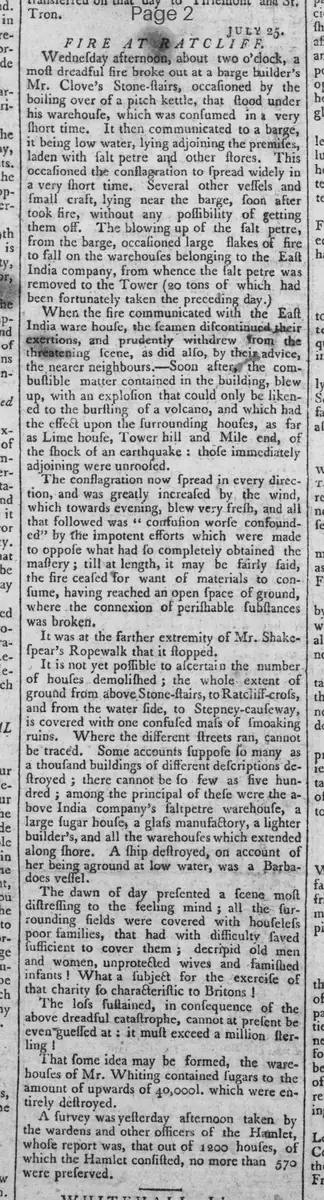
FIRE AT RATCLIFF.
Wednesday afternoon, about two o'clock, a most dreadful fire broke out at a barge builder's Mr. Clove's Stone-stairs, occasioned by the boiling over of a pitch kettle, that stood under his warehouse, which was consumed in a very short time. It then communicated to a barge, it being low water, lying adjoining the premises, laden with salt petre and other stores. This occasioned the conflagration to spread widely in a very short time. Several other vessels and small craft, lying near the barge, soon after took fire, without any possibility of getting them off. The blowing up of the salt petre, from the barge, occasioned large flakes of fire to fall on the warehouses belonging to the East India company, from whence the salt petre was removed to the Tower (20 tons of which had been fortunately taken the preceding day.)
When the fire communicated with the East India warehouse, the seamen discontinued their exertions, and prudently withdrew from the threatening scene, as did also, by their advice, the nearer neighbours. Soon after, the combustible matter contained in the building, blew up, with an explosion that could only be likened to the bursting of a volcano, and which had the effect upon the surrounding houses, as far as Limehouse, Tower hill and Mile end, of the shock of an earthquake: those immediately adjoining were unroofed.
The conflagration now spread in every direction, and was greatly increased by the wind, which towards evening, blew very fresh, and all that followed was "confusion worse confounded" by the impotent efforts which were made to oppose what had so completely obtained the mastery; till at length, it may be fairly said, the fire ceased for want of materials to consume, having reached an open space of ground, where the connexion of perishable substances was broken.
It was at the farther extremity of Mr. Shakespear's Ropewalk that it stopped.
It is not yet possible to ascertain the number of houses demolished: the whole extent of ground from above Stone-stairs, to Ratcliff-cross, and from the water side, to Stepney-causeway, is covered with one confused mass of smoking ruins. Where the different streets ran, cannot be traced. Some accounts suppose as many as a thousand buildings of different descriptions destroyed: there cannot be so few as five hundred; among the principal of these were the above India company's saltpetre warehouse, a large sugar house, a glass manufactory, a lighter builder's, and all the warehouses which extended along shore. A ship destroyed, on account of her being aground at low water, was a Barbados vessel.
The dawn of day presented a scene most distressing to the feeling mind; all the surrounding fields were covered with houseless poor families, that had with difficulty saved sufficient to cover them; decrepid old men and women, unprotected wives and famished infants! What a subject for the exercise of that charity so characteristic to Britons!
The loss sustained, in consequence of the above dreadful catastrophe, cannot at present be even guessed at: it must exceed a million. Sterling!
That some idea may be formed, the warehouses of Mr. Whiting contained sugars to the amount of upwards of 40,000l. which were entirely destroyed.
A survey was yesterday afternoon taken by the wardens and other officers of the Hamlet, whose report was, that out of 1200 houses, of which the Hamlet consisted, no more than 570 were preserved.
What sub-type of article is it?
What keywords are associated?
What entities or persons were involved?
Where did it happen?
Foreign News Details
Primary Location
Ratcliff
Event Date
July 25
Key Persons
Outcome
approximately 630 houses destroyed out of 1200; losses exceeding one million pounds sterling; one barbados ship destroyed; no human casualties mentioned; many families left homeless.
Event Details
Fire started at Mr. Clove's barge builder's Stone-stairs from boiling over pitch kettle, spread to saltpetre-laden barge causing explosion, ignited East India Company warehouses with further explosion likened to volcano, spread by wind across Ratcliff area to Mr. Shakespear's Ropewalk, destroying warehouses, sugar house, glass manufactory, and other buildings.