Thank you for visiting SNEWPapers!
Sign up free
Editorial
February 15, 1797
Gazette Of The United States, & Philadelphia Daily Advertiser
Philadelphia, Philadelphia County, Pennsylvania
What is this article about?
The editorial defends the free press in the United States, contrasting it with restrained media in despotic governments and limited monarchies. It argues that presidents must endure public abuse from disappointed claimants, as no placation is possible, emphasizing the press as a sentinel against tyranny.
Clipping
OCR Quality
95%
Excellent
Full Text
COMMUNICATION.
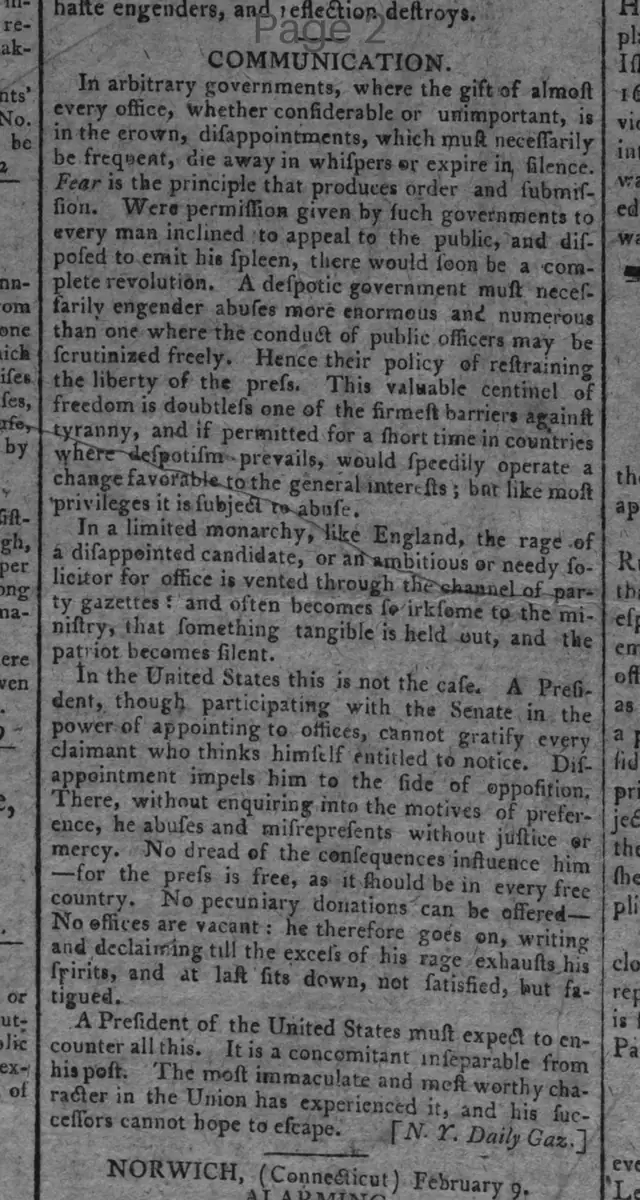
In arbitrary governments, where the gift of almost every office, whether considerable or unimportant, is in the crown, disappointments, which must necessarily be frequent, die away in whispers or expire in silence. Fear is the principle that produces order and submission. Were permission given by such governments to every man inclined to appeal to the public, and disposed to emit his spleen, there would soon be a complete revolution. A despotic government must necessarily engender abuses more enormous and numerous than one where the conduct of public officers may be scrutinized freely. Hence their policy of restraining the liberty of the press. This valuable centinel of freedom is doubtless one of the firmest barriers against tyranny, and if permitted for a short time in countries where despotism prevails, would speedily operate a change favorable to the general interests; but like most privileges it is subject to abuse.
In a limited monarchy, like England, the rage of a disappointed candidate, or an ambitious or needy solicitor for office is vented through the channel of party gazettes: and often becomes so irksome to the ministry, that something tangible is held out, and the patriot becomes silent.
In the United States this is not the case. A President, though participating with the Senate in the power of appointing to offices, cannot gratify every claimant who thinks himself entitled to notice. Disappointment impels him to the side of opposition. There, without enquiring into the motives of preference, he abuses and misrepresents without justice or mercy. No dread of the consequences influence him—for the press is free, as it should be in every free country. No pecuniary donations can be offered—No offices are vacant: he therefore goes on, writing and declaiming till the excess of his rage exhausts his spirits, and at last sits down, not satisfied, but fatigued.
A President of the United States must expect to encounter all this. It is a concomitant inseparable from his post. The most immaculate and most worthy character in the Union has experienced it, and his successors cannot hope to escape. [N. Y. Daily Gaz.]
In arbitrary governments, where the gift of almost every office, whether considerable or unimportant, is in the crown, disappointments, which must necessarily be frequent, die away in whispers or expire in silence. Fear is the principle that produces order and submission. Were permission given by such governments to every man inclined to appeal to the public, and disposed to emit his spleen, there would soon be a complete revolution. A despotic government must necessarily engender abuses more enormous and numerous than one where the conduct of public officers may be scrutinized freely. Hence their policy of restraining the liberty of the press. This valuable centinel of freedom is doubtless one of the firmest barriers against tyranny, and if permitted for a short time in countries where despotism prevails, would speedily operate a change favorable to the general interests; but like most privileges it is subject to abuse.
In a limited monarchy, like England, the rage of a disappointed candidate, or an ambitious or needy solicitor for office is vented through the channel of party gazettes: and often becomes so irksome to the ministry, that something tangible is held out, and the patriot becomes silent.
In the United States this is not the case. A President, though participating with the Senate in the power of appointing to offices, cannot gratify every claimant who thinks himself entitled to notice. Disappointment impels him to the side of opposition. There, without enquiring into the motives of preference, he abuses and misrepresents without justice or mercy. No dread of the consequences influence him—for the press is free, as it should be in every free country. No pecuniary donations can be offered—No offices are vacant: he therefore goes on, writing and declaiming till the excess of his rage exhausts his spirits, and at last sits down, not satisfied, but fatigued.
A President of the United States must expect to encounter all this. It is a concomitant inseparable from his post. The most immaculate and most worthy character in the Union has experienced it, and his successors cannot hope to escape. [N. Y. Daily Gaz.]
What sub-type of article is it?
Press Freedom
Partisan Politics
What keywords are associated?
Free Press
Presidential Criticism
Government Types
Political Disappointment
Press Liberty
What entities or persons were involved?
President Of The United States
Senate
Editorial Details
Primary Topic
Defense Of Press Freedom In Republics
Stance / Tone
Supportive Of Free Press Despite Abuses
Key Figures
President Of The United States
Senate
Key Arguments
In Arbitrary Governments, Fear Suppresses Public Criticism And The Press Is Restrained To Prevent Revolution.
Free Press Acts As A Barrier Against Tyranny But Is Subject To Abuse.
In Limited Monarchies Like England, Disappointed Individuals Vent Through Party Gazettes Until Placated.
In The United States, Disappointed Office Seekers Abuse The President Through The Free Press Without Fear Of Consequences.
Presidents Must Expect Such Criticism As Inseparable From The Office.