Thank you for visiting SNEWPapers!
Sign up free
Editorial
July 21, 1917
The Barre Daily Times
Barre, Washington County, Vermont
What is this article about?
The Rutland Herald criticizes Governor Graham's proposal to appoint a temporary secretary of state who won't run in 1918, arguing it prioritizes politics over policy and the office needs a permanent, capable leader like McFeeters, Morse, or Black.
Clipping
OCR Quality
95%
Excellent
Full Text
Appoint a Real Official.
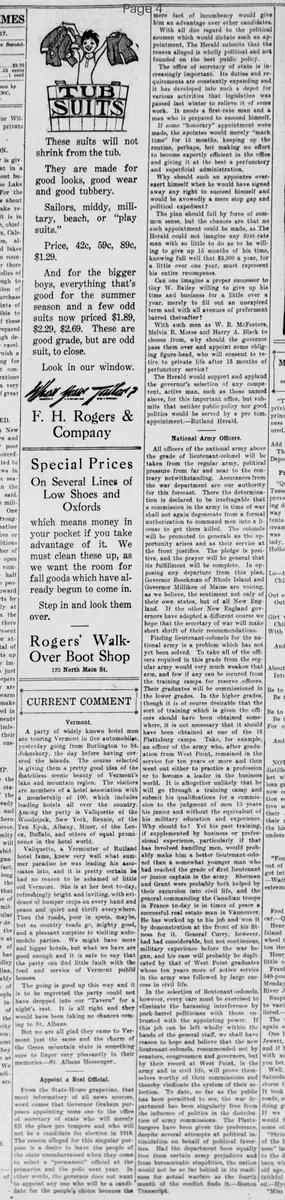
From the State-House grapevine, that most informatory of all news sources, word comes that Governor Graham proposes appointing some one to the office of secretary of state who will merely fill the place pro tempore and who will not be a candidate for election in 1918. The reason alleged for this singular purpose is a desire to leave the people of the state unembarrassed when they come to select a "permanent" official at the primaries and the polls next year. In other words, the governor does not want to appoint any one who will be a candidate, mere fact of incumbency would give him an advantage over other candidates. With all due regard to the political acumen which would dictate such an appointment, The Herald submits that the reason alleged is wholly political and not founded on the best public policy. The office of secretary of state is increasingly important. Its duties and requirements are constantly expanding and it has developed into such a depot for various activities that legislation was passed last winter to relieve it of some work. It needs a first-rate man and a man who is prepared to succeed himself. If some "honorary" appointment were made, the appointee would merely "mark time" for 15 months, keeping up the routine, perhaps, but making no effort to become expertly efficient in the office and giving it at the best a perfunctory and superficial administration. Why should such an appointee overexert himself when he would have signed away any right to succeed himself and would be avowedly a mere stop gap and political expedient? The plan should fail by force of common sense, but the chances are that no such appointment could be made, as The Herald could not imagine any first-rate man with so little to do as to be willing to give up 15 months of his time, knowing full well that $3,500 a year, for a little over one year, must represent his entire recompense. Can one imagine a proper successor to Guy W. Bailey willing to give up his time and business for a little over a year, merely to fill out an unexpired term and with all avenues of preferment barred thereafter? With such men as W. R. McFeeters, Melvin R. Morse and Harry A. Black to choose from, why should the governor pass them over and appoint some obliging figure-head, who will consent to retire to private life after 15 months of perfunctory service? The Herald would support and applaud the governor's selection of any competent, active man, such as those named above, for this important office, but submits that neither public policy nor good politics would be served by a pro tem. appointment.--Rutland Herald.
From the State-House grapevine, that most informatory of all news sources, word comes that Governor Graham proposes appointing some one to the office of secretary of state who will merely fill the place pro tempore and who will not be a candidate for election in 1918. The reason alleged for this singular purpose is a desire to leave the people of the state unembarrassed when they come to select a "permanent" official at the primaries and the polls next year. In other words, the governor does not want to appoint any one who will be a candidate, mere fact of incumbency would give him an advantage over other candidates. With all due regard to the political acumen which would dictate such an appointment, The Herald submits that the reason alleged is wholly political and not founded on the best public policy. The office of secretary of state is increasingly important. Its duties and requirements are constantly expanding and it has developed into such a depot for various activities that legislation was passed last winter to relieve it of some work. It needs a first-rate man and a man who is prepared to succeed himself. If some "honorary" appointment were made, the appointee would merely "mark time" for 15 months, keeping up the routine, perhaps, but making no effort to become expertly efficient in the office and giving it at the best a perfunctory and superficial administration. Why should such an appointee overexert himself when he would have signed away any right to succeed himself and would be avowedly a mere stop gap and political expedient? The plan should fail by force of common sense, but the chances are that no such appointment could be made, as The Herald could not imagine any first-rate man with so little to do as to be willing to give up 15 months of his time, knowing full well that $3,500 a year, for a little over one year, must represent his entire recompense. Can one imagine a proper successor to Guy W. Bailey willing to give up his time and business for a little over a year, merely to fill out an unexpired term and with all avenues of preferment barred thereafter? With such men as W. R. McFeeters, Melvin R. Morse and Harry A. Black to choose from, why should the governor pass them over and appoint some obliging figure-head, who will consent to retire to private life after 15 months of perfunctory service? The Herald would support and applaud the governor's selection of any competent, active man, such as those named above, for this important office, but submits that neither public policy nor good politics would be served by a pro tem. appointment.--Rutland Herald.
What sub-type of article is it?
Partisan Politics
What keywords are associated?
Secretary Of State
Governor Appointment
Temporary Official
Political Expedient
Public Policy
State Office
What entities or persons were involved?
Governor Graham
Guy W. Bailey
W. R. Mcfeeters
Melvin R. Morse
Harry A. Black
Rutland Herald
Editorial Details
Primary Topic
Opposition To Temporary Appointment Of Secretary Of State
Stance / Tone
Critical Of Governor's Political Strategy
Key Figures
Governor Graham
Guy W. Bailey
W. R. Mcfeeters
Melvin R. Morse
Harry A. Black
Rutland Herald
Key Arguments
Governor's Plan Is Politically Motivated To Avoid Embarrassing Voters
Office Of Secretary Of State Is Increasingly Important And Needs A Permanent, Competent Appointee
Temporary Appointee Would Provide Only Perfunctory Administration
No First Rate Man Would Accept A Short Term Role With No Future Prospects
Governor Should Choose From Qualified Candidates Like Mcfeeters, Morse, Or Black