Thank you for visiting SNEWPapers!
Sign up free
Richmond Enquirer
Richmond, Richmond County, Virginia
What is this article about?
In the Virginia House of Delegates on January 20, Mr. Gregory delivered a speech during debate on a bill to organize a constitutional convention, advocating for county-based representation, the protection of property interests, and the principle of majority rule while critiquing alternatives like taxation-based systems.
Clipping
OCR Quality
Full Text
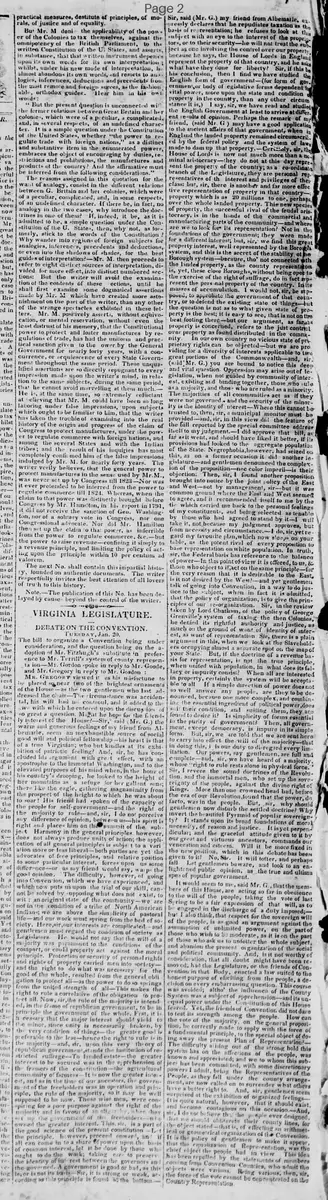
DEBATE ON THE CONVENTION.
TUESDAY, Jan. 20.
The bill to organize a Convention being under consideration, and the question being on the adoption of Mr. Fitzhugh's substitute in preference to Mr. Terrill's system of county representation—Mr. Gordon spoke in reply to Mr. Goode, and Mr. Gregory in reply to Mr. Gordon:
MR. GREGORY viewed it as his misfortune to be placed so near two of the brightest ornaments of the House—as the two gentlemen who last addressed the chair—The circumstance was accidental, his will had no control, and it added to the diffidence with which he entered upon the discussion of so great a question. What he hope for the friendly interest of the House?—Sir, said Mr. G. the warm and generous feelings of my friend from Albemarle, seem an inexhaustible source of social good will and political fellowship—his heart is that of a true Virginian; who but kindles at its exhibition of patriotic feeling? And, sir, he has concluded his argument with great effect, with an apostrophe to the immortal Washington, and to the elevated purposes of his mind when, in the hour of his country's drooping, he looked to the height of her mountains as a refuge for her gallant sons; there like the eagle, gathering magnanimity from the prospect of the height to which he was about to soar! His friend had spoken of the capacity of the people for self-government—and the right of the majority to rule—and, sir, I do not perceive any difference of opinion, between us—his spirit is right and places him on the summit of the subject. Harmony in the general principles, however, does not always produce unity of action; the application of all general principles is subject to a variation more or less liberal—both parties are yet the advocates of free principles, and relative position to some particular interest, forces upon us some difference—or as my friend would say, warp the good opinion. The difficulty, however, of going into Convention, which we have experienced, and which now puts us upon the trial of our skill, cannot be solved by supposing what does not exist, to wit: an original state of the community—we are not in the condition of a tribe of North American Indians; we are above the simplicity of pastoral life—and our work must spring from the bed of society. Here, sir, our interests are complicated—and gentlemen must regard the condition of society as Legislators. He would not say that the will of a majority was paramount to the conditions of the compact, or could properly act against the moral principle. Protection or security of personal rights and rights of property carried men into society—and the right to do what was necessary for the good of the whole, resulted from the general obligation to protect all as the power to do so springs from the united strength of all—This makes the right to rule a correlative of the obligation to protect all. Now, sir, the rule of the majority is intended, in the frame of republican government, to be in principle the government of the whole. First, it is necessary that the major interest should yield to the minor, since unity is necessarily broken, by the very condition of things—the greater good is preferable to the less—hence the right to rule is in the majority—and, sir, upon this very theory of republican government, stands the institution of restricted suffrage—To landed estate—the greater interest to be secured was in the apprehension of the framers of the constitution—the agricultural community of farmers—It is now the greater interest, and as in the time of our ancestors, the government of the freeholders was in operation and principle, the rule of the majority, so it may be well supposed to be now. These wise men, were conspiring for a poor purpose against the right of the majority and in favour of an oligarchy, when they set up the government of the freeholders—who owned the greater interest. This, sir, is a part of the good science of the present constitution—Let the principle, however, proceed onward, and if all can come in to a share of power upon the basis of common interest, let it be done by those who ought to do the work; taking care to preserve the identity of interest between the governors and the governed. A government is good or bad, as this is, or is not its basis—Sir, it is strong or weak, according as this principle is found at the bottom.
Sir, said Mr. G. my friend from Albemarle, expressly declares that he repudiates taxation as the basis of representation; he refuses to look at this subject with an eye to the interest of the proprietors, or to their security—he will not treat the subject as one involving the control over our property, because he says, the House of Lords in England represent the property of that country, and he asks what have they done for liberty? Sir, if this be his conclusion, then I find we have studied the English form of government—(for form of government, or body of legislative forms dependent for vital power, more upon the state and condition property in the country, than any other circumstance it is,) I say, sir, we have read and studied the English Government at least to arrive at different results of opinion. Perhaps the remark of my friend, (said Mr. G.) may have a good application to the ancient affairs of that government, when in England the landed property remained circumscribed by the feudal policy and the system of laws made to dam up that property.—Certainly, sir, the House of Lords is now not much more than a nominal aristocracy—they do not at this day represent the property of the country; as a co-ordinate branch of the Legislature, they are personal representatives of the interest and privileges of their class: but, sir, there is another and far more effective representation of property in that country—property which is as 20 millions to one, perhaps, over the whole landed property. This new species of property, the successful rival of the feudal aristocracy, is in the hands of the commercial and manufacturing parts of the community—and where are we to look for its representation? Not in the foundations of the government; they were made for a different interest; but, sir, we find this great property interest, well represented by the Borough system, and this is the secret of the stability of the Borough system—because, tho' not connected with the landed property, as the county representation is, yet, these close Boroughs, without being open to the exercise of the right of suffrage, do in fact represent the personal property of the country. In its masses of accumulation. I would not, sir, be supposed, to approbate the government of that country, or to defend the existing state of things—but the question is not as to what given state of property is the best; it is easy to see, that is not on the best footing there—but our argument, as far as property is concerned, refers to the just control over property as found distributed in the community.' In our own country no vicious state of proprietary rights can be objected—but we are providing for a diversity of interests applicable to two great portions of the Commonwealth—and, First (said Mr. G.) you are bound to notice this deep and vital question. Oppression may arise out of legislation, when not guided by community of interest, existing and binding together, those who rule as a majority, and those who are ruled as a minority. The majorities of all communities act as if they were not governed and the security of the minority is the identity of interest—Where this cannot be trusted to, then, sir, a municipal monitor must be provided—and, sir, in this view did the feature of the bill reported by the special committee address itself to my judgment.—I did approve that bill, as far as it went, and should have liked it better, if its provisions had looked to the aggregate population of the State. Negrophobia, however, had seized on this, as on a former occasion it did another legislature—and gentlemen denounced the complexion of the proposition—nec color imperii—is their objection. Then, sir, I found another proposition brought into notice by the joint policy of the East and West—not by management, sir—but it was common ground where the East and West seemed to agree, and it recommended itself to me by the tie which carried me back to the personal feelings of my constituents, and being selected as tenable by those who had agreed to stand by it—I will take it, not because my judgment approves, but from necessity and circumstance.—I do, sir, yet regard my favourite plan, which now sleeps on your table, as the potent rival of every proposition to base representation on white population. In truth, sir, the Federal basis has reference to the balance of power—In this point of view it is offered, to us, & those who object to it, act on the same principle—for the very reason that it is desirable to the East, is it not desired by the West?—and yet gentlemen talk of going into Convention, in a way to do justice to the subject, when in fact it is admitted, that the policy of organization, is to give the principles of our re-organization. Sir, in the review taken by Lord Chatham, of the policy of George Grenville's system of taxing the then Colonies, he denied its rightful authority and justice, as much on the ground of want of identity of interest, as want of representation. Sir, there is a plain argument in this, when we look at the Slaveholders occupying almost a separate spot on the map of your State. But, if the doctrine of a revenue basis for representation, is not the true principle, when united with population, in what does its fallacy or impurity consist? When all are interested in property, certainly the system will be acceptable to all. If a simple direction of power does not so well answer any people, are they to be denounced, because one more complex, and combining the essential ingredient of political power, does suit their condition, and suiting them, they are found to desire it? Is simplicity of forms essential to the purity of government? Then, all government, except democracy, is impure in its simple form. But, sir, we are told that we are sent here to carry into effect the will of the majority—that in doing this, it is our duty to disregard every limitation. Our powers, say gentlemen, are full and complete—and, sir, we have heard of a majority, whose "right to rule rests alone in physical force. Sir, I revere the sound doctrines of the Revolution. and the immortal men, who set up the sovereignty of the people, against the divine right of Kings. More than one crowned head had, before the era of our Revolution, found that the power, de facto, was in the people. But, sir, why should gentlemen now disturb the settled doctrine? Why invert the beautiful Pyramid of popular sovereignty? It stands upon its broad foundations of moral necessity, of reason and justice. It is yet perpendicular; and the graceful attitude given to it by our great and virtuous ancestors, commands our veneration and esteem. Will it be more fixed in the new position, which in this debate has been given to it? No, Sir. It will totter, and perhaps fall. Let gentlemen beware, and look to an enlightened public opinion, as the true and ultimate basis of popular government.
It would seem to me, said Mr. G., that the members of this House, are acting so far in obedience to the will of the people, taking the vote of last Spring to be a fair expression of that will, as to be engaged in the discharge of a duty imposed;— but I also think, that respect for the sovereign will of the people, is as good an argument against the assumption of unlimited power, on the part of those who wish to be moderate, as it is on the part of those who ask us to unfetter the whole subject, and abandon the present organization of the social and political community. And, is it not worthy of consideration, that all doubt might have been removed, had the Legislature, or the friends of Convention in that Body, enacted a law suited to the honest purpose of eliciting from the people, a decision on every embarrassing question. This course was avoided altho the influence of the County System was a subject of apprehension—and its unequal power under the Constitution of this House feared. Yet, the friends of Convention, did not dare to test its strength among the people. How can the vote of the majority, on the general proposition, be correctly made to apply with the force of a fundamental principle, to the special object of doing away the present Plan of Representation?— The difficulty arising out of the strong hold this system has on the affections of the people, was known and appreciated; and we to whom this subject has been committed, with some discretionary powers I admit, being the Representatives of the People, as they fall under the county arrangement, are now called on to surrender what others have a better right to. And, sir, gentlemen seem surprised at the exhibition of organized feelings— (It is quite natural, however, that it should exist, and become contagious on this occasion.—And, sir. I do not believe that the people ever designed, that we should obliterate their county lines, for the object stated -that is, of effecting an arithmetical or geometrical organization of the Convention. It is the policy of gentlemen to make it appear, that the equalization of Representation, was the chief object the people had in view. This idea has been repelled by the statements of members coming from Convention Counties, who admit the objects were various. Being various, then, sir, the force of the vote cannot be concentrated on the Country Representation.
What sub-type of article is it?
What keywords are associated?
What entities or persons were involved?
Where did it happen?
Domestic News Details
Primary Location
Virginia
Event Date
Tuesday, Jan. 20.
Key Persons
Event Details
Debate on the bill to organize a Convention, focusing on Mr. Fitzhugh's substitute versus Mr. Terrill's system of county representation. Mr. Gordon replied to Mr. Goode, and Mr. Gregory replied to Mr. Gordon, discussing majority rule, property rights, representation bases, and the implications for Virginia's constitutional convention.