Thank you for visiting SNEWPapers!
Sign up free
Editorial
August 21, 1795
Gazette Of The United States
Philadelphia, Philadelphia County, Pennsylvania
What is this article about?
A Federalist editorial in the Columbian Centinel refutes Boston's objections to ratifying the U.S.-British treaty, defending provisions on colonial and East Indies trade as beneficial and reciprocal, emphasizing national rights and economic advantages.
Clipping
OCR Quality
95%
Excellent
Full Text
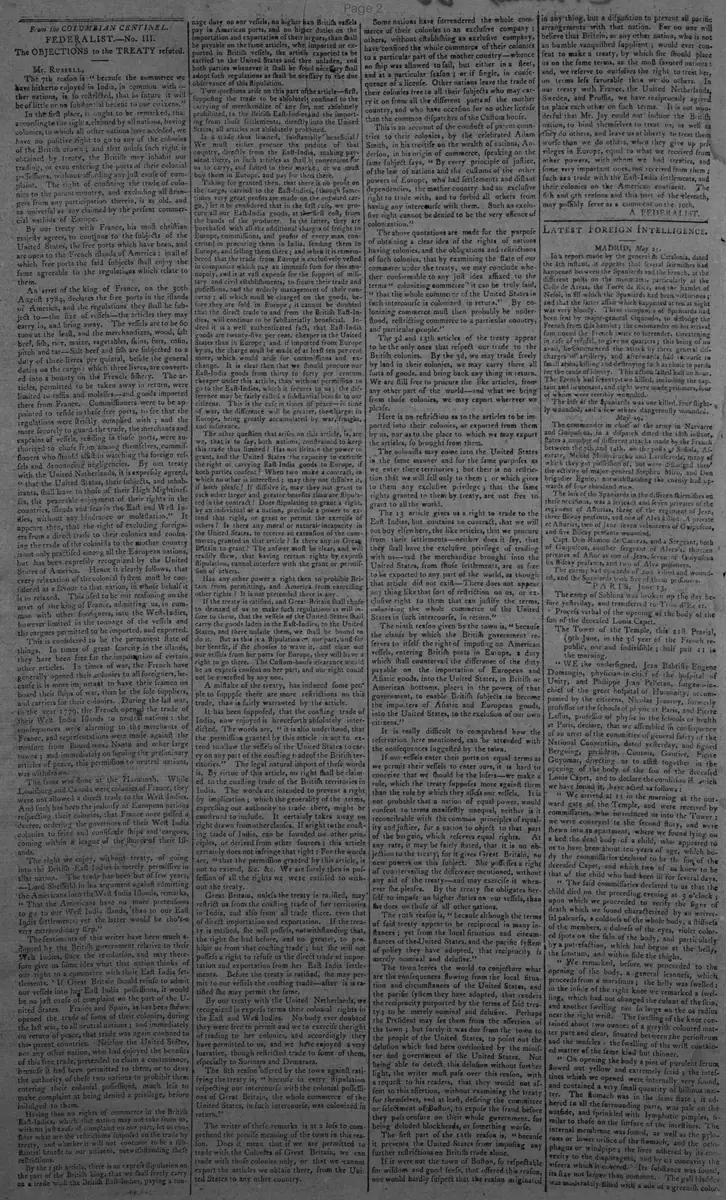
From the COLUMBIAN CENTINEL.
FEDERALIST.-No. III.
The OBJECTIONS to the TREATY refuted.
Mr. Russell,
The 7th reason is "because the commerce we have hitherto enjoyed in India, in common with other nations, is so restricted, that in future it will be of little or no substantial benefit to our citizens."
In the first place, it ought to be remarked, that according to the rights, claimed by all nations, having colonies, to which all other nations have acceded, we have no positive right to go to any of the colonies of the British crown; and that unless such right is obtained by treaty, the British may prohibit our trading, or even entering the ports of their colonial possessions, without affording any just cause of complaint. The right of confining the trade of colonies to the parent country, and excluding all strangers from any participation therein, is as old and as universal as any claimed by the present commercial nations of Europe.
By our treaty with France, his most Christian majesty agrees, to continue so to the subjects of the United States, the free ports which have been, and are open to the French islands of America: in all of which free ports the said subjects shall enjoy the same agreeable to the regulations which relate to them.
An arret of the king of France, on the 30th August 1784, declares the free ports in the islands of America, and the regulations they shall be subject to—the size of vessels—the articles they may carry in, and bring away. The vessels are to be 60 tons at the least, and the merchandizes, wood, salt beef, fish, rice, maize, vegetables, skins, furs, rosin, pitch and tar—Salt beef and fish are subjected to a duty of three livres per quintal, beside the general duties on the cargo: which three livres, are converted into a bounty on the French fishery. The articles, permitted to be taken away in return, were limited to tafia and molasses—and goods imported there from France. Commissioners were to be appointed to reside in these free ports, to see that the regulations were strictly complied with; and the more securely to guard the trade, the merchants and captains of vessels, residing in those ports, were authorized to choose from among themselves, commissioners who should act in watching the foreign vessels and denouncing negligencies. By our treaty with the United Netherlands, it is expressly agreed, "that the United States, their subjects, and inhabitants, shall leave to those of their High Mightinesses, the peaceable enjoyment of their rights in the countries, islands and seas in the East and West Indies, without any hindrance or molestation." It appears then, that the right of excluding foreigners from a direct trade to their colonies and confining the trade of the colonies to the mother country is not only practiced among all the European nations, but has been expressly recognized by the United States of America. Hence it clearly follows, that every relaxation of the colonial system must be considered as a favour to that nation, in whose behalf it is so relaxed. This used to be our reasoning on the arret of the king of France, admitting us, in common with other foreigners, into the West-Indies, however limited in the tonnage of the vessels and the cargoes permitted to be imported, and exported.
This is considered to be the permanent state of things. In times of great scarcity in the islands, they have been free for the importation of certain other articles. In times of war, the French have generally opened their colonies to all foreigners, because it is more important to have their seamen on board their ships of war, than be the sole suppliers, and carriers for their colonies. During the last war, in the year 1779, the French opened the trade of their West India Islands to neutral nations: the consequences were alarming to the merchants of France, and representations were made against the measure from Bourdeaux, Nantz and other large towns; and immediately on signing the preliminary articles of peace, this permission to neutral nations, was withdrawn.
The same was done at the Havannah. While Louisburg and Canada were colonies of France, they were not allowed a direct trade to the West Indies. And such has been the jealousy of European nations respecting their colonies, that France once passed a decree, ordering the governors of their West India colonies to seize and confiscate ships and cargoes, coming within a league of the shores of their Islands.
The right we enjoy, without treaty, of going into the British East Indies is merely permissive in that nation. The trade has been but of few years, Lord Sheffield in his argument against admitting the Americans into the West India Islands, remarks, "That the Americans have no more pretensions to go to our West India islands, than to our East India settlements, yet the latter would be thought a very extraordinary step."
The sentiments of this writer have been much adopted by the British government relative to their West Indies, since the revolution, and may therefore give us some idea what that nation thinks of our right to a commerce with their East India settlements. If Great Britain should refuse to admit our vessels into her East India possessions, it would be no just cause of complaint on the part of the United States. France and Spain, as has been shown opened the trade of some of their colonies, during the last war, to all neutral nations; and immediately on return of peace, that trade was again confined to the parent countries. Neither the United States, nor any other nation, who had enjoyed the benefits of this free trade, pretended to claim a continuance, because it had been permitted to them, or to deny the authority of these two nations to prohibit them entering their colonial possessions, much less to make complaint at being denied a privilege, before indulged to them.
Having then no rights of commerce in the British East-Indies, which that nation may not take from us, without just cause of complaint on our part, let us consider what are the restrictions imposed on the trade by treaty, and whether it will not continue to be a substantial benefit to our citizens, notwithstanding these restrictions.
By the 13th article, there is an express stipulation on the part of the British king, that we shall freely carry on a trade with the British East-Indies, paying a tonnage duty on our vessels, no higher than British vessels pay in American ports, and no higher duties on the importation and exportation of their cargoes, than shall be payable on the same articles, when imported or exported in British vessels, the articles exported to be carried to the United States and there unladen, and both parties whenever it shall be found necessary shall adopt such regulations as shall be necessary to the due observance of this stipulation.
Two questions arise on this part of the article first, supposing the trade to be absolutely confined to the carrying of merchandise of any sort, not absolutely prohibited, to the British East-Indies, and the importing from those settlements, directly into the United States, all articles not absolutely prohibited. Is a trade thus limited, substantially beneficial?
We must either procure those produce of that country, directly from the East-Indies, making payment there, in such articles as shall be convenient for us to carry, and suited to their market; or we must buy them in Europe, and pay for them there.
Taking for granted then, that there is no profit on the cargo, carried to the East-Indies, (though sometimes very great profits are made on the outward cargo,) let it be considered that in the first case, we procure all our East-India goods, at the first cost, from the hands of the producer. In the latter, they are purchased with all the additional charges of freight to Europe, commissions, and profits of every man concerned in procuring them in India, sending them to Europe, and selling them there; and when it is remembered that the trade from Europe is exclusively vested in companies which pay an immense sum for this monopoly, and is at vast expense for the support of military and civil establishments, to secure their trade and possessions, and the orderly management of their concerns; all which must be charged on the goods, before they are sold in Europe; it cannot be doubted that the direct trade to and from the British East-Indies, will continue to be substantially beneficial. Indeed it is a well authenticated fact, that East-India goods are twenty-five per cent. cheaper in the United States than in Europe; and if imported from Europe by us, the charge must be made of at least ten per cent more, which would arise for commissions and exchange. It is clear then that we should procure our East-India goods from thirty to forty per centum cheaper under this article, than without permission to go to the East-Indies, which it secures to us; the difference may be fairly called a substantial benefit to our citizens. This is the case in times of peace—in time of war, the difference will be greater, the charges in Europe, being greatly accumulated by war, freight, and insurance.
The other question that arises on this article, is, are we, that is to say, both nations, constrained to keep this trade thus limited? Has not Britain the power to grant, and the United States the capacity to exercise the right of carrying East India goods to Europe, if both parties consent? When two make a contract, in which no other is interested; may they not dissolve it, if both please? If dissolve it, may they not grant to each other larger and greater benefits than are stipulated in the contract? Does stipulating to grant a right, by an individual or a nation, preclude a power to extend that right, or grant or permit the exercise of others? Is there any moral or natural incapacity in the United States, to receive an extension of the commerce, granted in that article? Is there any in Great Britain to grant? The answer must be clear, and will readily show, that having certain rights by express stipulation, cannot interfere with the grant or permission of others.
Has any other power a right then to prohibit Britain from permitting, and America from exercising other rights? It is not pretended there is any.
If the treaty is ratified, and Great-Britain shall choose to demand of us to make such regulations as will insure to them, that the vessels of the United States shall carry the goods laden in the East-Indies, to the United States, and there unlade them, we shall be bound to do it. But as this is a stipulation on our part, and for her benefit, if she chooses to waive it, and clear out our vessels from her ports for Europe, they will have a right to go there. The Custom-house clearance would be an express consent on her part, and our right could not be contested by any one.
A mistake of the treaty, has induced some people to suppose there are more restrictions on this trade, than is fairly warranted by the article.
It has been supposed, that the coasting trade of India, now enjoyed is henceforth absolutely interdicted. The words are, "it is also understood, that the permission granted by this article is not to extend to allow the vessels of the United States to carry on any part of the coasting trade of the British territories." The legal natural import of these words is, By virtue of this article, no right shall be claimed to the coasting trade of the British territories in India. The words are intended to prevent a right by implication; which the generality of the terms, expressing our authority to trade there, might be construed to include. It certainly takes away no right drawn from other clauses. If a right to the coasting trade of India, can be founded on other principles, or derived from other sources; this article certainly does not infringe that right: For the words are, "that the permission granted by this article, is not to extend, &c. &c. We are surely then in possession of all the rights we were entitled to without the treaty.
Great Britain, unless the treaty is ratified, may restrict us from the coasting trade of her territories in India, and also from all trade there, even that of direct importation and exportation. If the treaty is ratified, she will possess, notwithstanding that, the right she had before, and no greater, to prohibit us from that coasting trade; but she will not possess a right to refuse us the direct trade of importation and exportation from her East India settlements. Before the treaty is ratified, she may permit to our vessels the coasting trade—after it is ratified she may permit the same.
By our treaty with the United Netherlands, we recognized in express terms their colonial rights in the East and West Indies. No body ever doubted they were free to permit and we to exercise the right of trading to her colonies, and accordingly they have permitted to us, and we have enjoyed a very lucrative, though restricted trade to some of them, especially to Surinam and Demarara.
The 8th reason offered by the town against ratifying the treaty is, "because in every stipulation respecting our intercourse with the colonial possessions of Great Britain, the whole commerce of the United States, in such intercourse, was colonized in return."
The writer of these remarks is at a loss to comprehend the precise meaning of the town in this reason. Does it mean that if we are permitted to trade with the Colonies of Great Britain, we can trade with those colonies only, or that we cannot export the articles we obtain there, from the United States to any other country.
Some nations have surrendered the whole commerce of their colonies to an exclusive company; others, without establishing an exclusive company, have confined the whole commerce of their colonies to a particular part of the mother country—whence no ship was allowed to sail, but either in a fleet, and at a particular season; or if single, in consequence of a license. Other nations leave the trade of their colonies free to all their subjects who may carry it on from all the different parts of the mother country, and who have occasion for no other license than the common dispatches of the Custom house.
This is an account of the conduct of parent countries to their colonies, by the celebrated Adam Smith, in his treatise on the wealth of nations. Anderson, in his origin of commerce, speaking on the same subject says, "By every principle of justice, of the law of nations and the customs of the other powers of Europe, who had settlements and distant dependencies, the mother country had an exclusive right to trade with, and to forbid all others from having any intercourse with them. Such an exclusive right cannot be denied to be the very essence of colonization."
The above quotations are made for the purpose of obtaining a clear idea of the rights of nations having colonies, and the obligations and restrictions of such colonies, that by examining the state of our commerce under the treaty, we may conclude whether conformable to any just idea affixed to the terms "colonizing commerce" it can be truly said, "that the whole commerce of the United States in such intercourse is colonized in return." By colonizing commerce must then probably be understood, restricting commerce to a particular country, and particular people.
The 3d and 13th articles of the treaty appear to be the only ones that respect our trade to the British colonies. By the 3d, we may trade freely by land in their colonies, we may carry there all sorts of goods, and bring back any thing in return. We are still free to procure the like articles, from any other part of the world—and what we bring from those colonies, we may export wherever we please.
Here is no restriction as to the articles to be imported into their colonies, or exported from them by us, nor as to the place to which we may export the articles, so brought from them.
The colonists may come into the United States in the same manner and for the same purposes as we enter their territories; but there is no restriction that we will sell only to them; or which gives to them any exclusive privilege; that the same rights granted to them by treaty, are not free to grant to all the world.
The 13th article gives us a right to trade to the East Indies, but contains no contract, that we will not buy elsewhere, the like articles, that we procure from their settlements—neither does it say, that they shall have the exclusive privilege of trading with us—and the merchandise brought into the United States, from those settlements, are as free to be exported to any part of the world, as though that article did not exist—There does not appear any thing like that sort of restriction on us, or exclusive right to them that can justify the terms, colonizing the whole commerce of the United States in such intercourse, in return.
The ninth reason given by the town is, "because the clause by which the British government reserves to itself the right of imposing on American vessels, entering British ports in Europe, a duty which shall countervail the difference of the duty payable on the importation of European and Asiatic goods, into the United States, in British or American bottoms, places in the power of that government, to enable British subjects to become the importers of Asiatic and European goods, into the United States, to the exclusion of our own citizens."
It is really difficult to comprehend how the reservation here mentioned, can be attended with the consequences suggested by the town.
If our vessels enter their ports on equal terms as we permit their vessels to enter ours, it is hard to conceive that we should be the losers—we make a rule, which the treaty supposes more against them than the rule by which they act our vessels. It is not probable that a nation of equal power, would consent to terms manifestly unequal, neither is it reconcilable with the common principles of equality and justice, for a nation to object to that part of the bargain, which reserves equal rights. At any rate, it may be fairly stated, that it is no objection to the treaty, for it gives Great Britain, no new powers on this subject. She possesses a right of countervailing the difference mentioned, without any aid of the treaty—and may exercise it whenever she pleases. By the treaty she obligates herself to impose no higher duties on our vessels, than she does on those of all other nations.
The 10th reason is, "because although the terms of said treaty appear to be reciprocal in many instances; yet from the local situation and circumstances of the United States, and the pacific system of policy they have adopted, that reciprocity is merely nominal and delusive."
The town leaves the world to conjecture what are the consequences flowing from the local situation and circumstances of the United States, and the pacific system they have adopted, that renders the reciprocity purported by the terms of said treaty; to be merely nominal and delusive. Perhaps the President may see them from the assertion of the town; but surely it was due from the town to the people of the United States, to point out the delusion which had been overlooked by the minister and government of the United States. Not being able to detect this delusion without further light, the writer must pass over this reason, with a request to his readers, that they would not assent to this assertion, without examining the treaty for themselves, and at least, desiring the committee or selectmen of Boston, to expose the fraud before they pass censure on their whole government, for being deluded blockheads, or something worse.
The first part of the 11th reason is, "because it prevents the United States from imposing any further restrictions on British trade alone."
If it were not the town of Boston, so respectable for wisdom and good sense, that offered this reason, one would hardly suspect that the reason originated in any thing, but a disposition to prevent all pacific arrangements with that nation. For no one will believe that Britain, or any other nation, who is not an humble vanquished supplicant; would ever consent to make a treaty, by which she should place us on the same terms, as the most favored nations: and, we reserve to ourselves the right to treat her, on terms less favorable than we do others. In our treaty with France, the United Netherlands, Sweden, and Prussia, we have reciprocally agreed to place each other on such terms. It is not wonderful that Mr. Jay could not induce the British nation, to bind themselves to treat us, as well as they do others, and leave us at liberty to treat them worse than we do others, when they give up privileges in Europe, equal to what we received from other powers, with whom we had treaties, and some very important ones, not received from them; such as a trade with the East-India settlements, and their colonies on the American continent. The 6th and 9th reasons and this part of the eleventh, may possibly serve as a comment on the 10th.
A FEDERALIST.
FEDERALIST.-No. III.
The OBJECTIONS to the TREATY refuted.
Mr. Russell,
The 7th reason is "because the commerce we have hitherto enjoyed in India, in common with other nations, is so restricted, that in future it will be of little or no substantial benefit to our citizens."
In the first place, it ought to be remarked, that according to the rights, claimed by all nations, having colonies, to which all other nations have acceded, we have no positive right to go to any of the colonies of the British crown; and that unless such right is obtained by treaty, the British may prohibit our trading, or even entering the ports of their colonial possessions, without affording any just cause of complaint. The right of confining the trade of colonies to the parent country, and excluding all strangers from any participation therein, is as old and as universal as any claimed by the present commercial nations of Europe.
By our treaty with France, his most Christian majesty agrees, to continue so to the subjects of the United States, the free ports which have been, and are open to the French islands of America: in all of which free ports the said subjects shall enjoy the same agreeable to the regulations which relate to them.
An arret of the king of France, on the 30th August 1784, declares the free ports in the islands of America, and the regulations they shall be subject to—the size of vessels—the articles they may carry in, and bring away. The vessels are to be 60 tons at the least, and the merchandizes, wood, salt beef, fish, rice, maize, vegetables, skins, furs, rosin, pitch and tar—Salt beef and fish are subjected to a duty of three livres per quintal, beside the general duties on the cargo: which three livres, are converted into a bounty on the French fishery. The articles, permitted to be taken away in return, were limited to tafia and molasses—and goods imported there from France. Commissioners were to be appointed to reside in these free ports, to see that the regulations were strictly complied with; and the more securely to guard the trade, the merchants and captains of vessels, residing in those ports, were authorized to choose from among themselves, commissioners who should act in watching the foreign vessels and denouncing negligencies. By our treaty with the United Netherlands, it is expressly agreed, "that the United States, their subjects, and inhabitants, shall leave to those of their High Mightinesses, the peaceable enjoyment of their rights in the countries, islands and seas in the East and West Indies, without any hindrance or molestation." It appears then, that the right of excluding foreigners from a direct trade to their colonies and confining the trade of the colonies to the mother country is not only practiced among all the European nations, but has been expressly recognized by the United States of America. Hence it clearly follows, that every relaxation of the colonial system must be considered as a favour to that nation, in whose behalf it is so relaxed. This used to be our reasoning on the arret of the king of France, admitting us, in common with other foreigners, into the West-Indies, however limited in the tonnage of the vessels and the cargoes permitted to be imported, and exported.
This is considered to be the permanent state of things. In times of great scarcity in the islands, they have been free for the importation of certain other articles. In times of war, the French have generally opened their colonies to all foreigners, because it is more important to have their seamen on board their ships of war, than be the sole suppliers, and carriers for their colonies. During the last war, in the year 1779, the French opened the trade of their West India Islands to neutral nations: the consequences were alarming to the merchants of France, and representations were made against the measure from Bourdeaux, Nantz and other large towns; and immediately on signing the preliminary articles of peace, this permission to neutral nations, was withdrawn.
The same was done at the Havannah. While Louisburg and Canada were colonies of France, they were not allowed a direct trade to the West Indies. And such has been the jealousy of European nations respecting their colonies, that France once passed a decree, ordering the governors of their West India colonies to seize and confiscate ships and cargoes, coming within a league of the shores of their Islands.
The right we enjoy, without treaty, of going into the British East Indies is merely permissive in that nation. The trade has been but of few years, Lord Sheffield in his argument against admitting the Americans into the West India Islands, remarks, "That the Americans have no more pretensions to go to our West India islands, than to our East India settlements, yet the latter would be thought a very extraordinary step."
The sentiments of this writer have been much adopted by the British government relative to their West Indies, since the revolution, and may therefore give us some idea what that nation thinks of our right to a commerce with their East India settlements. If Great Britain should refuse to admit our vessels into her East India possessions, it would be no just cause of complaint on the part of the United States. France and Spain, as has been shown opened the trade of some of their colonies, during the last war, to all neutral nations; and immediately on return of peace, that trade was again confined to the parent countries. Neither the United States, nor any other nation, who had enjoyed the benefits of this free trade, pretended to claim a continuance, because it had been permitted to them, or to deny the authority of these two nations to prohibit them entering their colonial possessions, much less to make complaint at being denied a privilege, before indulged to them.
Having then no rights of commerce in the British East-Indies, which that nation may not take from us, without just cause of complaint on our part, let us consider what are the restrictions imposed on the trade by treaty, and whether it will not continue to be a substantial benefit to our citizens, notwithstanding these restrictions.
By the 13th article, there is an express stipulation on the part of the British king, that we shall freely carry on a trade with the British East-Indies, paying a tonnage duty on our vessels, no higher than British vessels pay in American ports, and no higher duties on the importation and exportation of their cargoes, than shall be payable on the same articles, when imported or exported in British vessels, the articles exported to be carried to the United States and there unladen, and both parties whenever it shall be found necessary shall adopt such regulations as shall be necessary to the due observance of this stipulation.
Two questions arise on this part of the article first, supposing the trade to be absolutely confined to the carrying of merchandise of any sort, not absolutely prohibited, to the British East-Indies, and the importing from those settlements, directly into the United States, all articles not absolutely prohibited. Is a trade thus limited, substantially beneficial?
We must either procure those produce of that country, directly from the East-Indies, making payment there, in such articles as shall be convenient for us to carry, and suited to their market; or we must buy them in Europe, and pay for them there.
Taking for granted then, that there is no profit on the cargo, carried to the East-Indies, (though sometimes very great profits are made on the outward cargo,) let it be considered that in the first case, we procure all our East-India goods, at the first cost, from the hands of the producer. In the latter, they are purchased with all the additional charges of freight to Europe, commissions, and profits of every man concerned in procuring them in India, sending them to Europe, and selling them there; and when it is remembered that the trade from Europe is exclusively vested in companies which pay an immense sum for this monopoly, and is at vast expense for the support of military and civil establishments, to secure their trade and possessions, and the orderly management of their concerns; all which must be charged on the goods, before they are sold in Europe; it cannot be doubted that the direct trade to and from the British East-Indies, will continue to be substantially beneficial. Indeed it is a well authenticated fact, that East-India goods are twenty-five per cent. cheaper in the United States than in Europe; and if imported from Europe by us, the charge must be made of at least ten per cent more, which would arise for commissions and exchange. It is clear then that we should procure our East-India goods from thirty to forty per centum cheaper under this article, than without permission to go to the East-Indies, which it secures to us; the difference may be fairly called a substantial benefit to our citizens. This is the case in times of peace—in time of war, the difference will be greater, the charges in Europe, being greatly accumulated by war, freight, and insurance.
The other question that arises on this article, is, are we, that is to say, both nations, constrained to keep this trade thus limited? Has not Britain the power to grant, and the United States the capacity to exercise the right of carrying East India goods to Europe, if both parties consent? When two make a contract, in which no other is interested; may they not dissolve it, if both please? If dissolve it, may they not grant to each other larger and greater benefits than are stipulated in the contract? Does stipulating to grant a right, by an individual or a nation, preclude a power to extend that right, or grant or permit the exercise of others? Is there any moral or natural incapacity in the United States, to receive an extension of the commerce, granted in that article? Is there any in Great Britain to grant? The answer must be clear, and will readily show, that having certain rights by express stipulation, cannot interfere with the grant or permission of others.
Has any other power a right then to prohibit Britain from permitting, and America from exercising other rights? It is not pretended there is any.
If the treaty is ratified, and Great-Britain shall choose to demand of us to make such regulations as will insure to them, that the vessels of the United States shall carry the goods laden in the East-Indies, to the United States, and there unlade them, we shall be bound to do it. But as this is a stipulation on our part, and for her benefit, if she chooses to waive it, and clear out our vessels from her ports for Europe, they will have a right to go there. The Custom-house clearance would be an express consent on her part, and our right could not be contested by any one.
A mistake of the treaty, has induced some people to suppose there are more restrictions on this trade, than is fairly warranted by the article.
It has been supposed, that the coasting trade of India, now enjoyed is henceforth absolutely interdicted. The words are, "it is also understood, that the permission granted by this article is not to extend to allow the vessels of the United States to carry on any part of the coasting trade of the British territories." The legal natural import of these words is, By virtue of this article, no right shall be claimed to the coasting trade of the British territories in India. The words are intended to prevent a right by implication; which the generality of the terms, expressing our authority to trade there, might be construed to include. It certainly takes away no right drawn from other clauses. If a right to the coasting trade of India, can be founded on other principles, or derived from other sources; this article certainly does not infringe that right: For the words are, "that the permission granted by this article, is not to extend, &c. &c. We are surely then in possession of all the rights we were entitled to without the treaty.
Great Britain, unless the treaty is ratified, may restrict us from the coasting trade of her territories in India, and also from all trade there, even that of direct importation and exportation. If the treaty is ratified, she will possess, notwithstanding that, the right she had before, and no greater, to prohibit us from that coasting trade; but she will not possess a right to refuse us the direct trade of importation and exportation from her East India settlements. Before the treaty is ratified, she may permit to our vessels the coasting trade—after it is ratified she may permit the same.
By our treaty with the United Netherlands, we recognized in express terms their colonial rights in the East and West Indies. No body ever doubted they were free to permit and we to exercise the right of trading to her colonies, and accordingly they have permitted to us, and we have enjoyed a very lucrative, though restricted trade to some of them, especially to Surinam and Demarara.
The 8th reason offered by the town against ratifying the treaty is, "because in every stipulation respecting our intercourse with the colonial possessions of Great Britain, the whole commerce of the United States, in such intercourse, was colonized in return."
The writer of these remarks is at a loss to comprehend the precise meaning of the town in this reason. Does it mean that if we are permitted to trade with the Colonies of Great Britain, we can trade with those colonies only, or that we cannot export the articles we obtain there, from the United States to any other country.
Some nations have surrendered the whole commerce of their colonies to an exclusive company; others, without establishing an exclusive company, have confined the whole commerce of their colonies to a particular part of the mother country—whence no ship was allowed to sail, but either in a fleet, and at a particular season; or if single, in consequence of a license. Other nations leave the trade of their colonies free to all their subjects who may carry it on from all the different parts of the mother country, and who have occasion for no other license than the common dispatches of the Custom house.
This is an account of the conduct of parent countries to their colonies, by the celebrated Adam Smith, in his treatise on the wealth of nations. Anderson, in his origin of commerce, speaking on the same subject says, "By every principle of justice, of the law of nations and the customs of the other powers of Europe, who had settlements and distant dependencies, the mother country had an exclusive right to trade with, and to forbid all others from having any intercourse with them. Such an exclusive right cannot be denied to be the very essence of colonization."
The above quotations are made for the purpose of obtaining a clear idea of the rights of nations having colonies, and the obligations and restrictions of such colonies, that by examining the state of our commerce under the treaty, we may conclude whether conformable to any just idea affixed to the terms "colonizing commerce" it can be truly said, "that the whole commerce of the United States in such intercourse is colonized in return." By colonizing commerce must then probably be understood, restricting commerce to a particular country, and particular people.
The 3d and 13th articles of the treaty appear to be the only ones that respect our trade to the British colonies. By the 3d, we may trade freely by land in their colonies, we may carry there all sorts of goods, and bring back any thing in return. We are still free to procure the like articles, from any other part of the world—and what we bring from those colonies, we may export wherever we please.
Here is no restriction as to the articles to be imported into their colonies, or exported from them by us, nor as to the place to which we may export the articles, so brought from them.
The colonists may come into the United States in the same manner and for the same purposes as we enter their territories; but there is no restriction that we will sell only to them; or which gives to them any exclusive privilege; that the same rights granted to them by treaty, are not free to grant to all the world.
The 13th article gives us a right to trade to the East Indies, but contains no contract, that we will not buy elsewhere, the like articles, that we procure from their settlements—neither does it say, that they shall have the exclusive privilege of trading with us—and the merchandise brought into the United States, from those settlements, are as free to be exported to any part of the world, as though that article did not exist—There does not appear any thing like that sort of restriction on us, or exclusive right to them that can justify the terms, colonizing the whole commerce of the United States in such intercourse, in return.
The ninth reason given by the town is, "because the clause by which the British government reserves to itself the right of imposing on American vessels, entering British ports in Europe, a duty which shall countervail the difference of the duty payable on the importation of European and Asiatic goods, into the United States, in British or American bottoms, places in the power of that government, to enable British subjects to become the importers of Asiatic and European goods, into the United States, to the exclusion of our own citizens."
It is really difficult to comprehend how the reservation here mentioned, can be attended with the consequences suggested by the town.
If our vessels enter their ports on equal terms as we permit their vessels to enter ours, it is hard to conceive that we should be the losers—we make a rule, which the treaty supposes more against them than the rule by which they act our vessels. It is not probable that a nation of equal power, would consent to terms manifestly unequal, neither is it reconcilable with the common principles of equality and justice, for a nation to object to that part of the bargain, which reserves equal rights. At any rate, it may be fairly stated, that it is no objection to the treaty, for it gives Great Britain, no new powers on this subject. She possesses a right of countervailing the difference mentioned, without any aid of the treaty—and may exercise it whenever she pleases. By the treaty she obligates herself to impose no higher duties on our vessels, than she does on those of all other nations.
The 10th reason is, "because although the terms of said treaty appear to be reciprocal in many instances; yet from the local situation and circumstances of the United States, and the pacific system of policy they have adopted, that reciprocity is merely nominal and delusive."
The town leaves the world to conjecture what are the consequences flowing from the local situation and circumstances of the United States, and the pacific system they have adopted, that renders the reciprocity purported by the terms of said treaty; to be merely nominal and delusive. Perhaps the President may see them from the assertion of the town; but surely it was due from the town to the people of the United States, to point out the delusion which had been overlooked by the minister and government of the United States. Not being able to detect this delusion without further light, the writer must pass over this reason, with a request to his readers, that they would not assent to this assertion, without examining the treaty for themselves, and at least, desiring the committee or selectmen of Boston, to expose the fraud before they pass censure on their whole government, for being deluded blockheads, or something worse.
The first part of the 11th reason is, "because it prevents the United States from imposing any further restrictions on British trade alone."
If it were not the town of Boston, so respectable for wisdom and good sense, that offered this reason, one would hardly suspect that the reason originated in any thing, but a disposition to prevent all pacific arrangements with that nation. For no one will believe that Britain, or any other nation, who is not an humble vanquished supplicant; would ever consent to make a treaty, by which she should place us on the same terms, as the most favored nations: and, we reserve to ourselves the right to treat her, on terms less favorable than we do others. In our treaty with France, the United Netherlands, Sweden, and Prussia, we have reciprocally agreed to place each other on such terms. It is not wonderful that Mr. Jay could not induce the British nation, to bind themselves to treat us, as well as they do others, and leave us at liberty to treat them worse than we do others, when they give up privileges in Europe, equal to what we received from other powers, with whom we had treaties, and some very important ones, not received from them; such as a trade with the East-India settlements, and their colonies on the American continent. The 6th and 9th reasons and this part of the eleventh, may possibly serve as a comment on the 10th.
A FEDERALIST.
What sub-type of article is it?
Foreign Affairs
Trade Or Commerce
Partisan Politics
What keywords are associated?
Jay Treaty
British Colonies
East Indies Trade
Colonial Restrictions
Federalist Arguments
Treaty Ratification
What entities or persons were involved?
Mr. Russell
British Government
United States
France
United Netherlands
Town Of Boston
Editorial Details
Primary Topic
Refutation Of Objections To The Treaty With Great Britain
Stance / Tone
Pro Ratification Defense
Key Figures
Mr. Russell
British Government
United States
France
United Netherlands
Town Of Boston
Key Arguments
Nations Have The Right To Restrict Colonial Trade, Making Any Access A Favor.
The Treaty Secures Direct Trade To British East Indies On Equal Terms, Providing Substantial Benefits By Reducing Costs 30 40%.
Objections Misinterpret Restrictions; The Treaty Does Not Limit Coasting Trade Rights Beyond What Existed.
Reciprocity In The Treaty Is Fair And Equal, Not Nominal.
The Treaty Prevents Unilateral Restrictions On British Trade But Aligns With Other U.S. Treaties.