Thank you for visiting SNEWPapers!
Sign up free
Alexandria Advertiser And Commercial Intelligencer
Alexandria, Virginia
What is this article about?
The London Courier reports on the preliminaries of peace between Britain and France, expecting ratification soon by Chief Consul Napoleon. Marquis Cornwallis appointed British plenipotentiary. Details acquisitions by war and peace, critiquing terms as unfavorable to Britain while France retains most gains. Discusses war's failures and peace's necessity.
Clipping
OCR Quality
Full Text
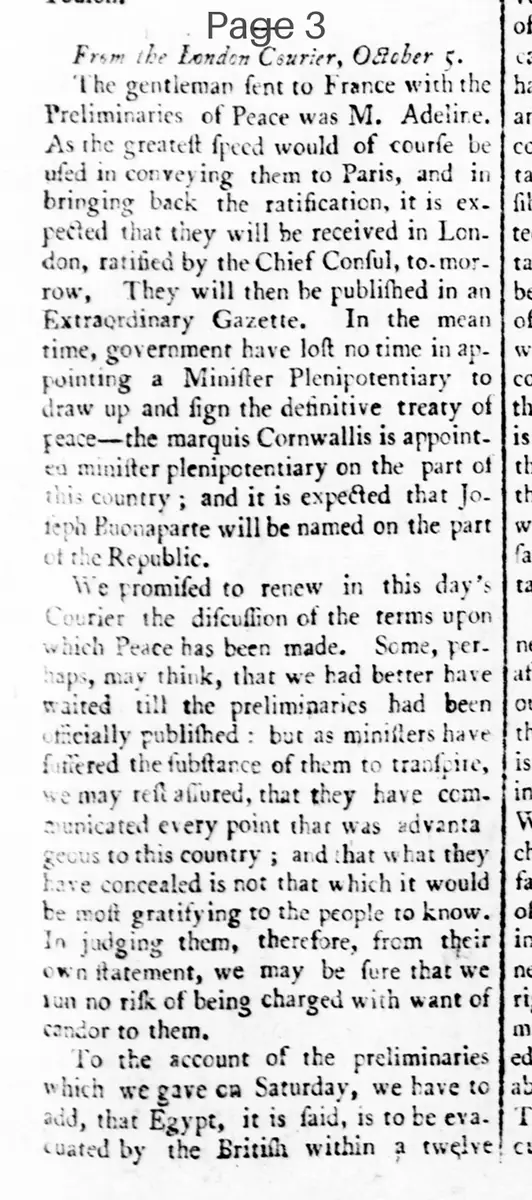
The gentleman sent to France with the Preliminaries of Peace was M. Adeline. As the greatest speed would of course be used in conveying them to Paris, and in bringing back the ratification, it is expected that they will be received in London, ratified by the Chief Consul, tomorrow.
They will then be published in an Extraordinary Gazette. In the mean time, government have lost no time in appointing a Minister Plenipotentiary to draw up and sign the definitive treaty of peace—the marquis Cornwallis is appointed minister plenipotentiary on the part of this country: and it is expected that Joseph Buonaparte will be named on the part of the Republic.
We promised to renew in this day's Courier the discussion of the terms upon which Peace has been made. Some, perhaps, may think, that we had better have waited till the preliminaries had been officially published: but as ministers have suffered the substance of them to transpire, we may rest assured, that they have communicated every point that was advantageous to this country; and that what they have concealed is not that which it would be most gratifying to the people to know. In judging them, therefore, from their own statement, we may be sure that we run no risk of being charged with want of candor to them.
To the account of the preliminaries which we gave on Saturday, we have to add, that Egypt, it is said, is to be evacuated by the British within a twelve month, and things there are to be restored to their former footing. It is mentioned too, but on doubtful authority, that Cuxhaven is to be given up, and will be neutralized, in order to be thrown into the scale of indemnities in settling the peace of the Empire: and that Hanover is to remain entire, but shall be obliged to contribute in money, &c. to the fund of indemnities. A commercial treaty between England and the French Republic shall be negotiated which will include the Batavian Republic. All hostilities shall cease in Europe within three months, and in other parts of the globe in six, though it seems more probable that a notice to desist from all hostilities will be given as soon as the preliminaries are ratified. All prisoners to be restored.
"Blessed is the man divine that gives us peace:"
Peace is so great a blessing, so deep a benefit that it is difficult to say whether the most brilliant and glorious war in which any country ever was engaged be a sufficient compensation for having undertaken it. Very certain are we that the people will not think that the successes which have attended this war are any compensation for the loss of blood and of treasure, of liberty and of life, and the accumulation of taxes and of debt, which have been the consequences of it. Awful and important indeed is the lesson which it has read to us. We recollect with what proud pretensions, what exulting hopes we entered into the contest. All the low objects that human ambition generally pursues seemed to be as dust and dross in the balance. We desired not, we disdained all accession of territory; we courted not "the pomp and vanity of this wicked world." Our minds and our pursuits were elevated to sublimer prospects—and, assuming part of the province and pretensions of a divine being, we arrogated to ourselves the office of chastisers of the bad and the profane, the eager avengers of the insulted cause of virtue and good government, of morality and of social order, of real freedom, and of true religion. When the people compare the hopes we held out, with the objects we have accomplished, they will learn a lesson which, however it may mortify their pride, will afford abundant caution and discretion for the future.
Undoubtedly if his Majesty's Ministers could have obtained better terms, they would have done it. The question then to be considered is, whether these terms are such as ought to have been accepted in the present situation. Some, perhaps, there are, who may be inclined to doubt whether that war can have been successful, which it has been thought necessary to terminate in such a manner. Others there may be, who, believing and boasting our energies and resources to be inexhaustible, may conceive that such energies and resources ought to have secured better terms. Our own opinion is in favour of the Preliminaries of peace. It is in favour of the Peace, because the continuance of the war would have been ruinous; because another year of hostilities would have added so many millions to our debt, and perhaps rendered an increase of the income tax necessary: because France had taken a position from which it was impossible to drive her; because we had neglected that "tide in the affairs of men, which taken at the height, leads on to fortune;" because we had rejected the first overtures of the chief consul, and thereby paved the way for the victory of Marengo, and the consequent subjugation of Austria. To the present Ministers, indeed, that rejection is not imputable. If they concurred in it, they were not the authors of it; it was the offspring of that old administration, which has deducted a log from every peasant's fire, and a loaf from every peasant's table.
But though the peace may have been necessary, will any man gravely assert, after having compared the objects we held out at the commencement of the war with the objects we have accomplished, that it is an honorable one? We fought for the independence of Holland—we have failed. We fought for the restoration of monarchical Government in France—we have failed. We fought to curb the ambition of France, and to prevent her from obtaining a controlling influence on the continent—we have failed. What has Europe a right to say to us? You held out these promises to us; you roused our passions; alarmed our fears; incited our hopes; you have abandoned all your objects for Ceylon and Trinidad, neither of which can promote our interests or contribute to our security.
But, in order to form an accurate opinion, it is necessary to take a view of the acquisitions of Great-Britain and France—1st by the war—and 2d by the peace:
BY THE WAR.
Great Britain obtained—Ceylon, the Cape; all the Dutch and French possessions in the East, except Batavia and the Mauritius: Martinique, St. Lucia, St. Pierre and Miquelon, Surinam, Demerara, Curacoa, Minorca, Malta and Egypt.
France—Belgium and the Limits of the Rhine, Savoy, Piedmont, the Milanese, the Genoese, Tuscany, the command of Italy, a close alliance with Spain, the subjugation of Portugal, the Spanish part of St. Domingo, the establishment of Republics dependent upon her, the Helvetic, Batavian, Cisalpine and Ligurian: and the erection of a new monarchy dependent upon her, called the kingdom of Etruria.
It may seem to some, that England had a right to demand the retention of most of her conquests, when we consider the immense acquisition of territory and influence obtained by France. What is the fact, and what does she gain
BY THE PEACE?
Great Britain gains—Ceylon, Trinidad, and the Cape is to be a free port.
France gains—Belgium, and the limits of the Rhine. Savoy, the command of Italy, Spanish part of St. Domingo, all the conquests made from her in the East and the West. Pondicherry, Rampore, &c. Martinique, St. Lucia, Tobago, St. Pierre and Miquelon, she establishes and preserves her influence over the Helvetic, Batavian, Cisalpine and Ligurian Republics, she obtains the acknowledgment of the new King of Etruria, she procures the cession of the Dutch possessions in the east, except Ceylon, Minorca, Surinam, Demerara and Curacoa.
Such is the relative state of the two countries by the preliminaries of peace. The restoration of Egypt to the Porte is a boon granted by us: for we had achieved the conquest of that country before the preliminaries were signed. If it be said that the surrender of Alexandria was not known to our ministers at the time of the signing of the preliminaries, we answer, that the utter impossibility of that place holding out much longer was known; and therefore the entire expulsion of the French from Egypt was certain.
From the above statement our readers will see that except with respect to Trinidad and Ceylon, the status quo is established for Great-Britain: while France keeps all that she has conquered and all the countries over which she has obtained influence. The stipulation made in favor of Rome and Naples cannot be considered as any new advantages gained by this country for either of those two powers, for it is known that they had already been agreed to by France, and that they were to be carried into execution at the conclusion of the peace. Ancona was at that period to be surrendered to the Pope, and the French troops were to evacuate Otranto, Brindisi, and the other stations which they possessed in the Neapolitan territories. With respect to Turkey, we cannot but consider the guarantee of the integrity of her dominions as a mere nullity. No guarantee of ours can rescue her from her present debility and her rapidly approaching dissolution, nor from the designs of Austria and Russia, should they be inclined to take advantage of her present convulsed and distracted situation. We have not yet heard what power is to be the protector of Malta; the general opinion is, that it will be Russia; upon this point we have expressed our opinion.
It is far from our intention to undervalue Ceylon or Trinidad. Ceylon is a most fertile and productive island; of great advantage to us in every point of view.—Trinidad, though fruitful, is, we understand, by no means healthy; but is it a more valuable island than Martinique? or is it equal in its produce to the Spanish part of St. Domingo?
We have not touched upon the desertion of our German allies, nor upon the abandonment of the king of Sardinia, ruined from his junction with the coalition against France. We reserve the discussion of these points, very important ones indeed, for tomorrow; we shall then also take a view of the probable effect of the peace upon Great Britain, upon France, and upon the European powers.
Upon the whole it is obvious to every one, that we have made sacrifices to obtain peace, and that France has made none. Ample matter, indeed, for reflection, does it afford that that power, which we entered into the war to protect from plunder and partition; pays almost the whole price of the peace.
It is not a little curious, and not a little insulting, to bear the language of the ministerial papers. They who have argued so often and so perniciously, in favor of the War on its original principle, and for its original objects, now boast of the glorious terms we have procured, the ample compensation we have obtained for such a war.
"The more they contemplate the importance of the two great and valuable acquisitions in either hemisphere, which will remain to us on the termination of the war, the more they are disposed to admire the wisdom of the selection, and the steady firmness by which the ministers have been able to carry those points."
What sub-type of article is it?
What keywords are associated?
What entities or persons were involved?
Where did it happen?
Foreign News Details
Primary Location
France
Event Date
October 5
Key Persons
Outcome
britain retains ceylon and trinidad; cape becomes free port; france keeps most conquests including belgium, rhine limits, italy command; egypt evacuated by british; hostilities cease in europe within three months; all prisoners restored; commercial treaty to be negotiated.
Event Details
Report on preliminaries of peace sent to France by M. Adeline, expected ratification by Chief Consul tomorrow. Marquis Cornwallis appointed British plenipotentiary, Joseph Buonaparte likely for France. Discussion critiques war aims failures (Holland independence, French monarchy restoration, curbing French ambition) and peace terms favoring France's acquisitions while Britain sacrifices most conquests. Egypt to be evacuated within a year; Hanover intact but contributes to indemnities; Cuxhaven neutralized.