Thank you for visiting SNEWPapers!
Sign up free
Western Carolina Democrat And French Broad Hustler
Hendersonville, Henderson County, North Carolina
What is this article about?
M.L. Shipman's analysis predicts Democrat Congressman Gudger's re-election in North Carolina's 10th district over Republican J.J. Britt, citing Republican factionalism from the 1912 Taft-Roosevelt split and Democratic party solidarity post-primary. (187 chars)
Clipping
OCR Quality
Full Text
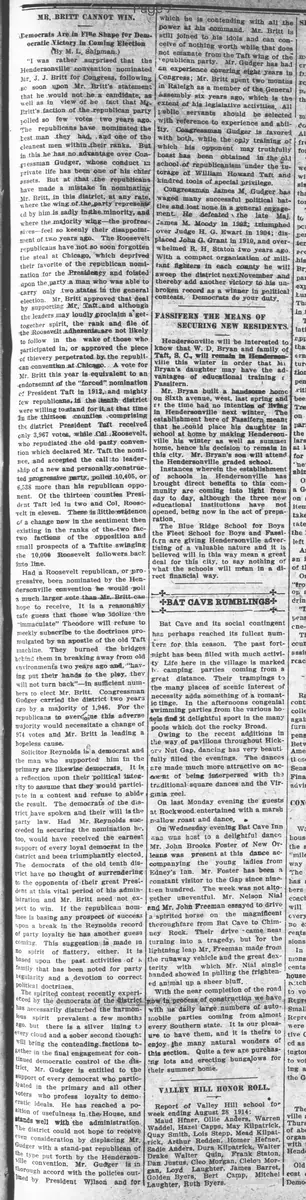
Democrats Are in Fine Shape for Democratic Victory in Coming Election
(By M. L. Shipman.)
"I was rather surprised that the Hendersonville convention nominated Mr. J. J. Britt for Congress, following so soon upon Mr. Britt's statement that he would not be a candidate, as well as in view of the fact that Britt's faction of the republican party rolled so few votes two years ago.
The republicans have nominated the best man they had, and one of the cleanest men within their ranks. But in this he has no advantage over Congressman Gudger, whose conduct in private life has been one of his chief assets. But at that the republicans have made a mistake in nominating Mr. Britt, in this district, at any rate, where the wing of the party represented by him is sadly in the minority, and where the majority wing-the progressives-feel so keenly their disappointment of two years ago. The Roosevelt republicans have not so soon forgotten the steal at Chicago, which deprived their favorite of the republican nomination for the Presidency and foisted upon the party a man who was able to carry only two states in the general election. Mr. Britt approved that deal by supporting Mr. Taft and although the leaders may loudly proclaim a get-together spirit, the rank and file of the Roosevelt adherents are not likely to follow in the wake of those who participated in, or approved the piece of thievery perpetrated by the republican convention at Chicago. A vote for Mr. Britt this year is equivalent to an endorsement of the "forced" nomination of President Taft in 1912, and mighty few republicans, in the tenth district were willing to stand for it at that time.
In the thirteen counties comprising the district President Taft received only 3,967 votes, while Col. Roosevelt, who repudiated the old party convention which declared Mr. Taft the nominee, and accepted the call to leadership of a new and personally constructed progressive party, polled 10,405, or 6,538 more than his republican opponent. Of the thirteen counties President Taft led in two and Col. Roosevelt in eleven. There is little evidence of a change now in the sentiment then existing in the ranks of the two factions of the opposition and small prospects of a Taftite swinging the 10,000 Roosevelt followers back into line.
Had a Roosevelt republican, or progressive, been nominated by the Hendersonville convention he would poll a much larger vote than Mr. Britt can hope to receive. It is a reasonably safe guess that those who idolize the "immaculate" Theodore will refuse to meekly subscribe to the doctrines promulgated by an apostle of the old Taft machine. They burned the bridges behind them in breaking away from old environments two years ago and "having put their hands to the plow, they will not turn back"—in sufficient numbers to elect Mr. Britt. Congressman Gudger carried the district two years ago by a majority of 1,946. For the republicans to overcome this adverse majority would necessitate a change of 974 votes and Mr. Britt is leading a hopeless cause.
Solicitor Reynolds is a democrat and the men who supported him in the primary are likewise democrats. It is a reflection upon their political integrity to assume that they would participate in a contest and refuse to abide the result. The democrats of the district have spoken and their will is the party law. Had Mr. Reynolds succeeded in securing the nomination he, too, would have received the earnest support of every loyal democrat in the district and been triumphantly elected. The democrats of the old tenth district have no thought of surrendering to the opponents of their great President at this vital period of his administration and Mr. Britt need not expect to win. If the republican nominee is basing any prospect of success upon a break in the Reynolds record of party loyalty he has another guess coming. This suggestion is made in no spirit of flattery, either. It is based upon the past activities of a family that has been noted for party regularity and a devotion to correct political doctrines.
The spirited contest recently experienced by the democrats of the district has necessarily disturbed the harmonious spirit prevalent a few months ago, but there is a silver lining to every cloud and a sober second thought will bring the contending factions together in the final engagement for continued democratic control of the district. Mr. Gudger is entitled to the support of every democrat who participated in the primary and all other voters who profess loyalty to democratic ideals. He has reached a position of usefulness in the House, and stands well with the administration.
The district could not hope to receive even consideration by displacing Mr. Gudger with a stand-pat republican of the type put forth by the Hendersonville convention. Mr. Gudger is in thorough accord with the policies outlined by President Wilson and for which he is contending with all the power at his command. Mr. Britt is still joined to his idols and can conceive of nothing worth while that does not emanate from the Taft wing of the republican party. Mr. Gudger has had an experience covering eight years in Congress; Mr. Britt spent two months in Raleigh as a member of the General Assembly six years ago, which is the extent of his legislative activities. All public servants should be selected with reference to experience and ability. Congressman Gudger is favored with both, while the only training of which his opponent may truthfully boast has been obtained in the old school of republicanism under the tutelage of William Howard Taft and kindred tools of special privilege.
Congressman James M. Gudger has waged many successful political battles and lost none in a general engagement. He defeated the late Maj. James M. Moody in 1902; triumphed over Judge H. G. Ewart in 1904; displaced John G. Grant in 1910, and overwhelmed R. H. Staton two years ago. With a compact organization of militant fighters in each county he will sweep the district next November and thereby add another victory to his unbroken record as a winner in political contests. Democrats do your duty.
What sub-type of article is it?
What keywords are associated?
What entities or persons were involved?
Where did it happen?
Story Details
Key Persons
Location
Tenth District, Hendersonville
Event Date
Next November, Two Years Ago
Story Details
Opinion piece arguing that Republican nominee J.J. Britt cannot win the congressional election in the tenth district against incumbent Democrat Gudger due to lingering divisions from the 1912 Republican convention favoring Taft over Roosevelt, weak Republican support, and strong Democratic unity and loyalty following their primary.