Thank you for visiting SNEWPapers!
Sign up free
Story
May 18, 1879
Daily Los Angeles Herald
Los Angeles, Los Angeles County, California
What is this article about?
The article warns of the increasing opium abuse in the United States, especially among women of the upper classes, often initiated by physicians' prescriptions. It attributes the habit to Chinese influence and medical practices, deems it incurable, and urges legal restrictions and medical caution to curb the vice.
Clipping
OCR Quality
95%
Excellent
Full Text
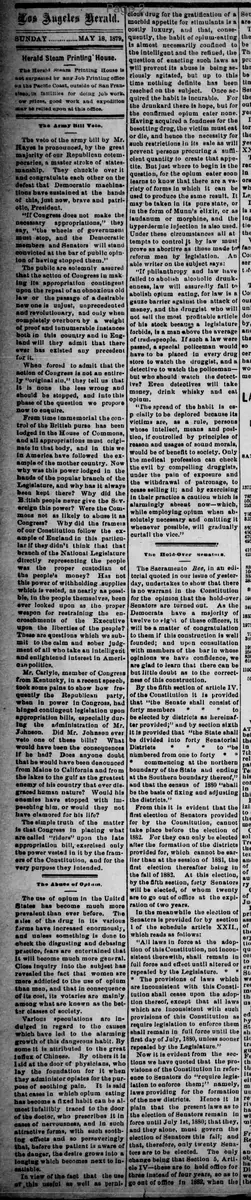
The Abuse of Opium.
The use of opium in the United States has become much more prevalent than ever before. The sales of the drug in its various forms have increased enormously, and unless something is done to check the disgusting and debasing practice, fears are entertained that it will become much more general.
Close inquiry into the subject has revealed the fact that women are more addicted to the use of opium than men, and that in consequence of its cost, its votaries are mainly among what are known as the better classes of society.
Various speculations are indulged in regard to the causes which have led to the alarming growth of this dangerous habit. By some it is attributed to the great influx of Chinese. By others it is laid at the door of physicians, who lay the foundation for it when they administer opiates for the purpose of soothing pain. It is said that cases in which opium eating has become a fixed habit can be almost infallibly traced to the door of the doctor, who prescribes it in cases of nervousness, and in such attractive forms, with such soothing effects and so perseveringly that, before the patient is aware of the danger, the desire grows into a longing which becomes next to insatiable.
In view of the fact that the use of this useful as well as pernicious drug for the gratification of a morbid appetite for stimulants is a costly luxury, and that, consequently, the habit of opium-eating is almost necessarily confined to the intelligent and the refined, the question of enacting such laws as will prevent its abuse is being seriously agitated, but up to this time nothing definite has been reached on the subject.
Once acquired the habit is incurable. For the drunkard there is hope, but for the confirmed opium eater none. Having acquired a fondness for the besotting drug, the victim must eat or die, and hence the necessity for such restrictions in its sale as will prevent persons procuring a sufficient quantity to create that appetite. But just where to begin is the question, for the opium eater soon learns to know that there are a variety of forms in which it can be used to produce the same result. It may be taken in its pure state, or in the form of laudanum or morphine, and the hypodermic injection is also used.
Under these circumstances all attempts to control it by law must prove as abortive as those made to reform men by legislation. An able writer on the subject says: "If philanthropy and law have failed to abolish alcoholic drunkenness, law will assuredly fail to abolish opium eating, for law is a gauze barrier against the attack of money, and the druggist who will not sell the most profitable article of his stock because a legislature forbids, is a man above the average of tradespeople. If such a law were passed, a special policeman would have to be placed in every drug store to watch the druggist, and a detective to watch the policeman-but who should watch the detective? Even detectives will take money, drink whisky and eat opium."
The spread of the habit is especially to be deplored because its victims are, as a rule, persons whose intellect, means and position, if controlled by principles of reason and usages of sound morals, would be of benefit to society. Only the medical profession can check the evil by compelling druggists, under the pain of exposure and the withdrawal of patronage, to cease selling it; and by exercising in their practice a caution which is alarmingly absent now-which while employing opium when absolutely necessary and omitting it whenever possible, will gradually curtail the vice.
The use of opium in the United States has become much more prevalent than ever before. The sales of the drug in its various forms have increased enormously, and unless something is done to check the disgusting and debasing practice, fears are entertained that it will become much more general.
Close inquiry into the subject has revealed the fact that women are more addicted to the use of opium than men, and that in consequence of its cost, its votaries are mainly among what are known as the better classes of society.
Various speculations are indulged in regard to the causes which have led to the alarming growth of this dangerous habit. By some it is attributed to the great influx of Chinese. By others it is laid at the door of physicians, who lay the foundation for it when they administer opiates for the purpose of soothing pain. It is said that cases in which opium eating has become a fixed habit can be almost infallibly traced to the door of the doctor, who prescribes it in cases of nervousness, and in such attractive forms, with such soothing effects and so perseveringly that, before the patient is aware of the danger, the desire grows into a longing which becomes next to insatiable.
In view of the fact that the use of this useful as well as pernicious drug for the gratification of a morbid appetite for stimulants is a costly luxury, and that, consequently, the habit of opium-eating is almost necessarily confined to the intelligent and the refined, the question of enacting such laws as will prevent its abuse is being seriously agitated, but up to this time nothing definite has been reached on the subject.
Once acquired the habit is incurable. For the drunkard there is hope, but for the confirmed opium eater none. Having acquired a fondness for the besotting drug, the victim must eat or die, and hence the necessity for such restrictions in its sale as will prevent persons procuring a sufficient quantity to create that appetite. But just where to begin is the question, for the opium eater soon learns to know that there are a variety of forms in which it can be used to produce the same result. It may be taken in its pure state, or in the form of laudanum or morphine, and the hypodermic injection is also used.
Under these circumstances all attempts to control it by law must prove as abortive as those made to reform men by legislation. An able writer on the subject says: "If philanthropy and law have failed to abolish alcoholic drunkenness, law will assuredly fail to abolish opium eating, for law is a gauze barrier against the attack of money, and the druggist who will not sell the most profitable article of his stock because a legislature forbids, is a man above the average of tradespeople. If such a law were passed, a special policeman would have to be placed in every drug store to watch the druggist, and a detective to watch the policeman-but who should watch the detective? Even detectives will take money, drink whisky and eat opium."
The spread of the habit is especially to be deplored because its victims are, as a rule, persons whose intellect, means and position, if controlled by principles of reason and usages of sound morals, would be of benefit to society. Only the medical profession can check the evil by compelling druggists, under the pain of exposure and the withdrawal of patronage, to cease selling it; and by exercising in their practice a caution which is alarmingly absent now-which while employing opium when absolutely necessary and omitting it whenever possible, will gradually curtail the vice.
What sub-type of article is it?
Curiosity
Medical Curiosity
What themes does it cover?
Moral Virtue
Misfortune
What keywords are associated?
Opium Abuse
Addiction
United States
Women
Physicians
Chinese Influence
Medical Caution
Where did it happen?
United States
Story Details
Location
United States
Story Details
Rising opium use in the US, particularly among affluent women, often started by doctors' prescriptions; habit is incurable and costly; calls for laws and medical restraint to prevent abuse.