Thank you for visiting SNEWPapers!
Sign up free
Story
February 14, 1850
The Daily Union
Washington, District Of Columbia
What is this article about?
US Senate debates slavery controversy; General Foote proposes committee of 15 to settle issues, inspired by Clay's Missouri compromise. Jefferson Davis argues against Clay's resolutions amid fears for the Union.
Clipping
OCR Quality
100%
Excellent
Full Text
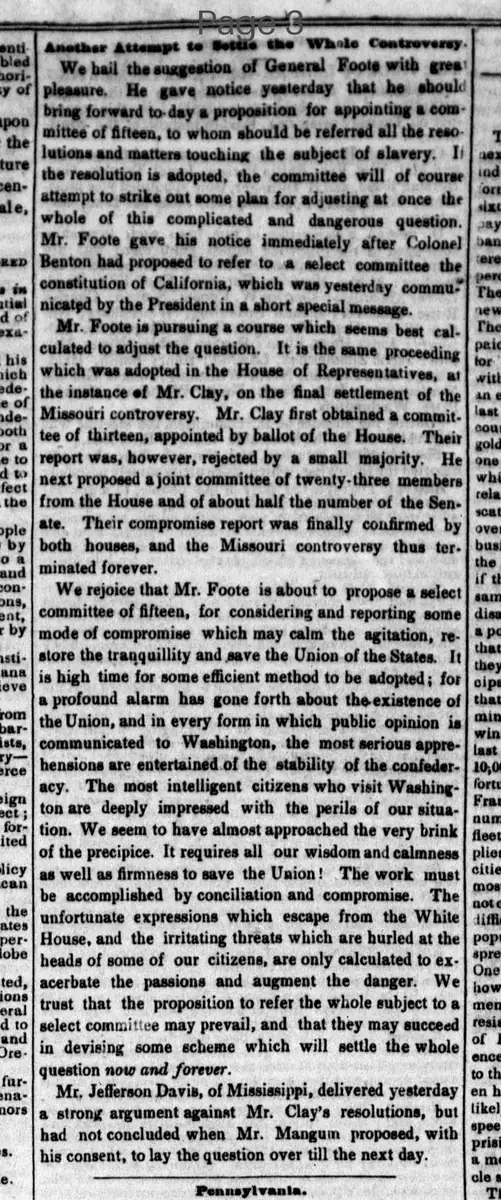
Another Attempt to Settle the Whole Controversy
We hail the suggestion of General Foote with great pleasure. He gave notice yesterday that he should bring forward to-day a proposition for appointing a committee of fifteen, to whom should be referred all the resolutions and matters touching the subject of slavery. If the resolution is adopted, the committee will of course attempt to strike out some plan for adjusting at once the whole of this complicated and dangerous question.
Mr. Foote gave his notice immediately after Colonel Benton had proposed to refer to a select committee the constitution of California, which was yesterday communicated by the President in a short special message.
Mr. Foote is pursuing a course which seems best calculated to adjust the question. It is the same proceeding which was adopted in the House of Representatives, at the instance of Mr. Clay, on the final settlement of the Missouri controversy. Mr. Clay first obtained a committee of thirteen, appointed by ballot of the House. Their report was, however, rejected by a small majority. He next proposed a joint committee of twenty-three members from the House and of about half the number of the Senate. Their compromise report was finally confirmed by both houses, and the Missouri controversy thus terminated forever.
We rejoice that Mr. Foote is about to propose a select committee of fifteen, for considering and reporting some mode of compromise which may calm the agitation, restore the tranquillity and save the Union of the States. It is high time for some efficient method to be adopted; for a profound alarm has gone forth about the existence of the Union, and in every form in which public opinion is communicated to Washington, the most serious apprehensions are entertained of the stability of the confederacy. The most intelligent citizens who visit Washington are deeply impressed with the perils of our situation. We seem to have almost approached the very brink of the precipice. It requires all our wisdom and calmness as well as firmness to save the Union! The work must be accomplished by conciliation and compromise. The unfortunate expressions which escape from the White House, and the irritating threats which are hurled at the heads of some of our citizens, are only calculated to exacerbate the passions and augment the danger. We trust that the proposition to refer the whole subject to a select committee may prevail, and that they may succeed in devising some scheme which will settle the whole question now and forever.
Mr. Jefferson Davis, of Mississippi, delivered yesterday a strong argument against Mr. Clay's resolutions, but had not concluded when Mr. Mangum proposed, with his consent, to lay the question over till the next day.
We hail the suggestion of General Foote with great pleasure. He gave notice yesterday that he should bring forward to-day a proposition for appointing a committee of fifteen, to whom should be referred all the resolutions and matters touching the subject of slavery. If the resolution is adopted, the committee will of course attempt to strike out some plan for adjusting at once the whole of this complicated and dangerous question.
Mr. Foote gave his notice immediately after Colonel Benton had proposed to refer to a select committee the constitution of California, which was yesterday communicated by the President in a short special message.
Mr. Foote is pursuing a course which seems best calculated to adjust the question. It is the same proceeding which was adopted in the House of Representatives, at the instance of Mr. Clay, on the final settlement of the Missouri controversy. Mr. Clay first obtained a committee of thirteen, appointed by ballot of the House. Their report was, however, rejected by a small majority. He next proposed a joint committee of twenty-three members from the House and of about half the number of the Senate. Their compromise report was finally confirmed by both houses, and the Missouri controversy thus terminated forever.
We rejoice that Mr. Foote is about to propose a select committee of fifteen, for considering and reporting some mode of compromise which may calm the agitation, restore the tranquillity and save the Union of the States. It is high time for some efficient method to be adopted; for a profound alarm has gone forth about the existence of the Union, and in every form in which public opinion is communicated to Washington, the most serious apprehensions are entertained of the stability of the confederacy. The most intelligent citizens who visit Washington are deeply impressed with the perils of our situation. We seem to have almost approached the very brink of the precipice. It requires all our wisdom and calmness as well as firmness to save the Union! The work must be accomplished by conciliation and compromise. The unfortunate expressions which escape from the White House, and the irritating threats which are hurled at the heads of some of our citizens, are only calculated to exacerbate the passions and augment the danger. We trust that the proposition to refer the whole subject to a select committee may prevail, and that they may succeed in devising some scheme which will settle the whole question now and forever.
Mr. Jefferson Davis, of Mississippi, delivered yesterday a strong argument against Mr. Clay's resolutions, but had not concluded when Mr. Mangum proposed, with his consent, to lay the question over till the next day.
What sub-type of article is it?
Historical Event
What themes does it cover?
Justice
Survival
What keywords are associated?
Slavery Controversy
Senate Committee
Missouri Compromise
Union Preservation
Political Debate
What entities or persons were involved?
General Foote
Colonel Benton
Mr. Clay
Mr. Jefferson Davis
Mr. Mangum
Where did it happen?
Washington
Story Details
Key Persons
General Foote
Colonel Benton
Mr. Clay
Mr. Jefferson Davis
Mr. Mangum
Location
Washington
Story Details
General Foote proposes a Senate committee of fifteen to resolve the slavery controversy, drawing on Henry Clay's successful Missouri compromise approach. Jefferson Davis argues against Clay's resolutions as fears mount for the Union's stability.