Thank you for visiting SNEWPapers!
Sign up free
Story
January 10, 1929
Watauga Democrat
Boone, Watauga County, North Carolina
What is this article about?
In 1929, global scientific efforts target the common cold's causes, emphasizing temperature changes. Chicago launches a 'No Cold' campaign amid $20M annual losses, while research at Johns Hopkins and elsewhere explores prevention and links to respiratory diseases.
Clipping
OCR Quality
98%
Excellent
Full Text
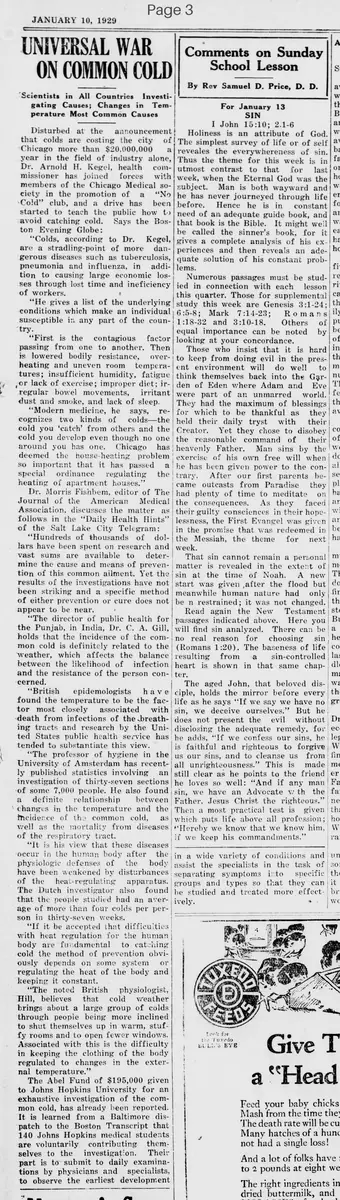
JANUARY 10, 1929
UNIVERSAL WAR ON COMMON COLD
Scientists in All Countries Investigating Causes; Changes in Temperature Most Common Causes.
Disturbed at the announcement that colds are costing the city of Chicago more than $20,000,000 a year in the field of industry alone, Dr. Arnold H. Kegel, health commissioner has joined forces with members of the Chicago Medical society in the promotion of a "No Cold" club, and a drive has been started to teach the public how to avoid catching cold. Says the Boston Evening Globe:
"Colds, according to Dr. Kegel, are a starting-point of more dangerous diseases such as tuberculosis, pneumonia and influenza, in addition to causing large economic losses through lost time and inefficiency of workers.
"He gives a list of the underlying conditions which make an individual susceptible in any part of the country.
"First is the contagious factor passing from one to another. Then is lowered bodily resistance, overheating and uneven room temperatures; insufficient humidity, fatigue or lack of exercise; improper diet; irregular bowel movements, irritant dust and smoke, and lack of sleep.
"Modern medicine, he says, recognizes two kinds of colds-the cold you catch from others and the cold you develop even though no one around you has one. Chicago has deemed the house-heating problem so important that it has passed a special ordinance regulating the heating of apartment houses."
Dr. Morris Fishbein, editor of The Journal of the American Medical Association, discusses the matter as follows in the "Daily Health Hints" of the Salt Lake City Telegram:
"Hundreds of thousands of dollars have been spent on research and vast sums are available to determine the cause and means of prevention of this common ailment. Yet the results of the investigations have not been striking and a specific method of either prevention or cure does not appear to be near.
"The director of public health for the Punjab, in India, Dr. C. A. Gill, holds that the incidence of the common cold is definitely related to the weather, which affects the balance between the likelihood of infection and the resistance of the person concerned.
"British epidemiologists have found the temperature to be the factor most closely associated with death from infections of the breathing tracts and research by the United States public health service has tended to substantiate this view.
"The professor of hygiene in the University of Amsterdam has recently published statistics involving an investigation of thirty-seven sections of some 7,000 people. He also found a definite relationship between changes in the temperature and the incidence of the common cold, as well as the mortality from diseases of the respiratory tract.
"It is his view that these diseases occur in the human body after the physiologic defenses of the body have been weakened by disturbances of the heat-regulating apparatus.
The Dutch investigator also found that the people studied had an average of more than four colds per person in thirty-seven weeks.
"If it be accepted that difficulties with heat regulation for the human body are fundamental to catching cold the method of prevention obviously depends on some system of regulating the heat of the body and keeping it constant.
"The noted British physiologist, Hill, believes that cold weather brings about a large group of colds through people being more inclined to shut themselves up in warm, stuffy rooms and to open fewer windows. Associated with this is the difficulty in keeping the clothing of the body regulated to changes in the external temperature."
The Abel Fund of $195,000 given to Johns Hopkins University for an exhaustive investigation of the common cold, has already been reported. It is learned from a Baltimore dispatch to the Boston Transcript that 140 Johns Hopkins medical students are voluntarily contributing themselves to the investigation. Their part is to submit to daily examinations by physicians and specialists, to observe the earliest development in a wide variety of conditions and assist the specialists in the task of separating symptoms into specific groups and types so that they can be studied and treated more effectively.
UNIVERSAL WAR ON COMMON COLD
Scientists in All Countries Investigating Causes; Changes in Temperature Most Common Causes.
Disturbed at the announcement that colds are costing the city of Chicago more than $20,000,000 a year in the field of industry alone, Dr. Arnold H. Kegel, health commissioner has joined forces with members of the Chicago Medical society in the promotion of a "No Cold" club, and a drive has been started to teach the public how to avoid catching cold. Says the Boston Evening Globe:
"Colds, according to Dr. Kegel, are a starting-point of more dangerous diseases such as tuberculosis, pneumonia and influenza, in addition to causing large economic losses through lost time and inefficiency of workers.
"He gives a list of the underlying conditions which make an individual susceptible in any part of the country.
"First is the contagious factor passing from one to another. Then is lowered bodily resistance, overheating and uneven room temperatures; insufficient humidity, fatigue or lack of exercise; improper diet; irregular bowel movements, irritant dust and smoke, and lack of sleep.
"Modern medicine, he says, recognizes two kinds of colds-the cold you catch from others and the cold you develop even though no one around you has one. Chicago has deemed the house-heating problem so important that it has passed a special ordinance regulating the heating of apartment houses."
Dr. Morris Fishbein, editor of The Journal of the American Medical Association, discusses the matter as follows in the "Daily Health Hints" of the Salt Lake City Telegram:
"Hundreds of thousands of dollars have been spent on research and vast sums are available to determine the cause and means of prevention of this common ailment. Yet the results of the investigations have not been striking and a specific method of either prevention or cure does not appear to be near.
"The director of public health for the Punjab, in India, Dr. C. A. Gill, holds that the incidence of the common cold is definitely related to the weather, which affects the balance between the likelihood of infection and the resistance of the person concerned.
"British epidemiologists have found the temperature to be the factor most closely associated with death from infections of the breathing tracts and research by the United States public health service has tended to substantiate this view.
"The professor of hygiene in the University of Amsterdam has recently published statistics involving an investigation of thirty-seven sections of some 7,000 people. He also found a definite relationship between changes in the temperature and the incidence of the common cold, as well as the mortality from diseases of the respiratory tract.
"It is his view that these diseases occur in the human body after the physiologic defenses of the body have been weakened by disturbances of the heat-regulating apparatus.
The Dutch investigator also found that the people studied had an average of more than four colds per person in thirty-seven weeks.
"If it be accepted that difficulties with heat regulation for the human body are fundamental to catching cold the method of prevention obviously depends on some system of regulating the heat of the body and keeping it constant.
"The noted British physiologist, Hill, believes that cold weather brings about a large group of colds through people being more inclined to shut themselves up in warm, stuffy rooms and to open fewer windows. Associated with this is the difficulty in keeping the clothing of the body regulated to changes in the external temperature."
The Abel Fund of $195,000 given to Johns Hopkins University for an exhaustive investigation of the common cold, has already been reported. It is learned from a Baltimore dispatch to the Boston Transcript that 140 Johns Hopkins medical students are voluntarily contributing themselves to the investigation. Their part is to submit to daily examinations by physicians and specialists, to observe the earliest development in a wide variety of conditions and assist the specialists in the task of separating symptoms into specific groups and types so that they can be studied and treated more effectively.
What sub-type of article is it?
Medical Curiosity
Curiosity
What themes does it cover?
Recovery
Misfortune
What keywords are associated?
Common Cold
Medical Research
Temperature Changes
Prevention
Public Health
Economic Loss
What entities or persons were involved?
Dr. Arnold H. Kegel
Dr. Morris Fishbein
Dr. C. A. Gill
Hill
Where did it happen?
Chicago; Punjab, India; Amsterdam; Baltimore
Story Details
Key Persons
Dr. Arnold H. Kegel
Dr. Morris Fishbein
Dr. C. A. Gill
Hill
Location
Chicago; Punjab, India; Amsterdam; Baltimore
Event Date
1929
Story Details
Scientists globally investigate common cold causes, linking it to temperature changes and susceptibility factors. Chicago promotes 'No Cold' club and heating regulations to prevent economic losses and serious diseases. Research funded at Johns Hopkins involves student volunteers for symptom studies.