Thank you for visiting SNEWPapers!
Sign up free
Editorial
October 14, 1909
Fort Mill Times
Fort Mill, York County, South Carolina
What is this article about?
Editorial advocates for South Carolina legislation to regulate electric power rates charged by the Southern Power Company, warning of potential monopoly-driven price hikes under leader Duke, who is criticized for tobacco trust practices. Compares to regulation of other utilities.
Clipping
OCR Quality
98%
Excellent
Full Text
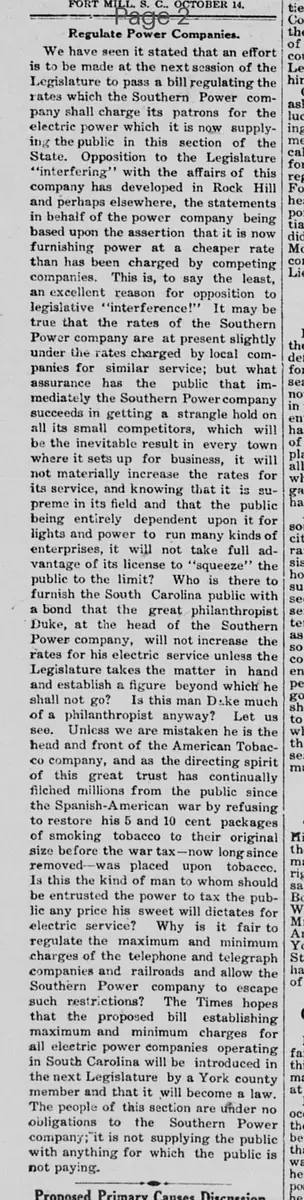
Regulate Power Companies.
We have seen it stated that an effort is to be made at the next session of the Legislature to pass a bill regulating the rates which the Southern Power company shall charge its patrons for the electric power which it is now supplying the public in this section of the State. Opposition to the Legislature "interfering" with the affairs of this company has developed in Rock Hill and perhaps elsewhere, the statements in behalf of the power company being based upon the assertion that it is now furnishing power at a cheaper rate than has been charged by competing companies. This is, to say the least, an excellent reason for opposition to legislative "interference!" It may be true that the rates of the Southern Power company are at present slightly under the rates charged by local companies for similar service; but what assurance has the public that immediately the Southern Power company succeeds in getting a strangle hold on all its small competitors, which will be the inevitable result in every town where it sets up for business, it will not materially increase the rates for its service, and knowing that it is supreme in its field and that the public being entirely dependent upon it for lights and power to run many kinds of enterprises, it will not take full advantage of its license to "squeeze" the public to the limit? Who is there to furnish the South Carolina public with a bond that the great philanthropist Duke, at the head of the Southern Power company, will not increase the rates for his electric service unless the Legislature takes the matter in hand and establishes a figure beyond which he shall not go? Is this man Duke much of a philanthropist anyway? Let us see. Unless we are mistaken he is the head and front of the American Tobacco company, and as the directing spirit of this great trust has continually filched millions from the public since the Spanish-American war by refusing to restore his 5 and 10 cent packages of smoking tobacco to their original size before the war tax-now long since removed--was placed upon tobacco. Is this the kind of man to whom should be entrusted the power to tax the public any price his sweet will dictates for electric service? Why is it fair to regulate the maximum and minimum charges of the telephone and telegraph companies and railroads and allow the Southern Power company to escape such restrictions? The Times hopes that the proposed bill establishing maximum and minimum charges for all electric power companies operating in South Carolina will be introduced in the next Legislature by a York county member and that it will become a law. The people of this section are under no obligations to the Southern Power company; it is not supplying the public with anything for which the public is not paying.
We have seen it stated that an effort is to be made at the next session of the Legislature to pass a bill regulating the rates which the Southern Power company shall charge its patrons for the electric power which it is now supplying the public in this section of the State. Opposition to the Legislature "interfering" with the affairs of this company has developed in Rock Hill and perhaps elsewhere, the statements in behalf of the power company being based upon the assertion that it is now furnishing power at a cheaper rate than has been charged by competing companies. This is, to say the least, an excellent reason for opposition to legislative "interference!" It may be true that the rates of the Southern Power company are at present slightly under the rates charged by local companies for similar service; but what assurance has the public that immediately the Southern Power company succeeds in getting a strangle hold on all its small competitors, which will be the inevitable result in every town where it sets up for business, it will not materially increase the rates for its service, and knowing that it is supreme in its field and that the public being entirely dependent upon it for lights and power to run many kinds of enterprises, it will not take full advantage of its license to "squeeze" the public to the limit? Who is there to furnish the South Carolina public with a bond that the great philanthropist Duke, at the head of the Southern Power company, will not increase the rates for his electric service unless the Legislature takes the matter in hand and establishes a figure beyond which he shall not go? Is this man Duke much of a philanthropist anyway? Let us see. Unless we are mistaken he is the head and front of the American Tobacco company, and as the directing spirit of this great trust has continually filched millions from the public since the Spanish-American war by refusing to restore his 5 and 10 cent packages of smoking tobacco to their original size before the war tax-now long since removed--was placed upon tobacco. Is this the kind of man to whom should be entrusted the power to tax the public any price his sweet will dictates for electric service? Why is it fair to regulate the maximum and minimum charges of the telephone and telegraph companies and railroads and allow the Southern Power company to escape such restrictions? The Times hopes that the proposed bill establishing maximum and minimum charges for all electric power companies operating in South Carolina will be introduced in the next Legislature by a York county member and that it will become a law. The people of this section are under no obligations to the Southern Power company; it is not supplying the public with anything for which the public is not paying.
What sub-type of article is it?
Economic Policy
Legal Reform
What keywords are associated?
Power Regulation
Southern Power Company
Electric Rates
Legislative Bill
Monopoly Concerns
Duke Tobacco Trust
What entities or persons were involved?
Southern Power Company
Duke
American Tobacco Company
South Carolina Legislature
York County Member
Editorial Details
Primary Topic
Regulation Of Electric Power Company Rates
Stance / Tone
Advocacy For Legislative Rate Regulation
Key Figures
Southern Power Company
Duke
American Tobacco Company
South Carolina Legislature
York County Member
Key Arguments
Current Low Rates May Rise After Eliminating Competitors And Gaining Monopoly
Duke's Tobacco Trust History Shows Exploitation Of Public
Public Needs Protection Via Legislative Maximum Rates
Other Utilities Like Railroads And Telephones Are Regulated
No Obligation To Unregulated Power Company