Thank you for visiting SNEWPapers!
Sign up free
Editorial
July 12, 1827
The Wilmingtonian, And Delaware Advertiser
Wilmington, New Castle County, Delaware
What is this article about?
This editorial reflects on the necessity of labor for true happiness, warning that idleness breeds misery and decay, as seen in retirees. It advises tempering the wish for long life with submission to God's will, as extended years may bring prolonged suffering, loss, and isolation.
Clipping
OCR Quality
98%
Excellent
Full Text
LONG LIFE.
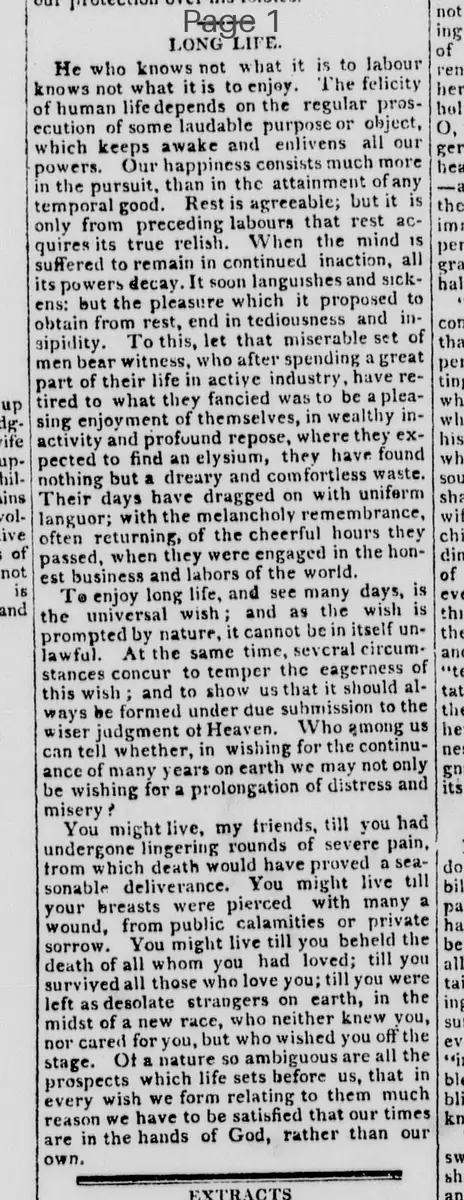
He who knows not what it is to labour knows not what it is to enjoy. The felicity of human life depends on the regular prosecution of some laudable purpose or object, which keeps awake and enlivens all our powers. Our happiness consists much more in the pursuit, than in the attainment of any temporal good. Rest is agreeable; but it is only from preceding labours that rest acquires its true relish. When the mind is suffered to remain in continued inaction, all its powers decay. It soon languishes and sickens: but the pleasure which it proposed to obtain from rest, end in tediousness and insipidity. To this, let that miserable set of men bear witness, who after spending a great part of their life in active industry, have retired to what they fancied was to be a pleasing enjoyment of themselves, in wealthy inactivity and profound repose, where they expected to find an elysium, they have found nothing but a dreary and comfortless waste. Their days have dragged on with uniform languor; with the melancholy remembrance, often returning, of the cheerful hours they passed, when they were engaged in the honest business and labors of the world.
To enjoy long life, and see many days, is the universal wish; and as the wish is prompted by nature, it cannot be in itself unlawful. At the same time, several circumstances concur to temper the eagerness of this wish; and to show us that it should always be formed under due submission to the wiser judgment of Heaven. Who among us can tell whether, in wishing for the continuance of many years on earth we may not only be wishing for a prolongation of distress and misery?
You might live, my friends, till you had undergone lingering rounds of severe pain, from which death would have proved a seasonable deliverance. You might live till your breasts were pierced with many a wound, from public calamities or private sorrow. You might live till you beheld the death of all whom you had loved; till you survived all those who love you; till you were left as desolate strangers on earth, in the midst of a new race, who neither knew you, nor cared for you, but who wished you off the stage. Of a nature so ambiguous are all the prospects which life sets before us, that in every wish we form relating to them much reason we have to be satisfied that our times are in the hands of God, rather than our own.
He who knows not what it is to labour knows not what it is to enjoy. The felicity of human life depends on the regular prosecution of some laudable purpose or object, which keeps awake and enlivens all our powers. Our happiness consists much more in the pursuit, than in the attainment of any temporal good. Rest is agreeable; but it is only from preceding labours that rest acquires its true relish. When the mind is suffered to remain in continued inaction, all its powers decay. It soon languishes and sickens: but the pleasure which it proposed to obtain from rest, end in tediousness and insipidity. To this, let that miserable set of men bear witness, who after spending a great part of their life in active industry, have retired to what they fancied was to be a pleasing enjoyment of themselves, in wealthy inactivity and profound repose, where they expected to find an elysium, they have found nothing but a dreary and comfortless waste. Their days have dragged on with uniform languor; with the melancholy remembrance, often returning, of the cheerful hours they passed, when they were engaged in the honest business and labors of the world.
To enjoy long life, and see many days, is the universal wish; and as the wish is prompted by nature, it cannot be in itself unlawful. At the same time, several circumstances concur to temper the eagerness of this wish; and to show us that it should always be formed under due submission to the wiser judgment of Heaven. Who among us can tell whether, in wishing for the continuance of many years on earth we may not only be wishing for a prolongation of distress and misery?
You might live, my friends, till you had undergone lingering rounds of severe pain, from which death would have proved a seasonable deliverance. You might live till your breasts were pierced with many a wound, from public calamities or private sorrow. You might live till you beheld the death of all whom you had loved; till you survived all those who love you; till you were left as desolate strangers on earth, in the midst of a new race, who neither knew you, nor cared for you, but who wished you off the stage. Of a nature so ambiguous are all the prospects which life sets before us, that in every wish we form relating to them much reason we have to be satisfied that our times are in the hands of God, rather than our own.
What sub-type of article is it?
Moral Or Religious
What keywords are associated?
Labor
Happiness
Idleness
Long Life
Misery
Divine Will
Virtue
What entities or persons were involved?
God
Editorial Details
Primary Topic
Virtue Of Labor And Ambiguity Of Long Life
Stance / Tone
Moral Exhortation
Key Figures
God
Key Arguments
Happiness Derives From Pursuing Laudable Purposes Rather Than Idleness
Rest Is Relished Only After Labor
Idleness Causes Mental Decay And Misery, As Evidenced By Retirees
Wishing For Long Life Is Natural But Must Submit To Divine Will
Long Life May Prolong Suffering, Sorrow, And Isolation