Thank you for visiting SNEWPapers!
Sign up free
The Columbia Herald
Columbia, Maury County, Tennessee
What is this article about?
The New York Shipping List discusses the potential impacts of a European war involving France, Prussia, and possibly Spain on U.S. commerce, predicting crippled trade, limited benefits from food exports, and no advantages for the American merchant marine due to the 1856 Treaty of Paris, which the U.S. did not join.
Clipping
OCR Quality
Full Text
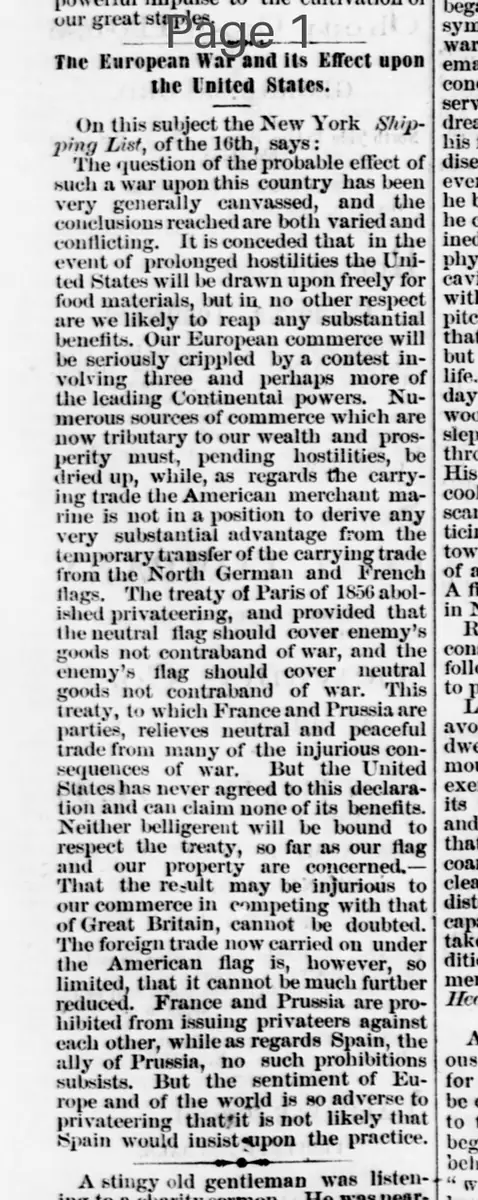
On this subject the New York Shipping List, of the 16th, says:
The question of the probable effect of such a war upon this country has been very generally canvassed, and the conclusions reached are both varied and conflicting. It is conceded that in the event of prolonged hostilities the United States will be drawn upon freely for food materials, but in no other respect are we likely to reap any substantial benefits. Our European commerce will be seriously crippled by a contest involving three and perhaps more of the leading Continental powers. Numerous sources of commerce which are now tributary to our wealth and prosperity must, pending hostilities, be dried up, while, as regards the carrying trade the American merchant marine is not in a position to derive any very substantial advantage from the temporary transfer of the carrying trade from the North German and French flags. The treaty of Paris of 1856 abolished privateering, and provided that the neutral flag should cover enemy's goods not contraband of war, and the enemy's flag should cover neutral goods not contraband of war. This treaty, to which France and Prussia are parties, relieves neutral and peaceful trade from many of the injurious consequences of war.
But the United States has never agreed to this declaration and can claim none of its benefits. Neither belligerent will be bound to respect the treaty, so far as our flag and our property are concerned. That the result may be injurious to our commerce in competing with that of Great Britain, cannot be doubted. The foreign trade now carried on under the American flag is, however, so limited, that it cannot be much further reduced. France and Prussia are prohibited from issuing privateers against each other, while as regards Spain, the ally of Prussia, no such prohibitions subsists. But the sentiment of Europe and of the world is so adverse to privateering that it is not likely that Spain would insist upon the practice.
What sub-type of article is it?
What keywords are associated?
Where did it happen?
Foreign News Details
Primary Location
Europe
Outcome
united states european commerce will be seriously crippled; limited benefits from food material exports; american merchant marine unlikely to gain substantial advantage; potential injury from privateering as u.s. not party to 1856 treaty of paris.
Event Details
The New York Shipping List analyzes the probable effects of prolonged European hostilities involving leading Continental powers like France and Prussia on the United States, noting varied conclusions but conceding draws on food materials while commerce is crippled, sources of wealth dried up, and limited carrying trade benefits due to the American merchant marine's position. The 1856 Treaty of Paris, abolishing privateering and protecting neutral goods, applies to France and Prussia but not the U.S., potentially harming American commerce compared to Britain's. Foreign trade under American flag is already limited. Spain, Prussia's ally, faces no privateering prohibition but unlikely to pursue it.