Thank you for visiting SNEWPapers!
Sign up free
The Sun
New York, New York County, New York
What is this article about?
During the cross-examination of Senator Allds in his bribery trial, prosecutor James W. Osborne questions suspicious $2,000 cash deposits in May 1901, shortly after the legislature adjourned and the alleged $1,000 Conger bribe. Allds claims no recollection or attributes to family sales and client fees. Osborne also probes Allds's role in Adirondack land title searches benefiting speculators and his stock purchase.
Clipping
OCR Quality
Full Text
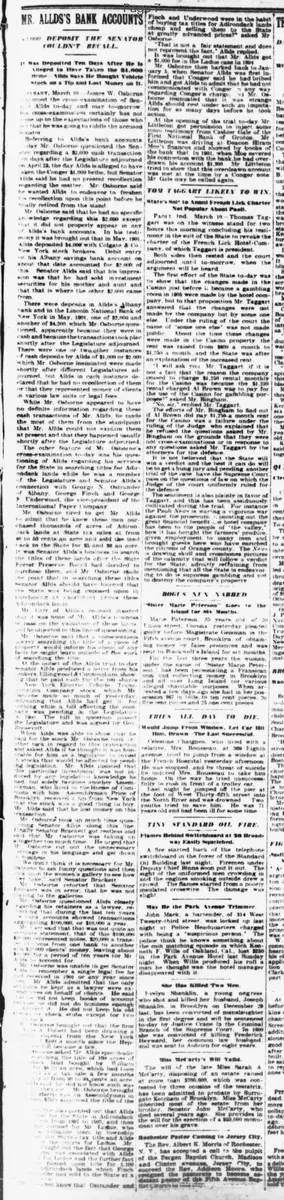
DEPOSIT THE SENATOR COULDN'T RECALL.
It was deposited ten days after he is voted to have taken the $1,000.
Bribe, the Allds says he bought vehicle stock on a tip and lost money on it.
At noon, March 10, James W. Osborne signed the cross-examination of Senator Allds to-day and may to-morrow. Cross-examination certainly has not come up to the expectations of those who thought he was going to riddle the accused Senator.
Referring to Allds's bank accounts, Mr. Osborne questioned the Senator regarding a $2,000 cash transaction ten days after the Legislature adjourned on April 23, the day Allds is alleged to have taken the Conger $1,000 bribe, but Senator Allds said he had no present recollection regarding the matter. Mr. Osborne said he wanted Allds to endeavor to freshen his recollection upon this point before he finally retired from the stand.
Mr. Osborne said that he had no specific knowledge regarding this $2,000 except that it did not properly appear in any Allds's bank accounts. In his testimony it was brought out that in May, 1901, Allds deposited $4,000 with Colgate & Co., New York stock brokers. Debit entry on his Albany savings bank account on about that date accounted for $2,000 of this. Senator Allds said that his impression was that he had sold investment securities for his mother and aunt and that that is where the other $2,000 came from.
There were deposits in Allds's Albany bank and in the Lincoln National Bank of New York in May, 1901, one of $2,000 and another of $4,200, which Mr. Osborne questioned, apparently because they were in cash and because the transactions took place shortly after the Legislature adjourned.
There were one or two other instances of cash deposits by Allds of $1,000 or $2,000 which Mr. Osborne insinuated were made shortly after different Legislatures adjourned, but Allds in each instance declared that he had no recollection of them or that they represented money of clients in various law suits or legal fees.
While Mr. Osborne appeared to have no definite information regarding these cash transactions of Mr. Allds, he made the most of them from the standpoint that Mr. Allds could not explain them at present and that they happened usually shortly after the Legislature adjourned.
The other feature of Mr. Osborne's cross-examination to-day was his questioning of Allds regarding his services for the State in searching titles for Adirondack lands while he was a member of the Legislature and Senator Allds's connection with George X. Ostrander of Albany, George Finch and George P. Underwood, the vice-president of the International Paper Company.
Mr. Osborne tried to get Mr. Allds to admit that he knew these men purchased thousands of acres of Adirondack lands at State tax rates at from 60 to 50 cents an acre and sold the land back to the State for $35 and $50 an acre.
It was Senator Allds's business to search the titles of these lands after the State Forest Preserve Board had decided to purchase them, and Mr. Osborne made the point that in searching these titles Senator Allds should have learned that the State was being imposed upon in these purchases.
Mr. Carr of Allds's counsel insisted that it was none of Mr. Allds's business to discuss this on the allegation of these letters, so he objected to this line of questioning.
Mr. Osborne said that a conscientious lawyer searching the title of a piece of property would inform his client of any facts he might learn outside of the work of searching the title.
At the outcome of the Allds trial to-day Senator Allds produced a letter from his brokers, Ellingwood & Cunningham showing that he paid cash for ten shares New York Electric Vehicle Transit Company stock which Mr. Osborne made so much of yesterday, intimating that Allds had got it for nothing while a bill affecting the company was pending in the Legislature.
The bill in question passed the Legislature and was signed by Gov. Roosevelt.
When Allds was able to show that he paid for the stock Mr. Osborne took another tack in regard to this transaction and asked Allds if he thought it was honorable for him as a legislator to invest in stocks that would be affected by pending legislation. Mr. Allds insisted that his particular investment was not influenced by any legislative knowledge he had but solely because another Assemblyman, who lived in the room of Commons with him, Assemblyman Price of Brooklyn, received a tip from New York that the stock was a good thing to buy.
Mr. Allds said that he lost money on this transaction.
Mr. Osborne took up much time guessing Senator Allds along this line. Finally Senator Brackett got restless and said that Mr. Osborne was taking up altogether too much time. He urged that Mr. Osborne cut out the unnecessary verbiage in his language and get down to facts.
We don't think it is necessary for Mr. Osborne to ask funny questions and then look in the women's gallery to see how they take it, said Senator Brackett.
Mr. Osborne retorted that Senator Brackett was in error, that he was not playing to the galleries.
Mr. Osborne questioned Allds closely regarding his retainers as a lawyer, asking that during the last ten years his accounts showed transactions aggregating $100,000, or $10,000 a year.
Mr. Carr said that that was not quite an accurate statement, that of this $100,000 $30,000 represented notes, $20,000 transfers from one bank to another and $40,000 clients' money, leaving about $10,000 for a period of ten years for Mr. Allds's account for.
Mr. Osborne was unable to get Senator Allds to remember a single legal fee he received in law or any year since.
Mr. Allds admitted that the only books he kept as a lawyer were expense books on behalf of clients. He said he did not keep books of account, did not do business enough.
He did not keep his old check stubs except for two years.
It was brought out that the firm of Folette had been drawing a salary from the New York Sun a month since the Hepburn law.
Mr. Osborne asked Mr. Allds specifically regarding searching the title of 1,000 acres of land bought by Ladue, who was connected with Finch and the further fact that upon title for $100 Adirondack lands which Finch or Ostrander had sold to the State.
Allds did not know such was the case.
Mr. Osborne brought out that Assemblyman Ladue raised the title for the State of Adirondack from 20 to 100, and then asked for Mr. Ladue, who valuable Irishism township tax title and Allds the for Ladue. Mr. shout the fact that George wanted with Allds.
Lehua end the further fact upon title for $100 Adirondack lands which Finch or had sold to the State, not know.
Finch and Underwood were in the habit of buying tax titles for Adirondack lands cheap and selling them to the State at greatly advanced prices? asked Mr. Osborne.
That is not a fair statement and does not represent the fact, Allds replied.
It was brought out that Mr. Allds got a $1,000 fee in the Ladue case in 1904.
Mr. Osborne then harked back to January 5, when Senator Allds was first informed that Conger said he had bribed him and got Allds to admit that he had not communicated with Conger in any way regarding Conger's charge, and Mr. Osborne insinuated that it was strange Allds should rest under such an imputation for so many days before he took action.
At the opening of the trial to-day Mr. Littleton got permission to inject some more testimony from Cashier Gale of the First National Bank of Groton. Mr. Littleton was driving at Deacon Hiram Moe's finances and showed by books of the bank that in 1901, when Moe severed his connection with the bank, he had overdrawn his account $1,000. Mr. Littleton tried to show that this overdrawn account was met at the time by a Conger note.
Mr. Gale may be called again.
What sub-type of article is it?
What themes does it cover?
What keywords are associated?
What entities or persons were involved?
Where did it happen?
Story Details
Key Persons
Location
Albany, New York; Adirondack Lands
Event Date
May 1901; April 23, 1901; March 10
Story Details
Prosecutor Osborne cross-examines Senator Allds on unexplained cash deposits post-legislature adjournment, alleged Conger bribe, Adirondack land title searches aiding speculators, and stock purchase, while Allds denies recollection or wrongdoing.