Thank you for visiting SNEWPapers!
Sign up free
Domestic News
November 17, 1820
Richmond Enquirer
Richmond, Richmond County, Virginia
What is this article about?
Proceedings of the Agricultural Society of Albemarle on the cultivation and profits of rape seed, based on Commodore James Barron's observations near Hamburg, presented by John H. Cooke and read on October 10, 1820.
Clipping
OCR Quality
92%
Excellent
Full Text
From the Central Gazette.
Proceedings of the Agricultural Society of Albemarle.
On the Cultivation and Profits of Rape Seed
READ, OCTOBER 10th, 1820.
Bremo, June 1820.
SIR,... The enclosed paper, from Commodore James Barron, upon the culture and profits of Rape Seed you will observe is the result of his observations on this subject in the vicinity of Hamburg, during his late absence from the country. It will prove a valuable addition to the stock of useful knowledge already in the possession of the society ; and although I have not consulted Com. Barron, I am sure he will not be averse to my placing it where it is likely to be most extensively useful.
I am yours, respectfully,
JOHN H. COOKE.
P. MINOR, Esq.
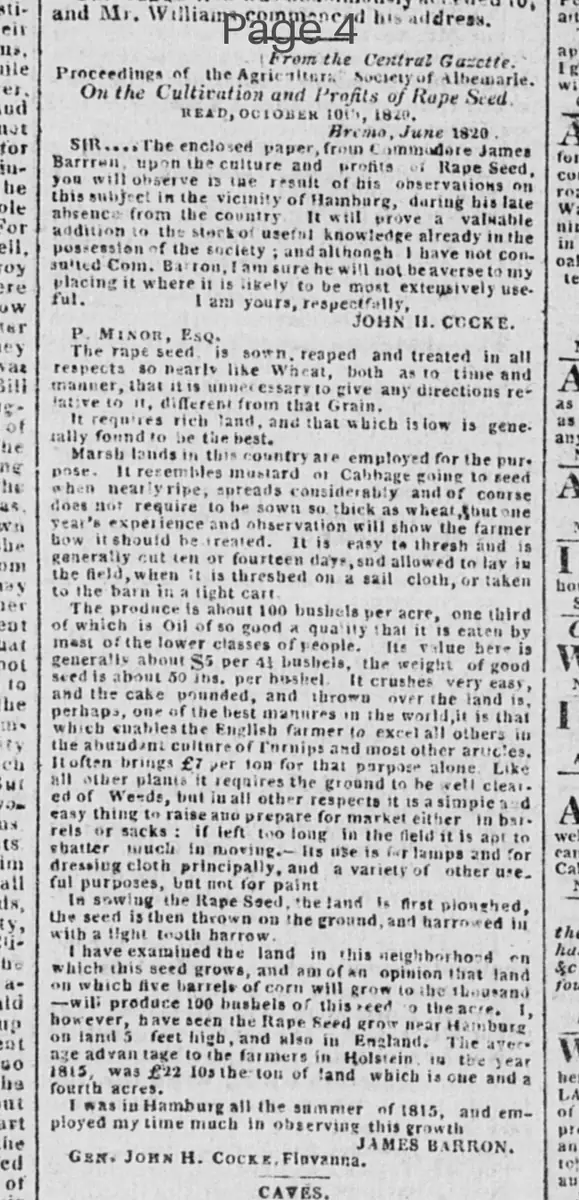
The rape seed is sown, reaped and treated in all respects so nearly like Wheat, both as to time and manner, that it is unnecessary to give any directions relative to it, different from that Grain. It requires rich land, and that which is low is generally found to be the best. Marsh lands in this country are employed for the purpose. It resembles mustard or Cabbage going to seed when nearly ripe, spreads considerably and of course does not require to be sown so thick as wheat but one year's experience and observation will show the farmer how it should be treated. It is easy to thresh and is generally cut ten or fourteen days, and allowed to lay in the field, when it is threshed on a sail cloth, or taken to the barn in a tight cart The produce is about 100 bushels per acre, one third of which is Oil of so good a quality that it is eaten by most of the lower classes of people. Its value here is generally about $5 per 41 bushels, the weight of good seed is about 50 lbs. per bushel. It crushes very easy, and the cake pounded, and sown over the land is, perhaps, one of the best manures in the world, it is that which enables the English farmer to excel all others in the abundant culture of Turnips and most other articles. It often brings $40 per ton for that purpose alone. Like all other plants it requires the ground to be well cleared of Weeds, but in all other respects it is as simple and easy thing to raise and prepare for market either in barrels or sacks : if left too long in the field it is apt to shatter much in moving.-its use is for lamps and for dressing cloth principally, and a variety of other useful purposes, but not for paint In sowing the Rape Seed, the land is first ploughed, the seed is then thrown on the ground, and harrowed in with a light tooth harrow. I have examined the land in this neighborhood on which this seed grows, and am of an opinion that land on which five barrels of corn will grow to the thousand —will produce 100 bushels of this seed to the acre. I, however, have seen the Rape Seed grow near Hamburg on land 5 feet high, and also in England. The average advantage to the farmers in Holstein in the year 1815, was 22 l0s the ton of land which is one and a fourth acres. I was in Hamburg all the summer of this, and employed my time much in observing this growth
JAMES BARRON.
Gen. John H. Cocke, Fluvanna.
Proceedings of the Agricultural Society of Albemarle.
On the Cultivation and Profits of Rape Seed
READ, OCTOBER 10th, 1820.
Bremo, June 1820.
SIR,... The enclosed paper, from Commodore James Barron, upon the culture and profits of Rape Seed you will observe is the result of his observations on this subject in the vicinity of Hamburg, during his late absence from the country. It will prove a valuable addition to the stock of useful knowledge already in the possession of the society ; and although I have not consulted Com. Barron, I am sure he will not be averse to my placing it where it is likely to be most extensively useful.
I am yours, respectfully,
JOHN H. COOKE.
P. MINOR, Esq.
The rape seed is sown, reaped and treated in all respects so nearly like Wheat, both as to time and manner, that it is unnecessary to give any directions relative to it, different from that Grain. It requires rich land, and that which is low is generally found to be the best. Marsh lands in this country are employed for the purpose. It resembles mustard or Cabbage going to seed when nearly ripe, spreads considerably and of course does not require to be sown so thick as wheat but one year's experience and observation will show the farmer how it should be treated. It is easy to thresh and is generally cut ten or fourteen days, and allowed to lay in the field, when it is threshed on a sail cloth, or taken to the barn in a tight cart The produce is about 100 bushels per acre, one third of which is Oil of so good a quality that it is eaten by most of the lower classes of people. Its value here is generally about $5 per 41 bushels, the weight of good seed is about 50 lbs. per bushel. It crushes very easy, and the cake pounded, and sown over the land is, perhaps, one of the best manures in the world, it is that which enables the English farmer to excel all others in the abundant culture of Turnips and most other articles. It often brings $40 per ton for that purpose alone. Like all other plants it requires the ground to be well cleared of Weeds, but in all other respects it is as simple and easy thing to raise and prepare for market either in barrels or sacks : if left too long in the field it is apt to shatter much in moving.-its use is for lamps and for dressing cloth principally, and a variety of other useful purposes, but not for paint In sowing the Rape Seed, the land is first ploughed, the seed is then thrown on the ground, and harrowed in with a light tooth harrow. I have examined the land in this neighborhood on which this seed grows, and am of an opinion that land on which five barrels of corn will grow to the thousand —will produce 100 bushels of this seed to the acre. I, however, have seen the Rape Seed grow near Hamburg on land 5 feet high, and also in England. The average advantage to the farmers in Holstein in the year 1815, was 22 l0s the ton of land which is one and a fourth acres. I was in Hamburg all the summer of this, and employed my time much in observing this growth
JAMES BARRON.
Gen. John H. Cocke, Fluvanna.
What sub-type of article is it?
Agriculture
What keywords are associated?
Rape Seed
Cultivation
Profits
Agricultural Society
Albemarle
Hamburg
Farming
What entities or persons were involved?
Commodore James Barron
John H. Cooke
P. Minor
Gen. John H. Cocke
Where did it happen?
Albemarle
Domestic News Details
Primary Location
Albemarle
Event Date
October 10th, 1820
Key Persons
Commodore James Barron
John H. Cooke
P. Minor
Gen. John H. Cocke
Event Details
Paper from Commodore James Barron on the culture and profits of rape seed, based on observations near Hamburg, presented by John H. Cooke to the Agricultural Society of Albemarle. Describes sowing like wheat on rich low land, yield of 100 bushels per acre, oil value, use as manure, and preparation methods.