Thank you for visiting SNEWPapers!
Sign up free
Evening Bulletin
Honolulu, Honolulu County, Hawaii
What is this article about?
Japan successfully floats a $60 million war loan at 6% bonds sold at 90% in London and New York markets, despite press complaints over the high rate. Backed by 1904-5 budget revenues of $111.8 million and extraordinary war expenditures of $184.9 million, mostly from loans. First loan at 93% on customs; second oversubscribed amid war successes.
Clipping
OCR Quality
Full Text
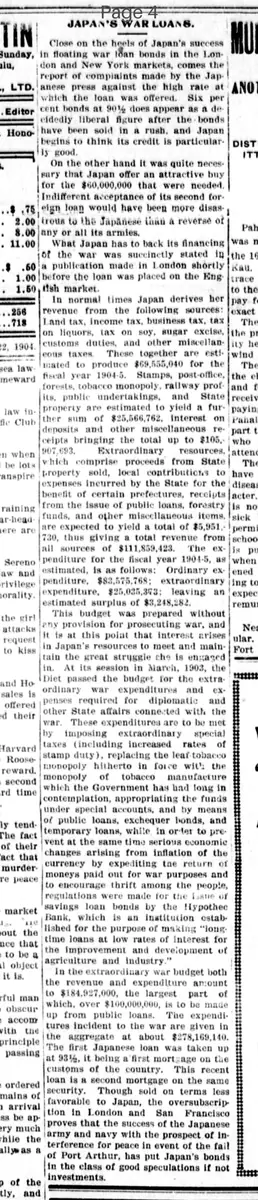
Close on the heels of Japan's success in floating war loan bonds in the London and New York markets, comes the report of complaints made by the Japanese press against the high rate at which the loan was offered. Six per cent bonds at 90% does appear as a decidedly liberal figure after the bonds have been sold in a rush, and Japan begins to think its credit is particularly good.
On the other hand it was quite necessary that Japan offer an attractive buy for the $60,000,000 that were needed. Indifferent acceptance of its second foreign loan would have been more disastrous to the Japanese than a reverse of any or all its armies.
What Japan has to back its financing of the war was succinctly stated in a publication made in London shortly before the loan was placed on the English market.
In normal times Japan derives her revenue from the following sources: Land tax, income tax, business tax, tax on liquors, tax on soy, sugar excise, customs duties, and other miscellaneous taxes. These together are estimated to produce $69,555,040 for the fiscal year 1904-5. Stamps, post-office, forests, tobacco monopoly, railway profits, public undertakings, and State property are estimated to yield a further sum of $25,566,762, interest on deposits and other miscellaneous receipts bringing the total up to $105,907,693.
Extraordinary resources, which comprise proceeds from State property sold, local contributions to expenses incurred by the State for the benefit of certain prefectures, receipts from the issue of public loans, forestry funds, and other miscellaneous items, are expected to yield a total of $5,951,730, thus giving a total revenue from all sources of $111,859,423. The expenditure for the fiscal year 1904-5, as estimated, is as follows: Ordinary expenditure, $83,575,768; extraordinary expenditure, $25,035,373; leaving an estimated surplus of $3,248,282.
This budget was prepared without any provision for prosecuting war, and it is at this point that interest arises in Japan's resources to meet and maintain the great struggle she is engaged in. At its session in March, 1903, the Diet passed the budget for the extraordinary war expenditures and expenses required for diplomatic and other State affairs connected with the war. These expenditures are to be met by imposing extraordinary special taxes (including increased rates of stamp duty), replacing the leaf-tobacco monopoly hitherto in force with the monopoly of tobacco manufacture which the Government has had long in contemplation, appropriating the funds under special accounts, and by means of public loans, exchequer bonds, and temporary loans, while, in order to prevent at the same time serious economic changes arising from inflation of the currency by expediting the return of moneys paid out for war purposes and to encourage thrift among the people, regulations were made for the issue of savings loan bonds by the Hypothec Bank, which is an institution established for the purpose of making "long-time loans at low rates of interest for the improvement and development of agriculture and industry."
In the extraordinary war budget both the revenue and expenditure amount to $184,927,000, the largest part of which, over $100,000,000, is to be made up from public loans. The expenditures incident to the war are given in the aggregate at about $278,169,140.
The first Japanese loan was taken up at 93%, it being a first mortgage on the customs of the country. This recent loan is a second mortgage on the same security. Though sold on terms less favorable to Japan, the oversubscription in London and San Francisco proves that the success of the Japanese army and navy with the prospect of interference for peace in event of the fall of Port Arthur, has put Japan's bonds in the class of good speculations if not investments.
What sub-type of article is it?
What keywords are associated?
Where did it happen?
Foreign News Details
Primary Location
Japan
Event Date
Fiscal Year 1904 5
Outcome
second $60,000,000 war loan oversubscribed in london, new york, and san francisco at 6% bonds for 90%; backed by customs mortgage; amid japanese military successes and potential peace if port arthur falls.
Event Details
Japan issues second foreign war loan of $60 million at attractive 6% rate sold at 90% despite press complaints, following first loan at 93%. Normal 1904-5 revenues total $111,859,423 with surplus; extraordinary war budget of $184,927,000 mostly from loans, covering $278,169,140 war expenditures approved by Diet in March 1903 via taxes, monopolies, and bonds.