Thank you for visiting SNEWPapers!
Sign up free
Editorial
March 30, 1793
National Gazette
Philadelphia, Philadelphia County, Pennsylvania
What is this article about?
An editorial criticizes the excise law as partial and oppressive, proposing heavy duties on luxuries like wines, silks, and gaming items to generate revenue, enrich the nation, and promote virtue. It opposes a standing army, linking it to threats against democracy and unnecessary Indian conflicts.
Clipping
OCR Quality
98%
Excellent
Full Text
EXTRACT.
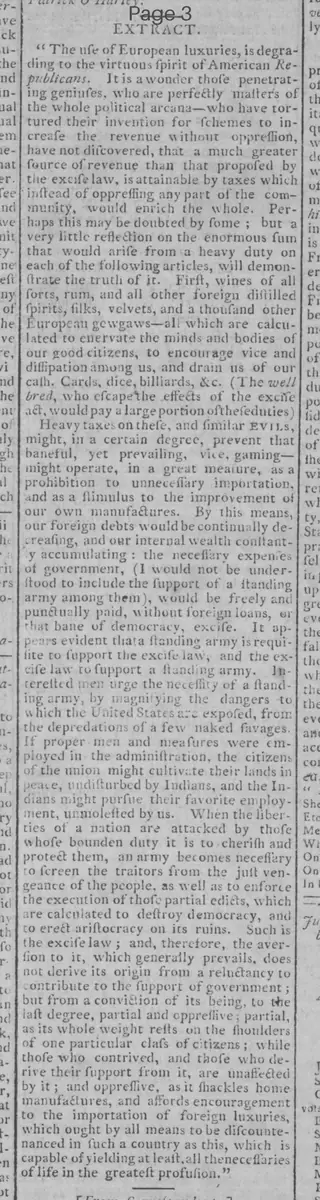
"The use of European luxuries, is degrading to the virtuous spirit of American Republicans. It is a wonder those penetrating geniuses, who are perfectly masters of the whole political arcana—who have tortured their invention for schemes to increase the revenue without oppression, have not discovered, that a much greater source of revenue than that proposed by the excise law, is attainable by taxes which instead of oppressing any part of the community, would enrich the whole. Perhaps this may be doubted by some; but a very little reflection on the enormous sum that would arise from a heavy duty on each of the following articles, will demonstrate the truth of it. First, wines of all sorts, rum, and all other foreign distilled spirits, silks, velvets, and a thousand other European gewgaws—all which are calculated to enervate the minds and bodies of our good citizens, to encourage vice and dissipation among us, and drain us of our cash. Cards, dice, billiards, &c. (The well bred, who escape the effects of the excise act, would pay a large portion of these duties) Heavy taxes on these, and similar Evils, might, in a certain degree, prevent that baneful, yet prevailing, vice, gaming—might operate, in a great measure, as a prohibition to unnecessary importation, and as a stimulus to the improvement of our own manufactures. By this means, our foreign debts would be continually decreasing, and our internal wealth constantly accumulating: the necessary expenses of government, (I would not be understood to include the support of a standing army among them), would be freely and punctually paid, without foreign loans, or that bane of democracy, excise. It appears evident that a standing army is requisite to support the excise law, and the excise law to support a standing army. Interested men urge the necessity of a standing army, by magnifying the dangers to which the United States are exposed, from the depredations of a few naked savages. If proper men and measures were employed in the administration, the citizens of the union might cultivate their lands in peace, undisturbed by Indians, and the Indians might pursue their favorite employment, unmolested by us. When the liberties of a nation are attacked by those whose bounden duty it is to cherish and protect them, an army becomes necessary to screen the traitors from the just vengeance of the people, as well as to enforce the execution of those partial edicts, which are calculated to destroy democracy, and to erect aristocracy on its ruins. Such is the excise law; and, therefore, the aversion to it, which generally prevails, does not derive its origin from a reluctancy to contribute to the support of government; but from a conviction of its being, to the last degree, partial and oppressive; partial, as its whole weight rests on the shoulders of one particular class of citizens; while those who contrived, and those who derive their support from it, are unaffected by it; and oppressive, as it shackles home manufactures, and affords encouragement to the importation of foreign luxuries, which ought by all means to be discountenanced in such a country as this, which is capable of yielding at least, all the necessaries of life in the greatest profusion."
"The use of European luxuries, is degrading to the virtuous spirit of American Republicans. It is a wonder those penetrating geniuses, who are perfectly masters of the whole political arcana—who have tortured their invention for schemes to increase the revenue without oppression, have not discovered, that a much greater source of revenue than that proposed by the excise law, is attainable by taxes which instead of oppressing any part of the community, would enrich the whole. Perhaps this may be doubted by some; but a very little reflection on the enormous sum that would arise from a heavy duty on each of the following articles, will demonstrate the truth of it. First, wines of all sorts, rum, and all other foreign distilled spirits, silks, velvets, and a thousand other European gewgaws—all which are calculated to enervate the minds and bodies of our good citizens, to encourage vice and dissipation among us, and drain us of our cash. Cards, dice, billiards, &c. (The well bred, who escape the effects of the excise act, would pay a large portion of these duties) Heavy taxes on these, and similar Evils, might, in a certain degree, prevent that baneful, yet prevailing, vice, gaming—might operate, in a great measure, as a prohibition to unnecessary importation, and as a stimulus to the improvement of our own manufactures. By this means, our foreign debts would be continually decreasing, and our internal wealth constantly accumulating: the necessary expenses of government, (I would not be understood to include the support of a standing army among them), would be freely and punctually paid, without foreign loans, or that bane of democracy, excise. It appears evident that a standing army is requisite to support the excise law, and the excise law to support a standing army. Interested men urge the necessity of a standing army, by magnifying the dangers to which the United States are exposed, from the depredations of a few naked savages. If proper men and measures were employed in the administration, the citizens of the union might cultivate their lands in peace, undisturbed by Indians, and the Indians might pursue their favorite employment, unmolested by us. When the liberties of a nation are attacked by those whose bounden duty it is to cherish and protect them, an army becomes necessary to screen the traitors from the just vengeance of the people, as well as to enforce the execution of those partial edicts, which are calculated to destroy democracy, and to erect aristocracy on its ruins. Such is the excise law; and, therefore, the aversion to it, which generally prevails, does not derive its origin from a reluctancy to contribute to the support of government; but from a conviction of its being, to the last degree, partial and oppressive; partial, as its whole weight rests on the shoulders of one particular class of citizens; while those who contrived, and those who derive their support from it, are unaffected by it; and oppressive, as it shackles home manufactures, and affords encouragement to the importation of foreign luxuries, which ought by all means to be discountenanced in such a country as this, which is capable of yielding at least, all the necessaries of life in the greatest profusion."
What sub-type of article is it?
Taxation
Moral Or Religious
Military Affairs
What keywords are associated?
Excise Law
Luxury Taxes
Standing Army
American Virtue
Foreign Luxuries
Indian Affairs
Democracy Threat
What entities or persons were involved?
Excise Law
Standing Army
Indians
Editorial Details
Primary Topic
Opposition To Excise Law And Proposal For Luxury Taxes
Stance / Tone
Strongly Anti Excise And Pro Virtuous Republicanism
Key Figures
Excise Law
Standing Army
Indians
Key Arguments
Taxes On Luxuries Like Wines, Spirits, Silks, And Gaming Items Would Generate More Revenue Than Excise Without Oppression
Luxuries Degrade American Virtue And Drain Cash, Encouraging Vice
Heavy Duties On Luxuries Would Prohibit Unnecessary Imports, Stimulate Domestic Manufactures, Reduce Foreign Debts
Excise Law Supports Standing Army And Vice Versa, Unnecessary If Proper Administration
Excise Is Partial, Burdening One Class While Sparing Others, And Oppressive To Home Industry
Opposition To Excise Stems From Its Threat To Democracy, Not Reluctance To Support Government