Thank you for visiting SNEWPapers!
Sign up free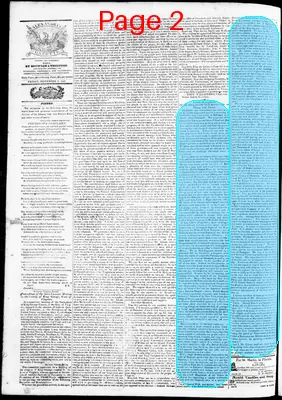
Editorial
November 9, 1827
Phenix Gazette
Alexandria, Virginia
What is this article about?
Editorial in the Boston Patriot defends President Adams' toast at a Baltimore dinner of the Cincinnati, using 'Ebony' for evil (British General Ross) and 'Topaz' for good (the American militiaman who killed him during the 1814 British invasion), portraying the event as providential. It mocks opposition papers' criticism and praises the sentiment's patriotism, humanity, and classical allusions.
Clipping
OCR Quality
92%
Excellent
Full Text
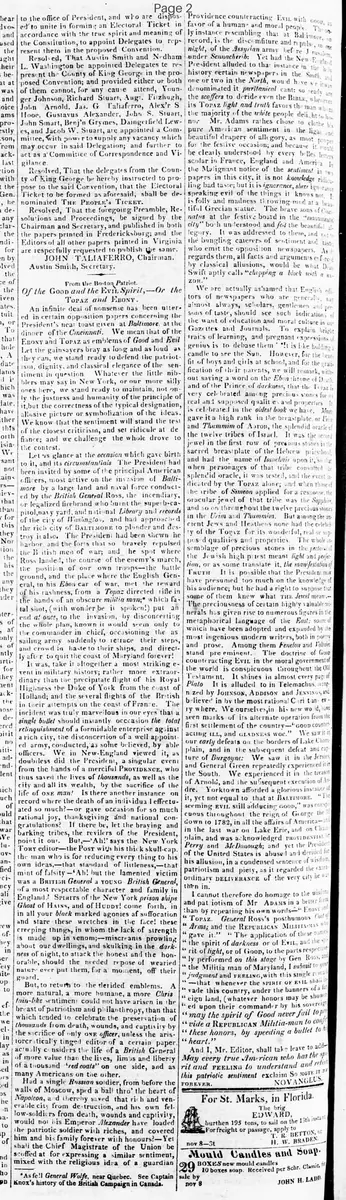
From the Boston Patriot.
Of the Good and the Evil Spirit,—Or the
Topaz and EBony.
An infinite deal of nonsense has been utter-
ed in certain opposition papers concerning the
President's neat toast given at Baltimore, at the
dinner of the Cincinnati. We mean that of the
EBony and Topaz as emblems of Good and Evil
Let the gainsayers bray as long and as loud as
they can, we stand ready to defend the patriot-
ism, dignity, and classical elegance of the sen-
timent in question. Whatever the little nib-
blers may say in New York, or our more silly
ones here, we stand ready to maintain, not on-
ly the justness and humanity of the principle of
it, but the correctness of the typical designation,
allusive picture or symbolization of the ideas.
We know that the sentiment will stand the test
of the closest criticism, and set ridicule at de-
fiance: and we challenge the whole drove to
the contest.
Let us glance at the occasion which gave birth
to it, and its circumstances The President had
been invited by some of the principal American
officers, most active on the invasion of Balli-
more by a large land and naval force conduct-
ed by the British General Ross, the incendiary,
or legalized firebrand who burnt the superb ca-
pitol, navy yard, and national Library and records
of the city of Washington, and had approached
the rich city of Baltimore to plunder and des-
troy it also. The President had been shown the
harbor and the forts that so bravely repulsed
the British men of war; and the spot where
Ross landed, the course of the enemy's march,
the position of our own troops—the battle
ground, and the place where the English Gen-
eral, in his Ebon car of war, met the reward
of his rashness, from a Topaz directed rifle in
the hands of an obscure militia man;* which fa-
tal shot, (with wonder be it spoken!) put an
end at once, to the invasion, by disconcerting
the whole plan, known it would seem only to
the commander in chief, occasioning the as-
sailing army suddenly to retrace their steps,
and crowd in haste to their ships, and direct-
ly after to quit the coast of Maryland forever!
It was, take it altogether a most striking e-
vent in military history; rather more extraor-
dinary than the precipitate flight of his Royal
Highness the Duke of York from the coast of
Holland; and the several flights of the British
in their attempts on the coast of France. The
incident was truly marvelous in our eyes that a
single bullet should instantly occasion the total
relinquishment of a formidable enterprise against
a rich city, the disconcertion of a well appointed
army, conducted, as some believed, by able
officers. We in New-England viewed it, as
doubtless did the President, a singular event
from the hands of a merciful Providence, who
thus saved the lives of thousands, as well as the
city and all its wealth, by the sacrifice of the
life of one man! Is there another instance on
record where the death of an individual effectu-
ated so much?—or gave occasion for so much
rational joy, thanksgiving and national con-
gratulations? If there be, let the braying and
barking tribes, the revilers of the President,
point it out. But,—'Ah!' says the New York
Tory editor—the Post with his thick skull-cap,
the man who is for reducing every thing to his
own ideas,—that standard of littleness,—that
mint of falsity—'Ah! but the lamented victim
was a British General a young British General
of a most respectable character and family in
England! Spirits of the New York prison ships
Ghost of Haines, and of Hugh! come forth, in
all your black marked agonies of suffocation
and stare these wretches in the face! these
creeping things, in whom the lack of strength
is made up in venom;—miserable prowling
about our dwellings, and skulking in the dark-
ness of night, to attack the honest and the hon-
-orable, should the needed repose of wearied
nature ever put them, for a moment, off their
guard.
But, to return to the intended emblems. A
more natural, a more humane, a more Chris-
tian-like sentiment could not have arisen in the
breast of patriotism and philanthropy, than that
which tended to celebrate the preservation of
thousands from death, wounds, and captivity by
the sacrifice of only one officer, unless the aris-
tocrat tically tinged editor of a certain paper
actually considers the life of a British General
of more value than the lives, limbs and liberty
of a thousand 'red coats' on one side, and as
many Americans on the other.
Had a single Russian soldier, from before the
walls of Moscow, sped a ball thro' the heart of
Napoleon, and thereby saved that rich and ven-
erable city from destruction, and his own fel-
low-soldiers from death, wounds and captivity,
would not his Emperor Alexander have loaded
the patriotic soldier with riches, and covered
him and his family forever with honours?—Yet
shall the Chief Magistrate of the Union be
scoffed at for expressing a similar sentiment,
mixed with the religious idea of a guardian
Providence counteracting Evil with Good, in
favor of a humane and moral people. The on-
ly instance resembling that at Baltimore, on
record is the discomfiture and repulse of
the
Assyrian army before Jerusalem under
Sennacherib Yet had the New-England
President alluded to that instance in the
Bible certain newspapers in the South
and one or two in the North, would have denominated it puritanical cant: so ready are
the scoffers to deride even the Bible, wherever
its Topaz light and truth favors the man whom
the majority of the white people delight to ho-
nor Mr. Adams rather chose to clothe his
pure American sentiment in the light and
beautiful drapery of allegory, as most proper
for the festive occasion; and because it would
be clearly understood by every belles lettres
scholar in France, England and America In
the Malignant notice of the sentiment in two
papers in this city, it is not knowledge ridiculing bad taste; but it is ignorance, sheer ignorance
speaking evil of the things it knows not. It
is folly and madness throwing mud at a beau-
tiful Grecian statue. The brave sons of Cme-
nalus at the festive board in the "monumental
city" both understood and felt the beautiful al-
legory. It was addressed to them, and not
the bungling caterers of sentiment and taste
who emit the opposition newspapers. As
regards them, all facts and arguments expressed
by classical allusions, would be what Dean
Swift aptly call, "chopping a block with a Ra-
zor."
We are actually ashamed that English editors
of newspapers who are generally, if not
almost always, scholars, gentlemen and persons of taste, should see such indications of
the want of education and moral culture in our
Gazettes and Journals. To explain bright
traits of learning, and pregnant expressions of
genius is to debase them! It is like holding a
candle to see the Sun. However, for the bene-
fit of boys and girls at school, and for the gratifi-
-cation of their parents, we will remark, with-
out saying a word on the Ebon throne of Death
and of the Prince of darkness, that the Topaz is
very celebrated among precious stones for its
real and supposed qualities and properties It
is celebrated in the oldest book we have. Moses
gave it a high rank in the breastplate or Urim
and Thummim of Aaron, the splendid oracle to
the twelve tribes of Israel. It was the second
jewel in the first row of precious stones in the
sacred breastplate of the Hebrew priesthood
and had the name of Issachar upon it, so that
when personages of that tribe consulted the
splendid oracle, it was tested, and the event indicated by the Topaz alone; and when those of
the tribe of Simeon applied for a response, the
oracular jewel of that tribe was the Sapphire
and so on throughout the twelve precious stones
in the Urim and Thummim. But among the ancient Jews and Heathens none had the celebrity of the Topaz for its wonderful, real or supposed qualities and properties. The whole as-
semblage of precious stones in the pectoral of
the Jewish high priest meant light and perfec-
tion, or as some translate it, the manifestation of
Truth It is possible that the President may
have presumed too much on the knowledge of
his audience; but he had a right to suppose that
some of them knew what The Jewel meant.—
The preciousness of certain highly valuable minerals has given rise to numerous figures in the
metaphorical language of the East; some of
which have been adopted and expanded by the
most ingenious modern writers, both in poetry
and prose. Among them Fenelon and Voltaire
stand pre-eminent. The doctrine of Good
counteracting Evil in the moral government of
the world is conspicuous throughout the Old
Testament. It shines in almost every page of
Plato It is alluded to in Telemachus, acknowledged by Johnson, Addison and Jenyns, and
believed in by the most rational Christian everywhere. We ourselves, in this new world, have
seen marks of its alternate operation from the
first settlement of the country—'good counter-
acting ill, and gladness woe.' We saw it in
our early defeats on the borders of Lake Cham-
plain, and in the subsequent defeat and capture of Burgoyne: We saw it in the Jerseys and General Greene repeatedly experienced it in
the South. We experienced it in the treason
of Arnold, and the subsequent execution of An-
dre. Yorktown afforded a glorious instance of
it, yet not equal to that at Baltimore.
"The seeming Evil still adducing good," was conspi-
cuous throughout the reign of George the
Third down to 1782, in all the affairs of America—and
in the last war on Lake Erie, and on that
plain, and was acknowledged PROVIDENTIAL
by Perry and McDonough; and yet the President
of the United States is abused and derided for
his allusion, in a condensed sentence of wisdom,
patriotism and piety, as it regarded the extra-
ordinary DELIVERANCE of the very city he was
then in.
I cannot therefore do homage to the wisdom
and patriotism of Mr
Adams in a better form
than by repeating
his own words "Ebony and
Arms; and the Republican Militia-man a
Topaz.
General Ross's
posthumous Coat of
66
gave it."
The application of these phrases
"the spirit of darkness
or of Evil, and the
spirit of light, or of Good, to the parts respecti-
vely performed on this stage by Gen. Ross, and
the Militia man of Maryland, I submit to your
judgment and feeling, with this single rema-
rk—that whenever the spirit of Evil shall
invade this country,
under the banners of a fo-
reign power, (whatever
honors may be showered
upon their commander by his sovereign"
"may the spirit of
Good never fail to pro-
vide a Republican
Militia-man to confer
those honors,
by
speeding
a bullet to his
heart."
Judgment and feeling to understand and relish
this patriotic sentiment exclaim So be it
FOREVER.
NOVANGLUS.
Of the Good and the Evil Spirit,—Or the
Topaz and EBony.
An infinite deal of nonsense has been utter-
ed in certain opposition papers concerning the
President's neat toast given at Baltimore, at the
dinner of the Cincinnati. We mean that of the
EBony and Topaz as emblems of Good and Evil
Let the gainsayers bray as long and as loud as
they can, we stand ready to defend the patriot-
ism, dignity, and classical elegance of the sen-
timent in question. Whatever the little nib-
blers may say in New York, or our more silly
ones here, we stand ready to maintain, not on-
ly the justness and humanity of the principle of
it, but the correctness of the typical designation,
allusive picture or symbolization of the ideas.
We know that the sentiment will stand the test
of the closest criticism, and set ridicule at de-
fiance: and we challenge the whole drove to
the contest.
Let us glance at the occasion which gave birth
to it, and its circumstances The President had
been invited by some of the principal American
officers, most active on the invasion of Balli-
more by a large land and naval force conduct-
ed by the British General Ross, the incendiary,
or legalized firebrand who burnt the superb ca-
pitol, navy yard, and national Library and records
of the city of Washington, and had approached
the rich city of Baltimore to plunder and des-
troy it also. The President had been shown the
harbor and the forts that so bravely repulsed
the British men of war; and the spot where
Ross landed, the course of the enemy's march,
the position of our own troops—the battle
ground, and the place where the English Gen-
eral, in his Ebon car of war, met the reward
of his rashness, from a Topaz directed rifle in
the hands of an obscure militia man;* which fa-
tal shot, (with wonder be it spoken!) put an
end at once, to the invasion, by disconcerting
the whole plan, known it would seem only to
the commander in chief, occasioning the as-
sailing army suddenly to retrace their steps,
and crowd in haste to their ships, and direct-
ly after to quit the coast of Maryland forever!
It was, take it altogether a most striking e-
vent in military history; rather more extraor-
dinary than the precipitate flight of his Royal
Highness the Duke of York from the coast of
Holland; and the several flights of the British
in their attempts on the coast of France. The
incident was truly marvelous in our eyes that a
single bullet should instantly occasion the total
relinquishment of a formidable enterprise against
a rich city, the disconcertion of a well appointed
army, conducted, as some believed, by able
officers. We in New-England viewed it, as
doubtless did the President, a singular event
from the hands of a merciful Providence, who
thus saved the lives of thousands, as well as the
city and all its wealth, by the sacrifice of the
life of one man! Is there another instance on
record where the death of an individual effectu-
ated so much?—or gave occasion for so much
rational joy, thanksgiving and national con-
gratulations? If there be, let the braying and
barking tribes, the revilers of the President,
point it out. But,—'Ah!' says the New York
Tory editor—the Post with his thick skull-cap,
the man who is for reducing every thing to his
own ideas,—that standard of littleness,—that
mint of falsity—'Ah! but the lamented victim
was a British General a young British General
of a most respectable character and family in
England! Spirits of the New York prison ships
Ghost of Haines, and of Hugh! come forth, in
all your black marked agonies of suffocation
and stare these wretches in the face! these
creeping things, in whom the lack of strength
is made up in venom;—miserable prowling
about our dwellings, and skulking in the dark-
ness of night, to attack the honest and the hon-
-orable, should the needed repose of wearied
nature ever put them, for a moment, off their
guard.
But, to return to the intended emblems. A
more natural, a more humane, a more Chris-
tian-like sentiment could not have arisen in the
breast of patriotism and philanthropy, than that
which tended to celebrate the preservation of
thousands from death, wounds, and captivity by
the sacrifice of only one officer, unless the aris-
tocrat tically tinged editor of a certain paper
actually considers the life of a British General
of more value than the lives, limbs and liberty
of a thousand 'red coats' on one side, and as
many Americans on the other.
Had a single Russian soldier, from before the
walls of Moscow, sped a ball thro' the heart of
Napoleon, and thereby saved that rich and ven-
erable city from destruction, and his own fel-
low-soldiers from death, wounds and captivity,
would not his Emperor Alexander have loaded
the patriotic soldier with riches, and covered
him and his family forever with honours?—Yet
shall the Chief Magistrate of the Union be
scoffed at for expressing a similar sentiment,
mixed with the religious idea of a guardian
Providence counteracting Evil with Good, in
favor of a humane and moral people. The on-
ly instance resembling that at Baltimore, on
record is the discomfiture and repulse of
the
Assyrian army before Jerusalem under
Sennacherib Yet had the New-England
President alluded to that instance in the
Bible certain newspapers in the South
and one or two in the North, would have denominated it puritanical cant: so ready are
the scoffers to deride even the Bible, wherever
its Topaz light and truth favors the man whom
the majority of the white people delight to ho-
nor Mr. Adams rather chose to clothe his
pure American sentiment in the light and
beautiful drapery of allegory, as most proper
for the festive occasion; and because it would
be clearly understood by every belles lettres
scholar in France, England and America In
the Malignant notice of the sentiment in two
papers in this city, it is not knowledge ridiculing bad taste; but it is ignorance, sheer ignorance
speaking evil of the things it knows not. It
is folly and madness throwing mud at a beau-
tiful Grecian statue. The brave sons of Cme-
nalus at the festive board in the "monumental
city" both understood and felt the beautiful al-
legory. It was addressed to them, and not
the bungling caterers of sentiment and taste
who emit the opposition newspapers. As
regards them, all facts and arguments expressed
by classical allusions, would be what Dean
Swift aptly call, "chopping a block with a Ra-
zor."
We are actually ashamed that English editors
of newspapers who are generally, if not
almost always, scholars, gentlemen and persons of taste, should see such indications of
the want of education and moral culture in our
Gazettes and Journals. To explain bright
traits of learning, and pregnant expressions of
genius is to debase them! It is like holding a
candle to see the Sun. However, for the bene-
fit of boys and girls at school, and for the gratifi-
-cation of their parents, we will remark, with-
out saying a word on the Ebon throne of Death
and of the Prince of darkness, that the Topaz is
very celebrated among precious stones for its
real and supposed qualities and properties It
is celebrated in the oldest book we have. Moses
gave it a high rank in the breastplate or Urim
and Thummim of Aaron, the splendid oracle to
the twelve tribes of Israel. It was the second
jewel in the first row of precious stones in the
sacred breastplate of the Hebrew priesthood
and had the name of Issachar upon it, so that
when personages of that tribe consulted the
splendid oracle, it was tested, and the event indicated by the Topaz alone; and when those of
the tribe of Simeon applied for a response, the
oracular jewel of that tribe was the Sapphire
and so on throughout the twelve precious stones
in the Urim and Thummim. But among the ancient Jews and Heathens none had the celebrity of the Topaz for its wonderful, real or supposed qualities and properties. The whole as-
semblage of precious stones in the pectoral of
the Jewish high priest meant light and perfec-
tion, or as some translate it, the manifestation of
Truth It is possible that the President may
have presumed too much on the knowledge of
his audience; but he had a right to suppose that
some of them knew what The Jewel meant.—
The preciousness of certain highly valuable minerals has given rise to numerous figures in the
metaphorical language of the East; some of
which have been adopted and expanded by the
most ingenious modern writers, both in poetry
and prose. Among them Fenelon and Voltaire
stand pre-eminent. The doctrine of Good
counteracting Evil in the moral government of
the world is conspicuous throughout the Old
Testament. It shines in almost every page of
Plato It is alluded to in Telemachus, acknowledged by Johnson, Addison and Jenyns, and
believed in by the most rational Christian everywhere. We ourselves, in this new world, have
seen marks of its alternate operation from the
first settlement of the country—'good counter-
acting ill, and gladness woe.' We saw it in
our early defeats on the borders of Lake Cham-
plain, and in the subsequent defeat and capture of Burgoyne: We saw it in the Jerseys and General Greene repeatedly experienced it in
the South. We experienced it in the treason
of Arnold, and the subsequent execution of An-
dre. Yorktown afforded a glorious instance of
it, yet not equal to that at Baltimore.
"The seeming Evil still adducing good," was conspi-
cuous throughout the reign of George the
Third down to 1782, in all the affairs of America—and
in the last war on Lake Erie, and on that
plain, and was acknowledged PROVIDENTIAL
by Perry and McDonough; and yet the President
of the United States is abused and derided for
his allusion, in a condensed sentence of wisdom,
patriotism and piety, as it regarded the extra-
ordinary DELIVERANCE of the very city he was
then in.
I cannot therefore do homage to the wisdom
and patriotism of Mr
Adams in a better form
than by repeating
his own words "Ebony and
Arms; and the Republican Militia-man a
Topaz.
General Ross's
posthumous Coat of
66
gave it."
The application of these phrases
"the spirit of darkness
or of Evil, and the
spirit of light, or of Good, to the parts respecti-
vely performed on this stage by Gen. Ross, and
the Militia man of Maryland, I submit to your
judgment and feeling, with this single rema-
rk—that whenever the spirit of Evil shall
invade this country,
under the banners of a fo-
reign power, (whatever
honors may be showered
upon their commander by his sovereign"
"may the spirit of
Good never fail to pro-
vide a Republican
Militia-man to confer
those honors,
by
speeding
a bullet to his
heart."
Judgment and feeling to understand and relish
this patriotic sentiment exclaim So be it
FOREVER.
NOVANGLUS.
What sub-type of article is it?
Partisan Politics
Moral Or Religious
War Or Peace
What keywords are associated?
Presidential Toast
Battle Of Baltimore
General Ross
Ebony Topaz
Providence
Partisan Criticism
War Of 1812
What entities or persons were involved?
President Adams
General Ross
British Forces
Republican Militia Man
New York Post Editor
Novanglus
Editorial Details
Primary Topic
Defense Of President Adams' Toast On Ebony And Topaz Emblems For The Battle Of Baltimore
Stance / Tone
Strongly Patriotic And Supportive, Mocking Opposition Critics
Key Figures
President Adams
General Ross
British Forces
Republican Militia Man
New York Post Editor
Novanglus
Key Arguments
The Toast Symbolizes Good (Topaz Rifle Shot) Counteracting Evil (Ebony General Ross) In Providential Deliverance Of Baltimore
Opposition Papers' Criticism Stems From Ignorance And Tory Sympathies
The Event Was A Singular Act Of Providence Saving Thousands By One Death
Similar To Biblical And Historical Instances Of Good Prevailing Over Evil
The Sentiment Is Humane, Classical, And Fitting For The Occasion
Critics Undervalue American Lives Over British Officers