Thank you for visiting SNEWPapers!
Sign up free
Editorial
September 15, 1870
Saint Mary's Beacon
Leonardtown, Lexington Park, Saint Mary's County, Maryland
What is this article about?
Alexander Delmar's speech criticizes Radical (Grant) party's financial claims, arguing debt reduction and tax policies originated under Johnson administration, with revenues actually declining under Grant.
Clipping
OCR Quality
95%
Excellent
Full Text
Facts from the People.
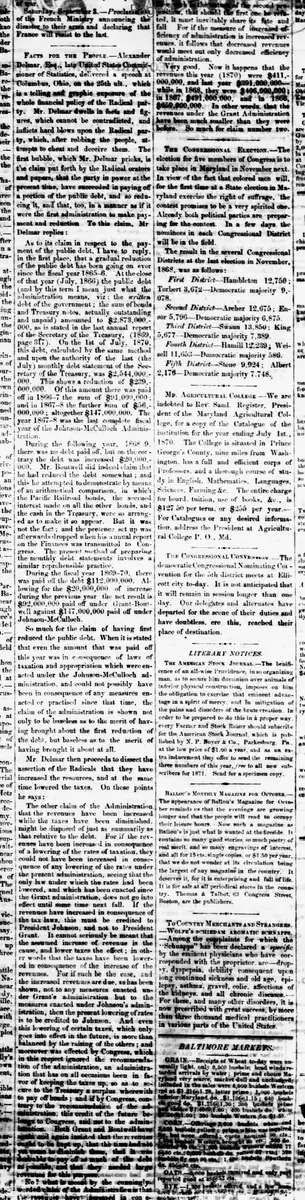
Alexander Delmar, Esq., late United States Commissioner of Statistics, delivered a speech at Columbus, Ohio, on the 20th ult., which is a telling and graphic exposure of the whole financial policy of the Radical party. Mr. Delmar dwells in facts and figures, which cannot be contradicted, and inflicts hard blows upon the Radical party, which, after robbing the people, attempts to cheat and deceive them. The first bubble, which Mr. Delmar pricks, is the claim put forth by the Radical orators and papers, that the party in power at the present time, have succeeded in paying off a portion of the public debt, and so reducing it, and that, too, in a manner as if it were the first administration to make payment and reduction. To this claim, Mr. Delmar replies:
As to its claim in respect to the payment of the public debt, I have to reply, in the first place, that a gradual reduction of the public debt has been going on ever since the fiscal year 1865-6. At the close of that year (July, 1866) the public debt (and by this term I mean just what the administration means, viz: the written debt of the government; the sum of bonds and Treasury notes, actually outstanding and unpaid) amounted to $2,873,000,000, as is stated in the last annual report of the Secretary of the Treasury. (1869, page 377). On the 1st of July, 1870, this debt, calculated by the same method and upon the authority of the last (the July) monthly debt statement of the Secretary of the Treasury, was $2,544,000,000. This shows a reduction of $329,000,000. Of this amount there was paid off in 1866-7 the sum of $91,000,000; and in 1867-8 the further sum of $56,000,000; altogether $147,000,000. The year 1867-8 was the last complete fiscal year of the Johnson-McCulloch Administration.
During the following year, 1868-9, there was no debt paid off, but on the contrary the debt was increased $20,000,000. Mr. Boutwell did indeed claim that he had reduced the debt somewhat; and this he attempted to demonstrate by means of an arithmetical comparison, in which the Pacific Railroad bonds, the accrued interest made on all the other bonds, and the cash in the Treasury, were so arranged as to make it so appear. But it was not the fact; and the pretence set up was afterwards dropped when his annual report on the Finances was transmitted to Congress. The present method of preparing the monthly debt statements involves a similar reprehensible practice.
During the fiscal year 1869-70, there was paid off the debt $112,000,000. Allowing for the $20,000,000 of increase during the previous year the net result is $92,000,000 paid off under Grant-Boutwell against $147,000,000 paid off under Johnson-McCulloch.
So much for the claim of having first reduced the public debt. When it is stated that even the amount that was paid off this year was in consequence of laws of taxation and appropriation which were enacted under the Johnson-McCulloch administration, and could not possibly have been in consequence of any measures enacted or practised since that time, the claim of the administration is shown not only to be baseless as to the merit of having brought about the first reduction of the debt, but baseless as to the merit of having brought it about at all.
Mr. Delmar then proceeds to dissect the assertion of the Radicals that they have increased the resources, and at the same time lowered the taxes. On these points he says:
The other claim of the Administration that the revenues have been increased while the taxes have been diminished, might be disposed of just as summarily as that relative to the debt. For if the revenues have been increased in consequence of a lowering of the rates of taxation, they could not have been increased in consequence of any lowering of the rates under the present administration, seeing that the only law under which the rates had been lowered, and which has been enacted since the Grant administration, does not go into effect until some time next fall. If the revenues have increased in consequence of the tax laws, this must be credited to President Johnson, and not to President Grant. It cannot seriously be meant that the assumed increase of revenue is the cause, and lower taxes the effect: in other words that the taxes have been lowered in consequence of the increase of the revenues. For if such be the case, and the increased revenues are due, as has been shown, not to any measures enacted under Grant's administration but to the measures enacted under Johnson's administration, then the present lowering of rates is to be credited to Johnson. And even this lowering of certain taxes, which only goes into effect in the future, is more than balanced by the raising of the others; and moreover was effected by Congress, which in this respect ignored the recommendation of the administration, an administration that has on all occasions been in favor of keeping the taxes up, so as to secure to the Treasury a surplus wherewith to pay off bonds; and if by Congress, contrary to the recommendation of the administration, this credit of the future belongs to Congress, and not to the administration. Both Grant and Boutwell have again and again insisted that the revenue ought to be kept up, that the time had not come to diminish the taxes, and that it was desirable to apply as much of the revenues for this purpose as possible.
Notwithstanding by the cunning of the Radicals, it must inevitably share its fate and fall. For if the measure of increased efficiency of administration is increased revenues, it follows that decreased revenues would meet out only decreased efficiency of administration.
Very good. Now it happens that the revenues this year (1870) were $411,000,000, and last year $391,000,000—while in 1868, there were $406,000,000; in 1867, $491,000,000, and in 1866, $559,000,000. In other words, that the revenues under the Grant Administration have been much smaller than they were before. So much for claim number two.
Alexander Delmar, Esq., late United States Commissioner of Statistics, delivered a speech at Columbus, Ohio, on the 20th ult., which is a telling and graphic exposure of the whole financial policy of the Radical party. Mr. Delmar dwells in facts and figures, which cannot be contradicted, and inflicts hard blows upon the Radical party, which, after robbing the people, attempts to cheat and deceive them. The first bubble, which Mr. Delmar pricks, is the claim put forth by the Radical orators and papers, that the party in power at the present time, have succeeded in paying off a portion of the public debt, and so reducing it, and that, too, in a manner as if it were the first administration to make payment and reduction. To this claim, Mr. Delmar replies:
As to its claim in respect to the payment of the public debt, I have to reply, in the first place, that a gradual reduction of the public debt has been going on ever since the fiscal year 1865-6. At the close of that year (July, 1866) the public debt (and by this term I mean just what the administration means, viz: the written debt of the government; the sum of bonds and Treasury notes, actually outstanding and unpaid) amounted to $2,873,000,000, as is stated in the last annual report of the Secretary of the Treasury. (1869, page 377). On the 1st of July, 1870, this debt, calculated by the same method and upon the authority of the last (the July) monthly debt statement of the Secretary of the Treasury, was $2,544,000,000. This shows a reduction of $329,000,000. Of this amount there was paid off in 1866-7 the sum of $91,000,000; and in 1867-8 the further sum of $56,000,000; altogether $147,000,000. The year 1867-8 was the last complete fiscal year of the Johnson-McCulloch Administration.
During the following year, 1868-9, there was no debt paid off, but on the contrary the debt was increased $20,000,000. Mr. Boutwell did indeed claim that he had reduced the debt somewhat; and this he attempted to demonstrate by means of an arithmetical comparison, in which the Pacific Railroad bonds, the accrued interest made on all the other bonds, and the cash in the Treasury, were so arranged as to make it so appear. But it was not the fact; and the pretence set up was afterwards dropped when his annual report on the Finances was transmitted to Congress. The present method of preparing the monthly debt statements involves a similar reprehensible practice.
During the fiscal year 1869-70, there was paid off the debt $112,000,000. Allowing for the $20,000,000 of increase during the previous year the net result is $92,000,000 paid off under Grant-Boutwell against $147,000,000 paid off under Johnson-McCulloch.
So much for the claim of having first reduced the public debt. When it is stated that even the amount that was paid off this year was in consequence of laws of taxation and appropriation which were enacted under the Johnson-McCulloch administration, and could not possibly have been in consequence of any measures enacted or practised since that time, the claim of the administration is shown not only to be baseless as to the merit of having brought about the first reduction of the debt, but baseless as to the merit of having brought it about at all.
Mr. Delmar then proceeds to dissect the assertion of the Radicals that they have increased the resources, and at the same time lowered the taxes. On these points he says:
The other claim of the Administration that the revenues have been increased while the taxes have been diminished, might be disposed of just as summarily as that relative to the debt. For if the revenues have been increased in consequence of a lowering of the rates of taxation, they could not have been increased in consequence of any lowering of the rates under the present administration, seeing that the only law under which the rates had been lowered, and which has been enacted since the Grant administration, does not go into effect until some time next fall. If the revenues have increased in consequence of the tax laws, this must be credited to President Johnson, and not to President Grant. It cannot seriously be meant that the assumed increase of revenue is the cause, and lower taxes the effect: in other words that the taxes have been lowered in consequence of the increase of the revenues. For if such be the case, and the increased revenues are due, as has been shown, not to any measures enacted under Grant's administration but to the measures enacted under Johnson's administration, then the present lowering of rates is to be credited to Johnson. And even this lowering of certain taxes, which only goes into effect in the future, is more than balanced by the raising of the others; and moreover was effected by Congress, which in this respect ignored the recommendation of the administration, an administration that has on all occasions been in favor of keeping the taxes up, so as to secure to the Treasury a surplus wherewith to pay off bonds; and if by Congress, contrary to the recommendation of the administration, this credit of the future belongs to Congress, and not to the administration. Both Grant and Boutwell have again and again insisted that the revenue ought to be kept up, that the time had not come to diminish the taxes, and that it was desirable to apply as much of the revenues for this purpose as possible.
Notwithstanding by the cunning of the Radicals, it must inevitably share its fate and fall. For if the measure of increased efficiency of administration is increased revenues, it follows that decreased revenues would meet out only decreased efficiency of administration.
Very good. Now it happens that the revenues this year (1870) were $411,000,000, and last year $391,000,000—while in 1868, there were $406,000,000; in 1867, $491,000,000, and in 1866, $559,000,000. In other words, that the revenues under the Grant Administration have been much smaller than they were before. So much for claim number two.
What sub-type of article is it?
Economic Policy
Taxation
Partisan Politics
What keywords are associated?
Public Debt
Radical Party
Taxation
Revenues
Johnson Administration
Grant Administration
Financial Policy
What entities or persons were involved?
Alexander Delmar
Radical Party
Johnson Mcculloch Administration
Grant Boutwell Administration
Secretary Of The Treasury
Congress
Editorial Details
Primary Topic
Critique Of Radical Party's Claims On Public Debt Reduction And Tax Policies
Stance / Tone
Strongly Critical Of Radical (Grant) Administration
Key Figures
Alexander Delmar
Radical Party
Johnson Mcculloch Administration
Grant Boutwell Administration
Secretary Of The Treasury
Congress
Key Arguments
Public Debt Reduction Began In 1865 6 Under Johnson Administration, With $147 Million Paid Off By 1867 8
Debt Increased By $20 Million In 1868 9 Under Grant
Net Debt Reduction Under Grant Boutwell Is $92 Million, Less Than Under Johnson Mcculloch
Tax Laws Lowering Rates Were Enacted Under Johnson, Effective Later
Revenues Have Decreased Under Grant: $559m In 1866 To $411m In 1870
Radical Claims Of Increased Revenues And Lowered Taxes Are False Or Misattributed