Thank you for visiting SNEWPapers!
Sign up free
The Hillsdale Standard
Hillsdale, Hillsdale County, Michigan
What is this article about?
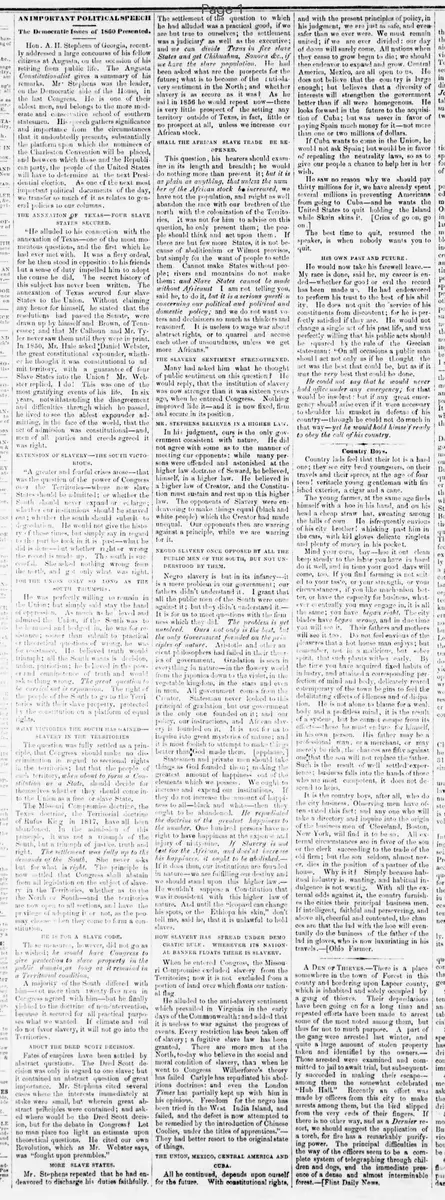
Hon. A. H. Stephens delivers a retiring speech in Augusta, Georgia, in 1860, defending Democratic policies on Texas annexation, slavery extension into territories, the Dred Scott decision, potential reopening of the African slave trade, and conditional union loyalty, emphasizing southern rights and natural law.
Clipping
OCR Quality
Full Text
The Democratic Issues of 1860 Presented.
Hon. A. H. Stephens of Georgia, recently addressed a large concourse of his fellow citizens at Augusta, on the occasion of his retiring from public life. The Augusta Constitutionalist gives a summary of his remarks. Mr. Stephens was the leader on the Democratic side of the House, in the last Congress. He is one of their ablest men, and belongs to the more moderate and conservative school of southern statesmen. His speech gathers significance and importance from the circumstances that it undoubtedly presents, substantially the platform upon which the nominees of the Charleston Convention will be placed and between which those and the Republican party, the people of the United States will have to determine at the next Presidential election. As one of the next most important political documents of the day, we transfer so much of it as relates to general policies to our columns.
THE ANNEXATION OF TEXAS—FOUR SLAVE STATES SECURED.
"He alluded to his connection with the annexation of Texas—one of the most momentous questions, and the first which he had ever met with. It was a fiery ordeal, for he then stood in opposition to his friends but a sense of duty impelled him to adopt the course he did. The secret history of this subject has never been written. The annexation of Texas secured four slave States to the Union. Without claiming any honor for himself, he stated that the resolutions had passed the Senate, were drawn up by himself and Brown, of Tennessee; and that Mr Calhoun and Mr. Tyler never saw them until they were in print. In 1850, Mr. Hale asked Daniel Webster, the great constitutional expounder, whether he thought it was constitutional to admit territory, with a guarantee of four Slave States into the Union? Mr. Webster replied, I do! This was one of the most gratifying events of his life. In six years, notwithstanding the disagreement and difficulties through which he passed, he lived to see the ablest expounder admitting, in the face of the world, that the act of admission was constitutional—and, men of all parties and creeds agreed it was right."
EXTENSION OF SLAVERY—THE SOUTH VICTORIOUS.
"A greater and fearful crisis arose—that was the question of the power of Congress over the Territories—where new slave States should be admitted: or whether the South should never expand or enlarge: whether our institutions should be starved out; whether the south should submit to degradation. He would not give the history of those times, but simply say in regard to the part he took in it is past—what he did is done—but whether right or wrong the record is made up. The south is successful. She asked nothing wrong from the north, and got only what was right."
FOR THE UNION ONLY SO LONG AS THE SOUTH TRIUMPHIS.
He was perfectly willing to remain in the Union; but simply said stay the hand of oppression. As much as he loved and admired the Union, if the South was to be made and humiliated in, he was for resistance; rather than submit to practical or theoretical impositions of wrong. he was for resistance. He believed truth would triumph; all the South wants is decision. Union, patriotism: he believed in the power and omnipotence of truth and would ask nothing wrong. The great question to be carried out is expansion. The right of the people of the South to go to the Territories with their slave property, protected by the constitution on a platform of equal rights.
WHAT VICTORIES THE SOUTH HAS GAINED— SLAVERY IN THE TERRITORIES
The question was fully settled as a principle, that Congress should make no discrimination in regard to sectional rights in the territories; but that the people of each territory, when about to form a Constitution as a State, should decide for themselves whether they should come in to the Union as a free or slave State. The Missouri Compromise doctrine, the Texas doctrine, the Territorial doctrine of Rufus King in 1817, have all been abandoned. In the admission of this principle, it was not a triumph of the South, but a triumph of justice, truth and right. The settlement was fully up to the demands of the South. She never asks but for what is right. The principle is now settled that Congress shall abstain from all legislation on the subject of slavery in the Territories, whether as to the the North or South—and the territories are now open to all sections, and have the privilege of adopting it or not, as the people may choose when they come to form a constitution.
HE IS FOR A SLAVE CODE.
These measures, however, did not go as he wished; he would have Congress to give protection to slave property in the public domain, as long as it remained in a Territorial condition. A majority of the South differed with him—not more than twenty five men in Congress agreed with him—but he finally yielded to the doctrine of non-intervention, because it secured for all practical purposes what we wanted If climate and soil do not favor slavery, it will not go into the Territories.
ABOUT THE DRED SCOTT DECISION
Fates of empires have been settled by abstract questions. The Dred Scott decision was only in regard to one slave; but it contained an abstract question of great importance. Mr. Stephens cited several cases where the interests immediately at stake were small, but wherein great abstract principles were contained: and asked where would be the Dred Scott decision, but for the debate in Congress? Let no man place too light an estimate upon theoretical questions. He cited our own Revolution, which as Mr. Webster says, was "fought upon preambles."
MORE SLAVE STATES.
Mr. Stephens repeated that he had endeavored to discharge his duties faithfully. The settlement of the question to which he had alluded was a practical good, if we are but true to ourselves; the settlement was a judiciary as well as the executive; and we can divide Texas in five slave States and get Chihuahua, Sonora &c., if we have the slave population. He had been asked what are the prospects for the future; what is to become of the anti-slavery sentiment in the North; and whether slavery is as secure as it was? As he said in 1856 he would repeat now—there is very little prospect of the setting any territory outside of Texas, in fact, little or no prospect at all, unless we increase our African stock.
SHALL THE AFRICAN SLAVE TRADE BE RE-OPENED.
This question, his hearers should examine in its length and breadth; he would do nothing more than present it; but it is as plain as anything, that unless the number of the African stock be increased, we have not the population, and might as well abandon the race with our brethren of the north with the colonization of the Territories. It was not for him to advise on this question, he only present them; the people should think and act upon them. If there are but few more States, it is not because of abolitionism or Wilmot provisos but simply for the want of people to settle them. Cannot make States without people; rivers and mountains do not make them: and Slave States cannot be made without Africans I am not telling you, said he, to do it, but it is a serious question concerning our political and domestic policy; and we do not want voters and declaimers so much as thinkers and reasoners. It is useless to wage war about abstract rights, or to quarrel and accuse each other of unsoundness, unless we get more Africans."
THE SLAVERY SENTIMENT STRENGTHENED.
Many had asked him what he thought of public sentiment on this question? He would reply, that the institution of slavery was now stronger than it was sixteen years ago, when he entered Congress. Nothing improved like it—and it is now fixed, firm and secure in its position.
MR. STEPHENS BELIEVES IN A HIGHER LAW.
In his judgment, ours is the only government consistent with nature. He did not agree with some as to the manner of meeting our opponents: while many persons were offended and astonished at the higher law doctrine of Seward, he believed, himself, in a higher law. He believed in a higher law of Creator, and the Constitution must sustain and rest upon this higher law. The opponents of Slavery were endeavoring to make things equal (black and white people) which the Creator had made unequal. 'Our opponents then are warring against a principle, while we are warring for it.
NEGRO SLAVERY ONCE OPPOSED BY ALL THE PUBLIC MEN OF THE SOUTH, BUT NOT UNDERSTOOD BY THEM.
Negro slavery is but in its infancy---it is a mere problem in our government; our fathers didn't understand it. I grant that all the public men of the South were once against it; but they didn't understand it - It is for us to meet questions with the firmness which they did. The problem is yet unsolved. Ours not only is the best, but the only Government founded on the principles of nature. Aristotle and other ancient philosophers had failed in their theories of government. Gradation is seen in everything in nature—in the flowery world from the japonica down to the violet, in the vegetable kingdom, in the stars and even in men. All government comes from the Creator. Statesmen never looked to this principal of gradation, but our government is the only one founded on it; and our policy, our institutions, and African slavery is founded on it. It is not for us to inquire into great mysteries of nature; and it is most foolish to attempt to make things better than God made them. [Applause.]
Statesmen and private men should take things as God founded them; making the greatest amount of happiness out of the elements which we possess. We ought to increase and expand our institutions. If they do not increase the amount of happiness to all—black and white—then they ought to be abandoned. He repudiated the doctrine of the greatest happiness to the number. One hundred persons have no right to have happiness at the expense and injury of ninety-nine. If Slavery is not best for the African, and doesn't increase his happiness, it ought to be abolished.— If it does then, our institutions are founded in nature—we are fulfilling our destiny and we should stand upon this higher law.— He wouldn't suppose a Constitution that was not consistent with this higher law of nature. And until the "leopard can change his spots, or the Ethiopian his skin," don't tell me, said he, that it is unlawful to hold slaves.
HOW SLAVERY HAS SPREAD UNDER DEMO- CRATIC RULE. WHEREVER ITS NATIONAL BANNER FLOATS THERE IS SLAVERY.
When he entered Congress, the Missouri Compromise excluded slavery from the Territories: now it is not excluded from a portion of land over which floats our national flag He alluded to the anti-slavery sentiment which prevailed in Virginia in the early days of the Commonwealth: and added that it is useless to war against the progress of events. Every restriction has been taken off of slavery; a fugitive slave law has been granted. There are more men at the North, to-day who believe in the social and moral condition of slavery, than when he went to Congress Wilberforce's theory has failed Carlyle has repudiated his abolition doctrines: and even the London Times has partially kept up with him in his opinions. Freedom for the negro has been tried in the West India Island, and failed, and the defect is now attempted to be remedied by the introduction of Chinese Coolies, under the titles of apprentices."— They had better resort to the original state of things.
THE UNION, MEXICO, CENTRAL AMERICA AND CUBA.
All he continued, depends upon ourselves for the future. With constitutional rights, and with the present principles of policy, in his judgment, we are just as safe, and even safer than we ever were. We must remain united; if we are ever divided: our day of doom will surely come. All nations when they cease to grow begin to die; we should then endeavor to expand and grow. Central America, Mexico, are all open to us. He does not believe that the country is large enough; but believes that a diversity of interests will strengthen the government better than if all were homogeneous. He looks forward in the future to the acquisition of Cuba; but was never in favor of paying Spain much money for it—not more than one or two millions of dollars. If Cuba wants to come in the Union, he would not ask Spain; but would be in favor of repealing the neutrality laws, so as to give our people a chance to help her in her wish. He saw no reason why we should pay thirty millions for it, we have already spent several millions in preventing Americans from going to Cuba—and he wants the United States to quit holding the Island while Spain skins it. [Cries of go on, go on.]
The best time to quit, resumed the speaker, is when nobody wants you to quit.
HIS OWN PAST AND FUTURE.
He would now take his farewell leave.— My race is done, said he, my career is ended—whether for good or evil the record has been made up. He had endeavored to perform his trust to the best of his ability. He does not quit the "service of his constituents from discontent; for he is perfectly satisfied if they are. He would not change a single act of his past life, and was perfectly willing that his public acts should be squared by the rule of the Grecian statesman: "On all occasions a public man should act not only as if he thought the act was the best that could be, but as if it was the very best that could be done."
He could not say that he would never hold office under any emergency; for that would be insolent : but if any great emergency should arise even if it were necessary to shoulder his musket in defense of his country—though he could not do much in that way—yet he would hold himself ready to obey the call of his country.
What sub-type of article is it?
What themes does it cover?
What keywords are associated?
What entities or persons were involved?
Where did it happen?
Story Details
Key Persons
Location
Augusta, Georgia
Event Date
1860
Story Details
In his retiring speech, Stephens recounts his role in Texas annexation securing slave states, defends southern victories on slavery in territories, supports non-intervention but prefers slave code, praises Dred Scott decision, suggests reopening African slave trade for expansion, affirms slavery's natural basis under higher law, advocates territorial acquisitions like Cuba, and pledges loyalty to union if rights protected.