Thank you for visiting SNEWPapers!
Sign up free
Story
May 1, 1912
The Laurens Advertiser
Laurens, Laurens County, South Carolina
What is this article about?
In 1912, Roosevelt and Taft campaign managers dispute control of South Carolina's 'black and tan' Republican delegates. Taft's manager McKinley refutes Roosevelt's claim of support from the First Congressional District, detailing how chairman English's attempt to dictate Roosevelt delegates failed, leading to Taft's selection by the majority.
Clipping
OCR Quality
98%
Excellent
Full Text
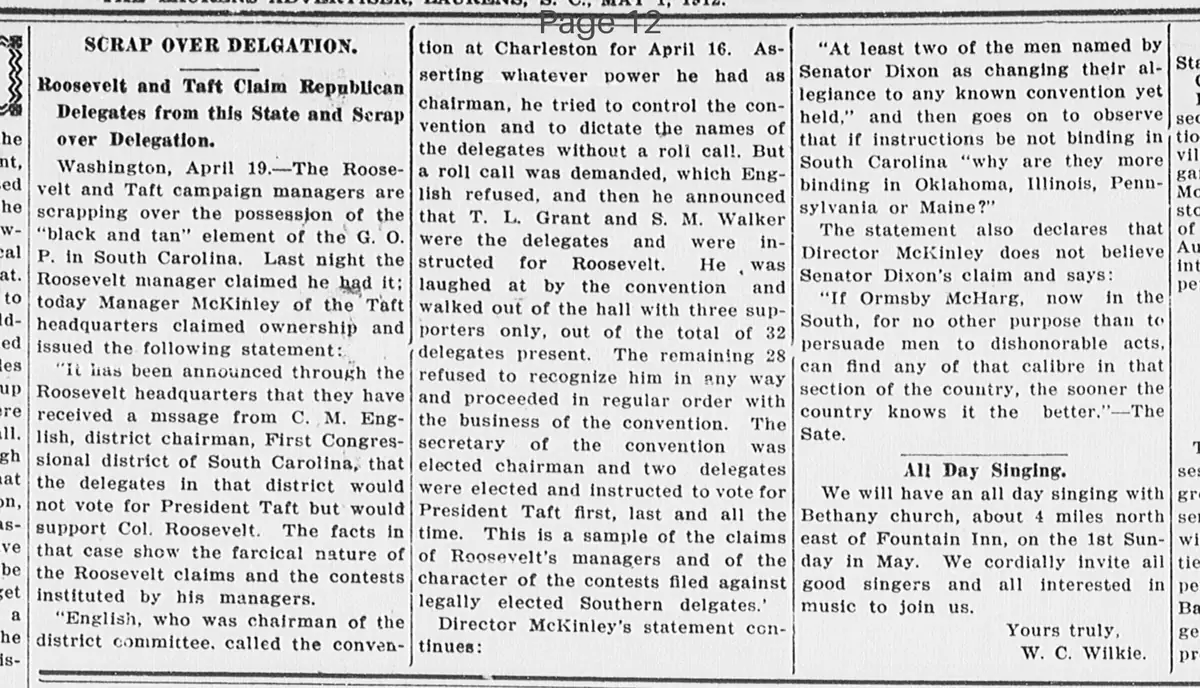
SCRAP OVER DELEGATION.
Roosevelt and Taft Claim Republican Delegates from this State and Scrap over Delegation.
Washington, April 19.—The Roosevelt and Taft campaign managers are scrapping over the possession of the "black and tan" element of the G. O. P. in South Carolina. Last night the Roosevelt manager claimed he had it; today Manager McKinley of the Taft headquarters claimed ownership and issued the following statement:
"It has been announced through the Roosevelt headquarters that they have received a message from C. M. English, district chairman, First Congressional district of South Carolina, that the delegates in that district would not vote for President Taft but would support Col. Roosevelt. The facts in that case show the farcical nature of the Roosevelt claims and the contests instituted by his managers.
"English, who was chairman of the district committee, called the convention at Charleston for April 16. Asserting whatever power he had as chairman, he tried to control the convention and to dictate the names of the delegates without a roll call. But a roll call was demanded, which English refused, and then he announced that T. L. Grant and S. M. Walker were the delegates and were instructed for Roosevelt. He was laughed at by the convention and walked out of the hall with three supporters only, out of the total of 32 delegates present. The remaining 28 refused to recognize him in any way and proceeded in regular order with the business of the convention. The secretary of the convention was elected chairman and two delegates were elected and instructed to vote for President Taft first, last and all the time. This is a sample of the claims of Roosevelt's managers and of the character of the contests filed against legally elected Southern delegates."
Director McKinley's statement continues:
"At least two of the men named by Senator Dixon as changing their allegiance to any known convention yet held," and then goes on to observe that if instructions be not binding in South Carolina "why are they more binding in Oklahoma, Illinois, Pennsylvania or Maine?"
The statement also declares that Director McKinley does not believe Senator Dixon's claim and says:
"If Ormsby McHarg, now in the South, for no other purpose than to persuade men to dishonorable acts, can find any of that calibre in that section of the country, the sooner the country knows it the better."—The State.
Roosevelt and Taft Claim Republican Delegates from this State and Scrap over Delegation.
Washington, April 19.—The Roosevelt and Taft campaign managers are scrapping over the possession of the "black and tan" element of the G. O. P. in South Carolina. Last night the Roosevelt manager claimed he had it; today Manager McKinley of the Taft headquarters claimed ownership and issued the following statement:
"It has been announced through the Roosevelt headquarters that they have received a message from C. M. English, district chairman, First Congressional district of South Carolina, that the delegates in that district would not vote for President Taft but would support Col. Roosevelt. The facts in that case show the farcical nature of the Roosevelt claims and the contests instituted by his managers.
"English, who was chairman of the district committee, called the convention at Charleston for April 16. Asserting whatever power he had as chairman, he tried to control the convention and to dictate the names of the delegates without a roll call. But a roll call was demanded, which English refused, and then he announced that T. L. Grant and S. M. Walker were the delegates and were instructed for Roosevelt. He was laughed at by the convention and walked out of the hall with three supporters only, out of the total of 32 delegates present. The remaining 28 refused to recognize him in any way and proceeded in regular order with the business of the convention. The secretary of the convention was elected chairman and two delegates were elected and instructed to vote for President Taft first, last and all the time. This is a sample of the claims of Roosevelt's managers and of the character of the contests filed against legally elected Southern delegates."
Director McKinley's statement continues:
"At least two of the men named by Senator Dixon as changing their allegiance to any known convention yet held," and then goes on to observe that if instructions be not binding in South Carolina "why are they more binding in Oklahoma, Illinois, Pennsylvania or Maine?"
The statement also declares that Director McKinley does not believe Senator Dixon's claim and says:
"If Ormsby McHarg, now in the South, for no other purpose than to persuade men to dishonorable acts, can find any of that calibre in that section of the country, the sooner the country knows it the better."—The State.
What sub-type of article is it?
Historical Event
What themes does it cover?
Deception
Justice
What keywords are associated?
Political Contest
Republican Delegates
South Carolina
Roosevelt Taft
Convention Dispute
Taft Support
What entities or persons were involved?
Roosevelt
Taft
C. M. English
T. L. Grant
S. M. Walker
Manager Mckinley
Senator Dixon
Ormsby Mcharg
Where did it happen?
South Carolina, Washington
Story Details
Key Persons
Roosevelt
Taft
C. M. English
T. L. Grant
S. M. Walker
Manager Mckinley
Senator Dixon
Ormsby Mcharg
Location
South Carolina, Washington
Event Date
April 19
Story Details
Roosevelt and Taft managers contest South Carolina Republican delegates; McKinley exposes English's failed attempt to impose Roosevelt supporters at Charleston convention on April 16, where majority elected Taft delegates.