Thank you for visiting SNEWPapers!
Sign up free
The Pioche Record
Pioche, Lincoln County, Nevada
What is this article about?
Paris fall fashion trends draw from masculine directoire dandy styles of the late 1700s, featuring exaggerated coat-tails, contrasting fabrics, pleats, full-length snug sleeves, belts at normal waistline, and abundant buttons. Grays are popular, skirts narrow with plaiting, and footwear slender with buckles.
Merged-components note: Merged image with spatial overlap into fashion article.
Clipping
OCR Quality
Full Text
What the Smartest Dressmakers Are Now Displaying.
Hints That May Help the Undecided
The new fashions are directoire, says Paris, but with a difference. The directoire styles we have all been used to during the past seasons were feminine directoire fashions—now the masculine directoire modes are to have their turn. And if ever modishness was the mode for masculinity, it was in the elegant directoire days when every chap under his dotage was a dandy—and some old fellows in the dotage age, too. These gay dogs, if you please, affected silk stockings, and starched sleeve and neck frills, and perfumed coiffures. They were as fastidious about their cosmetics as any belle of today, and at the same time they could handle a sword and swallow a round of toasts in a way that proved them anything but effeminate.
The directoire dandy wore an oddly cut coat, which was somewhat like the modern dress coat extremely exaggerated. This coat had a sharply cutaway effect in front and tremendously long tails at the back, a high, turned-down collar, huge revers, and long, snugly fitting sleeves. Filmy frills escaped from the sleeves and foamed down the front of a lively waistcoat, between the big coat revers. It is these dandified coats of the late seventeen-hundreds that have formed the inspiration for women's tailored wear this season. The coat-tails, the cutaway fronts, the gay vest, the frills, the fanciful revers are all here, and coats are built in contrasting color and material to suggest the directoire dandy's cloth coat and satin breeches. Half of the new tailored wear for fall—hailing from Paris—shows the coat and skirt of contrasting fabrics, and the broadcloth coat with a velvet or satin skirt is seen as frequently as the velvet coat with a skirt of cloth or silk. Smooth finished materials are in high favor, and though rough cheviots, wide welted serges and homespuns will undoubtedly be used, for tailored suits and coats, the silky broadcloths, very soft chiffon velvets, faille silks and poplin weaves will be favored for dressy costumes. A mixed weave of worsted with mohair threads, called in Paris a permo weave, is particularly well liked because of its lustrous, silky texture, and this permo fabric comes in all the subdued, hard-to-describe colorings in which the French couturiers delight. A taupe shade and a deep mulberry shade are perhaps the most distinctive.
Grays In Favor.
Grays continue in the pronounced favor accorded them this summer, and many of the women who wore nothing but black and white combinations last season are now taking up their grays. It is a wise woman who, electing to dress in gray for a season, selects one particular shade of gray and keeps to it. There are dozens of shades and gradations of shade in the grays: there are blue-grays, mauve-grays, pink-grays; taupe, smoke and elephant grays, and one gray can clash with another with as grating an effect as pink and orange or any other outrageous color combination.
Two striking features of Paris fashions for fall are the prevalence of pleats and the full-length sleeve. The elbow sleeve has passed with the high waistline—which is now relegated to the limbo of passe fashions. All belts are at the waistline normal; and some of the coat effects even drop below this point; and to make sure that nobody shall mistake the fact that a normal waistline is now the mode, fashion has decreed that all waists shall be emphasized by a girdle, belt or sash of one sort or another. This is again a memory of the directoire dandy, whose sash, if his costume was military, was a very ornamental part thereof.
Sleeves are not only long, but they are snug. They cover the forearm and even the wrist in all coats, frocks and blouses intended for day-wear. Elbow sleeves in the form of loose, lace draperies are noted on some of the newer evening frocks, but the bare forearm is not considered de rigeur during the morning or afternoon—unless with an informal at-home costume. Many of the sleeves have a most eccentric and fanciful cut, and frills falling from the lower edge add to their length. Cuffs are enormously modish and the fashionable cuff may be a mere band, or a deep affair slashed, notched and garnished with many buttons and buttonhole loops. In fact, buttons are the style fetish of the fall season. No good luck can come to a costume which does not boast buttons in some part of its make-up, and one may pay as much for one's buttons as for the material of one's gown. New buttons made of silk braid are very fashionable on tailored coats and skirts of broadcloth, and these braid buttons are used also on silk and velvet costumes with good effect.
Machine Plait Everything
Buttons and sleeves have rather sidetracked the Scribe from the subject of plaits—a most vitally significant issue just now; for it is the plait that is going to work a transformation in the silhouette, though the change will probably be so gradual that nobody will realize that skirt lines have completely changed until the metamorphosis has been wrought. Everything is plaited—in one way or another—and we are seeing again the old, old-fashioned knife plaits, tacked together on the under side with lengths of tape so that they may not spread apart. There are, among the new Paris models for autumn, skirts plaited all around at the top, in narrow knife-plaiting, yet so trimly held in place by rows of these confining tapes that the measurement at knee and foot does not exceed the prescribed two yards or so, and the silhouette is as slim and narrow as fashion still demands. Machine-plaited skirts are at the pinnacle of the mode. This machine plaiting—or accordion plaiting, as it is sometimes called—is put into even velvet and broadcloth fabrics, though, of course, the best effects are produced with satin, heavy silk or the soft, lustrous permo fabrics above referred to. When the whole skirt or part of it in panels or drapery, is not plaited, there is apt to be some trimming in the form of plaited quillings—or narrow bands of knife-plaiting stitched about half an inch inside either edge. A very smart coat designed by Mme. Paquin for her own use is of navy blue faille silk with yards and yards of this quilled plaiting, or plaited plaiting—whichever one chooses—in trimming bands. Pipings made of tiny plaitings stand up from every seam.
Watteau plaits and paniers are being used with discretion by many of the couturiers, to give a touch of grace and picturesqueness to fall models. The Watteau plait is noted even on tailored coats, and it appears constantly on handsome wraps for evening wear.
The panier is a much chastened and subdued modification of the impertinent puffed-out affair which heralded the arrival of this fashion last spring, and many of the looped and draped paniers on fall frocks are exquisitely graceful. Skirts remain narrow at the foot, all the width being introduced in plaitings and long, clinging draperies which do not interfere with the slim silhouette. There seems a tendency to make skirts a bit longer, though footwear is as coquettish and fetching as ever. The new boots for fall have patent leather or dull kid vamps and buttoned tops of dull kid, ox or cloth. The very aristocratic boot is as long and slender in line as it can be and fits its wearer daintily. Anything like a stubby effect is considered cheap and common, and the slender, aristocratic foot has the day.
Shoe buckles are tremendously fashionable—still another echo of our directoire dandy—and while the trim, buttoned boot will continue to be the correct thing for the street and for afternoon wear with handsome toilettes, buckled slippers and pumps with embroidered silk stockings promise to be in great favor for evening and house wear.
Shantung Costume.
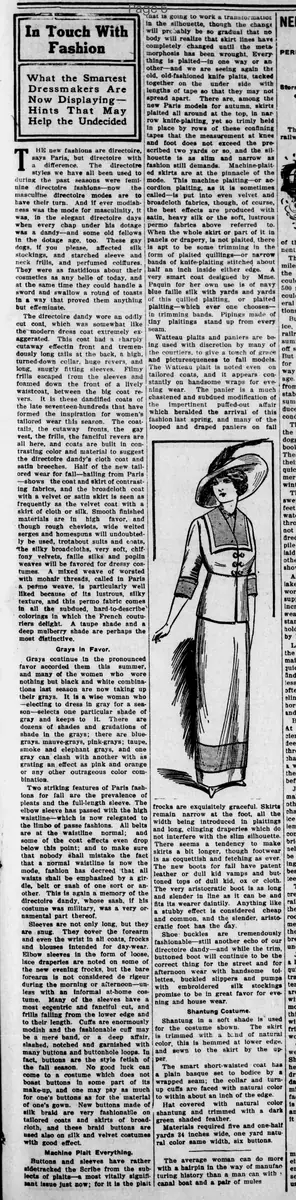
Shantung in a soft shade is used for the costume shown. The skirt is trimmed with a band of natural color, this is hemmed at lower edge, and sewn to the skirt by the upper. The smart short-waisted coat has a plain basque set to bodice by a wrapped seam; the collar and turn-up cuffs are faced with natural color to within about an inch of the edge. Hat covered with natural color shantung and trimmed with a dark green shaded feather.
Materials required five and one-half yards 34 inches wide, one yard natural color same width, six buttons.
The average woman can do more with a hairpin in the way of manufacturing history than a man can with canal boat and a pair of mules.
What sub-type of article is it?
What themes does it cover?
What keywords are associated?
What entities or persons were involved?
Where did it happen?
Story Details
Key Persons
Location
Paris
Event Date
Fall
Story Details
Paris introduces masculine directoire-inspired fashions for women, including tailored coats with cutaway fronts, long tails, contrasting fabrics, pleats, full snug sleeves, normal waistlines with belts, and buttons; grays favored; skirts narrow with plaiting; slender boots with buckles.