Thank you for visiting SNEWPapers!
Sign up free
Domestic News
March 26, 1857
The Carolina Spartan
Spartanburg, Spartanburg County, South Carolina
What is this article about?
Article shares uncredited advice on cultivating sweet potatoes, detailing hot-bed preparation, planting in loamy soil, spacing, care, and storage methods for optimal yield.
Clipping
OCR Quality
98%
Excellent
Full Text
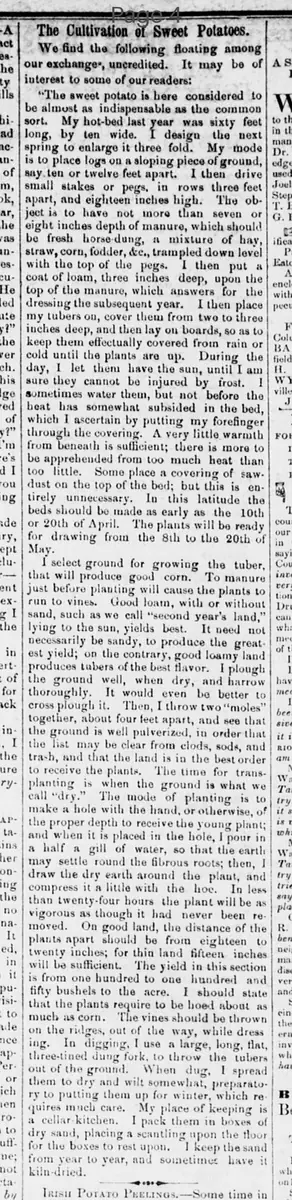
The Cultivation of Sweet Potatoes.
We find the following floating among our exchanges, uncredited. It may be of interest to some of our readers:
"The sweet potato is here considered to be almost as indispensable as the common sort. My hot-bed last year was sixty feet long, by ten wide. I design the next spring to enlarge it threefold. My mode is to place logs on a sloping piece of ground, say ten or twelve feet apart. I then drive small stakes or pegs, in rows three feet apart, and eighteen inches high. The object is to have not more than seven or eight inches depth of manure, which should be fresh horse-dung, a mixture of hay, straw, corn, fodder, &c., trampled down level with the top of the pegs. I then put a coat of loam, three inches deep, upon the top of the manure, which answers for the dressing the subsequent year. I then place my tubers on, cover them from two to three inches deep, and then lay on boards, so as to keep them effectually covered from rain or cold until the plants are up. During the day, I let them have the sun, until I am sure they cannot be injured by frost. I sometimes water them, but not before the heat has somewhat subsided in the bed which I ascertain by putting my forefinger through the covering. A very little warmth from beneath is sufficient; there is more to be apprehended from too much heat than too little. Some place a covering of sawdust on the top of the bed; but this is entirely unnecessary. In this latitude the beds should be made as early as the 10th or 20th of April. The plants will be ready for drawing from the 8th to the 20th of May.
I select ground for growing the tuber, that will produce good corn. To manure just before planting will cause the plants to run to vines. Good loam, with or without sand, such as we call "second year's land," lying to the sun, yields best. It need not necessarily be sandy, to produce the greatest yield; on the contrary, good loamy land produces tubers of the best flavor. I plough the ground well, when dry, and harrow thoroughly. It would even be better to cross plough it. Then, I throw two "moles" together, about four feet apart, and see that the ground is well pulverized, in order that the list may be clear from clods, sods, and trash, and that the land is in the best order to receive the plants. The time for transplanting is when the ground is what we call "dry." The mode of planting is to make a hole with the hand, or otherwise, of the proper depth to receive the young plant; and when it is placed in the hole, I pour in a half a gill of water, so that the earth may settle round the fibrous roots; then, I draw the dry earth around the plant, and compress it a little with the hoe. In less than twenty-four hours the plant will be as vigorous as though it had never been removed. On good land, the distance of the plants apart should be from eighteen to twenty inches; for thin land fifteen inches will be sufficient. The yield in this section is from one hundred to one hundred and fifty bushels to the acre. I should state that the plants require to be hoed about as much as corn. The vines should be thrown on the ridges, out of the way, while dressing. In digging, I use a large, long, flat, three-tined dung fork, to throw the tubers out of the ground. When dug, I spread them to dry and wilt somewhat, preparatory to putting them up for winter, which requires much care. My place of keeping is a cellar-kitchen. I pack them in boxes of dry sand, placing a scantling upon the floor for the boxes to rest upon. I keep the sand from year to year, and sometimes have it kiln-dried."
We find the following floating among our exchanges, uncredited. It may be of interest to some of our readers:
"The sweet potato is here considered to be almost as indispensable as the common sort. My hot-bed last year was sixty feet long, by ten wide. I design the next spring to enlarge it threefold. My mode is to place logs on a sloping piece of ground, say ten or twelve feet apart. I then drive small stakes or pegs, in rows three feet apart, and eighteen inches high. The object is to have not more than seven or eight inches depth of manure, which should be fresh horse-dung, a mixture of hay, straw, corn, fodder, &c., trampled down level with the top of the pegs. I then put a coat of loam, three inches deep, upon the top of the manure, which answers for the dressing the subsequent year. I then place my tubers on, cover them from two to three inches deep, and then lay on boards, so as to keep them effectually covered from rain or cold until the plants are up. During the day, I let them have the sun, until I am sure they cannot be injured by frost. I sometimes water them, but not before the heat has somewhat subsided in the bed which I ascertain by putting my forefinger through the covering. A very little warmth from beneath is sufficient; there is more to be apprehended from too much heat than too little. Some place a covering of sawdust on the top of the bed; but this is entirely unnecessary. In this latitude the beds should be made as early as the 10th or 20th of April. The plants will be ready for drawing from the 8th to the 20th of May.
I select ground for growing the tuber, that will produce good corn. To manure just before planting will cause the plants to run to vines. Good loam, with or without sand, such as we call "second year's land," lying to the sun, yields best. It need not necessarily be sandy, to produce the greatest yield; on the contrary, good loamy land produces tubers of the best flavor. I plough the ground well, when dry, and harrow thoroughly. It would even be better to cross plough it. Then, I throw two "moles" together, about four feet apart, and see that the ground is well pulverized, in order that the list may be clear from clods, sods, and trash, and that the land is in the best order to receive the plants. The time for transplanting is when the ground is what we call "dry." The mode of planting is to make a hole with the hand, or otherwise, of the proper depth to receive the young plant; and when it is placed in the hole, I pour in a half a gill of water, so that the earth may settle round the fibrous roots; then, I draw the dry earth around the plant, and compress it a little with the hoe. In less than twenty-four hours the plant will be as vigorous as though it had never been removed. On good land, the distance of the plants apart should be from eighteen to twenty inches; for thin land fifteen inches will be sufficient. The yield in this section is from one hundred to one hundred and fifty bushels to the acre. I should state that the plants require to be hoed about as much as corn. The vines should be thrown on the ridges, out of the way, while dressing. In digging, I use a large, long, flat, three-tined dung fork, to throw the tubers out of the ground. When dug, I spread them to dry and wilt somewhat, preparatory to putting them up for winter, which requires much care. My place of keeping is a cellar-kitchen. I pack them in boxes of dry sand, placing a scantling upon the floor for the boxes to rest upon. I keep the sand from year to year, and sometimes have it kiln-dried."
What sub-type of article is it?
Agriculture
What keywords are associated?
Sweet Potato Cultivation
Hot Bed Preparation
Planting Techniques
Farming Advice
Yield Storage
Domestic News Details
Event Details
Detailed instructions on preparing hot-beds with manure and loam for starting sweet potato plants in April, transplanting to loamy ground in May, spacing plants 15-20 inches apart, hoeing like corn, harvesting with a dung fork, and storing in sand-filled boxes in a cellar-kitchen. Yields 100-150 bushels per acre on good land.