Thank you for visiting SNEWPapers!
Sign up free
Story
December 31, 1851
North Carolina Standard
Raleigh, Wake County, North Carolina
What is this article about?
Senator Stephen Douglas explains in the U.S. Senate his absence from the final vote on the Fugitive Slave Law due to a pressing financial obligation in New York, reaffirming his support for the bill and the Compromise of 1850 measures, countering accusations of evasion.
Clipping
OCR Quality
98%
Excellent
Full Text
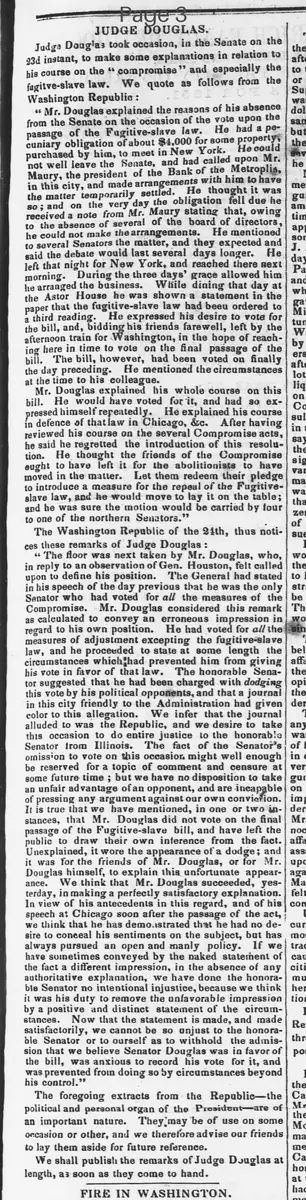
JUDGE DOUGLAS,
Judge Douglas took occasion, in the Senate on the 23d instant, to make some explanations in relation to his course on the "compromise" and especially the fugitive-slave law. We quote as follows from the Washington Republic:
"Mr. Douglas explained the reasons of his absence from the Senate on the occasion of the vote upon the passage of the Fugitive-slave law. He had a pecuniary obligation of about $4,000 for some property, purchased by him, to meet in New York. He could not well leave the Senate, and had called upon Mr. Maury, the president of the Bank of the Metropolis, in this city, and made arrangements with him to have the matter temporarily settled. He thought it was so; and on the very day the obligation fell due he mentioned to several Senators the matter, and they expected and said the debate would last several days longer. He left that night for New York, and reached there next morning. During the three days' grace allowed him he arranged the business. While dining that day at the Astor House he was shown a statement in the paper that the fugitive-slave law had been ordered to a third reading. He expressed his desire to vote for the bill, and, bidding his friends farewell, left by the afternoon train for Washington, in the hope of reaching here in time to vote on the final passage of the bill." The bill, however, had been voted on finally the day preceding. He mentioned the circumstances at the time to his colleague.
Mr. Douglas explained his whole course on this bill. He would have voted for it, and had so expressed himself repeatedly. He explained his course in defence of that law in Chicago, &c. After having reviewed his course on the several Compromise acts, he said he regretted the introduction of this resolution. He thought the friends of the Compromise ought to have left it for the abolitionists to have moved in the matter. Let them redeem their pledge to introduce a measure for the repeal of the Fugitive-slave law, and he would move to lay it on the table; and he was sure the motion would be carried by four to one of the northern Senators."
The Washington Republic of the 21st, thus notices these remarks of Judge Douglas:
"The floor was next taken by Mr. Douglas, who, in reply to an observation of Gen. Houston, felt called upon to define his position. The General had stated in his speech of the day previous that he was the only Senator who had voted for all the measures of the Compromise. Mr. Douglas considered this remark as calculated to convey an erroneous impression in regard to his own position. He had voted for all the measures of adjustment excepting the fugitive-slave law, and he proceeded to state at some length the circumstances which had prevented him from giving his vote in favor of that law. The honorable Senator suggested that he had been charged with dodging this vote by his political opponents, and that a journal in this city friendly to the Administration had given color to this allegation. We infer that the journal alluded to was the Republic, and we desire to take this occasion to do entire justice to the honorable Senator from Illinois. The fact of the Senator's omission to vote on this occasion might well enough be reserved for a topic of comment and censure at some future time; but we have no disposition to take an unfair advantage of an opponent, and are incapable of pressing any argument against our own conviction. It is true that we have mentioned, in one or two instances, that Mr. Douglas did not vote on the final passage of the Fugitive-slave bill, and have left the public to draw their own inference from the fact. Unexplained, it wore the appearance of a dodge; and it was for the friends of Mr. Douglas, or for Mr. Douglas himself, to explain this unfortunate appearance. We think that Mr. Douglas succeeded, yesterday, in making a perfectly satisfactory explanation. In view of his antecedents in this regard, and of his speech at Chicago soon after the passage of the act, we think that he has demonstrated that he had no desire to conceal his sentiments on the subject, but has always pursued an open and manly policy. If we have sometimes conveyed by the naked statement of the fact a different impression, in the absence of any authoritative explanation, we have done the honorable Senator no intentional injustice, because we think it was his duty to remove the unfavorable impression by a positive and distinct statement of the circumstances. Now that the statement is made, and made satisfactorily, we cannot be so unjust to the honorable Senator or to ourself as to withhold the admission that we believe Senator Douglas was in favor of the bill, was anxious to record his vote for it, and was prevented from doing so by circumstances beyond his control."
The foregoing extracts from the Republic, the political and personal organ of the President, are of an important nature. They may be of use on some occasion or other, and we therefore advise our friends to lay them aside for future reference.
We shall publish the remarks of Judge Douglas at length, as soon as they come to hand.
Judge Douglas took occasion, in the Senate on the 23d instant, to make some explanations in relation to his course on the "compromise" and especially the fugitive-slave law. We quote as follows from the Washington Republic:
"Mr. Douglas explained the reasons of his absence from the Senate on the occasion of the vote upon the passage of the Fugitive-slave law. He had a pecuniary obligation of about $4,000 for some property, purchased by him, to meet in New York. He could not well leave the Senate, and had called upon Mr. Maury, the president of the Bank of the Metropolis, in this city, and made arrangements with him to have the matter temporarily settled. He thought it was so; and on the very day the obligation fell due he mentioned to several Senators the matter, and they expected and said the debate would last several days longer. He left that night for New York, and reached there next morning. During the three days' grace allowed him he arranged the business. While dining that day at the Astor House he was shown a statement in the paper that the fugitive-slave law had been ordered to a third reading. He expressed his desire to vote for the bill, and, bidding his friends farewell, left by the afternoon train for Washington, in the hope of reaching here in time to vote on the final passage of the bill." The bill, however, had been voted on finally the day preceding. He mentioned the circumstances at the time to his colleague.
Mr. Douglas explained his whole course on this bill. He would have voted for it, and had so expressed himself repeatedly. He explained his course in defence of that law in Chicago, &c. After having reviewed his course on the several Compromise acts, he said he regretted the introduction of this resolution. He thought the friends of the Compromise ought to have left it for the abolitionists to have moved in the matter. Let them redeem their pledge to introduce a measure for the repeal of the Fugitive-slave law, and he would move to lay it on the table; and he was sure the motion would be carried by four to one of the northern Senators."
The Washington Republic of the 21st, thus notices these remarks of Judge Douglas:
"The floor was next taken by Mr. Douglas, who, in reply to an observation of Gen. Houston, felt called upon to define his position. The General had stated in his speech of the day previous that he was the only Senator who had voted for all the measures of the Compromise. Mr. Douglas considered this remark as calculated to convey an erroneous impression in regard to his own position. He had voted for all the measures of adjustment excepting the fugitive-slave law, and he proceeded to state at some length the circumstances which had prevented him from giving his vote in favor of that law. The honorable Senator suggested that he had been charged with dodging this vote by his political opponents, and that a journal in this city friendly to the Administration had given color to this allegation. We infer that the journal alluded to was the Republic, and we desire to take this occasion to do entire justice to the honorable Senator from Illinois. The fact of the Senator's omission to vote on this occasion might well enough be reserved for a topic of comment and censure at some future time; but we have no disposition to take an unfair advantage of an opponent, and are incapable of pressing any argument against our own conviction. It is true that we have mentioned, in one or two instances, that Mr. Douglas did not vote on the final passage of the Fugitive-slave bill, and have left the public to draw their own inference from the fact. Unexplained, it wore the appearance of a dodge; and it was for the friends of Mr. Douglas, or for Mr. Douglas himself, to explain this unfortunate appearance. We think that Mr. Douglas succeeded, yesterday, in making a perfectly satisfactory explanation. In view of his antecedents in this regard, and of his speech at Chicago soon after the passage of the act, we think that he has demonstrated that he had no desire to conceal his sentiments on the subject, but has always pursued an open and manly policy. If we have sometimes conveyed by the naked statement of the fact a different impression, in the absence of any authoritative explanation, we have done the honorable Senator no intentional injustice, because we think it was his duty to remove the unfavorable impression by a positive and distinct statement of the circumstances. Now that the statement is made, and made satisfactorily, we cannot be so unjust to the honorable Senator or to ourself as to withhold the admission that we believe Senator Douglas was in favor of the bill, was anxious to record his vote for it, and was prevented from doing so by circumstances beyond his control."
The foregoing extracts from the Republic, the political and personal organ of the President, are of an important nature. They may be of use on some occasion or other, and we therefore advise our friends to lay them aside for future reference.
We shall publish the remarks of Judge Douglas at length, as soon as they come to hand.
What sub-type of article is it?
Historical Event
Biography
What themes does it cover?
Justice
Deception
What keywords are associated?
Fugitive Slave Law
Senate Vote
Judge Douglas
Compromise Of 1850
Political Explanation
Washington Republic
What entities or persons were involved?
Judge Douglas
Mr. Maury
Gen. Houston
Where did it happen?
U.S. Senate, Washington; New York; Chicago
Story Details
Key Persons
Judge Douglas
Mr. Maury
Gen. Houston
Location
U.S. Senate, Washington; New York; Chicago
Event Date
23d Instant
Story Details
Senator Douglas explains his absence from the Fugitive Slave Law vote due to a $4,000 financial obligation in New York, which he rushed to settle, missing the final passage by one day; he affirms his support for the bill and Compromise measures, regretting resolutions challenging them.