Thank you for visiting SNEWPapers!
Sign up free
Daily National Intelligencer
Washington, District Of Columbia
What is this article about?
Report on U.S. House of Representatives proceedings on Dec. 27, 1816, debating amendment to bill for compensating military property losses in War of 1812, focusing on repealing section for destroyed houses; committee rejects rising. Followed by list of petitions from Dec. 12-19 for war compensations, pensions, duty relief, and other claims.
Merged-components note: Merged the image (likely masthead or illustration), congressional proceedings story, and list of petitions as they form a single coherent congressional news component. Sequential reading orders (49,50,51) and adjacent/spatially overlapping bboxes indicate they belong together. Changed label from 'notice' for the petitions list to 'story' to reflect the overall news content.
Clipping
OCR Quality
Full Text
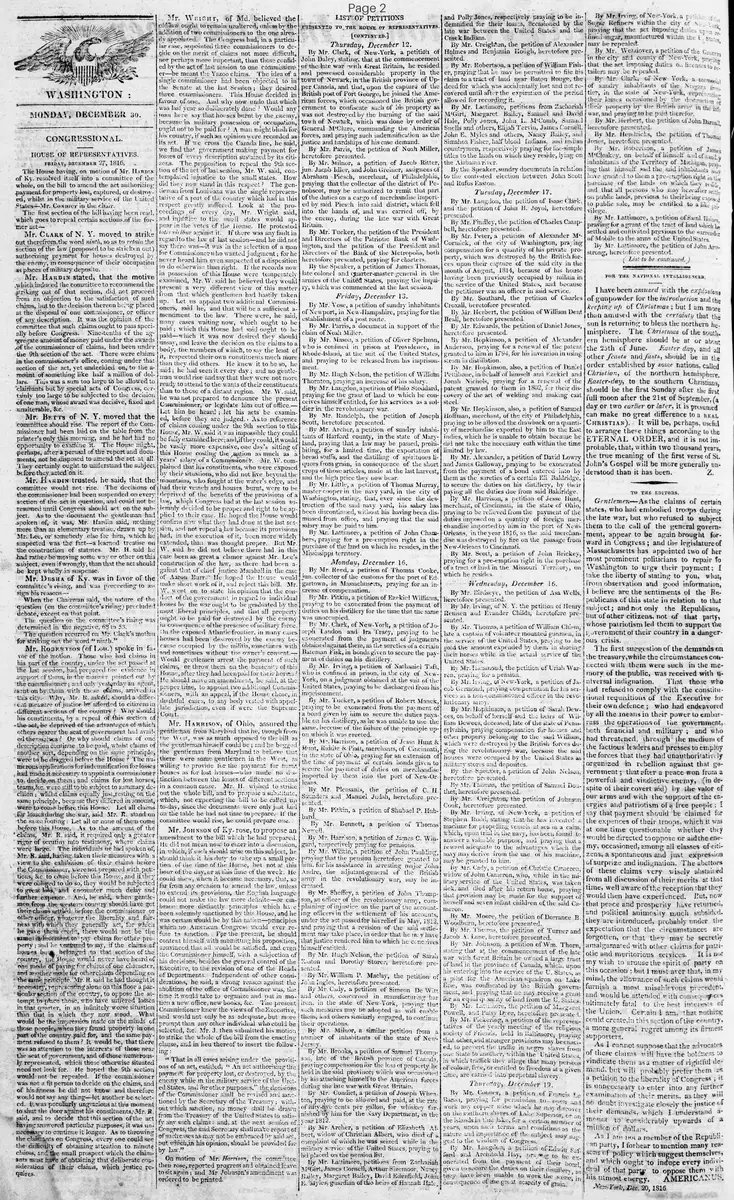
MONDAY DECEMBER 30
CONGRESSIONAL,
HOUSE OF REPRESENTATIVES.
FRIDAY, DECEMBER 27, 1816.
The House having, on motion of Mr. Harding of Ky. resolved itself into a committee of the whole, on the bill to amend the act authorizing payment for property lost, captured, or destroyed, whilst in the military service of the United States—Mr. Connor in the chair.
The first section of the bill having been read, which goes to repeal certain sections of the former act—
Mr. Clark of N. Y. moved to strike out therefrom the word ninth, so as to retain the section of the law (proposed to be stricken out) authorizing payment for houses destroyed by the enemy, in consequence of their occupation as places of military deposit.
Mr. Hardin stated, that the motive which induced the committee to recommend the striking out of that section, did not proceed from an objection to the satisfaction of such claims, but to the decision thereon being placed at the disposal of one commissioner, or officer of any description. It was the opinion of the committee that such claims ought to pass specially before Congress. Nine-tenths of the aggregate amount of money paid under the awards of the commissioner of claims, had been under the 9th section of the act. There were claims in the commissioner's office, coming under that section of the act, yet undecided on, to the amount of something like half a million of dollars. This was a sum too large to be allowed to claimants but by special acts of Congress, certainly too large to be subjected to the decision of one man, whose award was decisive, fixed and unalterable, &c.
Mr. Burr of N. Y. moved that the committee should rise. The report of the Commissioner had been laid on the table from the printer's only this morning, and he had had no opportunity to examine it. The House might, perhaps, after a perusal of the report and documents, not be disposed to amend the act at all. They certainly ought to understand the subject before they acted on it.
Mr. Hardin trusted, he said, that the committee would not rise. The decisions of the commissioner had been suspended on every section of the act in question, and could not be resumed until Congress should act on the subject. As to the document the gentleman had spoken of, it was, Mr. Hardin said, nothing more than an elementary treatise, drawn up by Mr. Lee, or somebody else for him, which he suspected was the fact—a learned treatise on the construction of statutes. Mr. H. said he had rather be moving some way or other on this subject, even if wrongly, than that the act should be kept wholly in suspense.
Mr. Desha of Ky. was in favor of the committee's rising, and was proceeding to assign his reasons—
When the Chairman said, the nature of the question (on the committee's rising) precluded debate, except on that point.
The question on the committee's rising was determined in the negative, 68 to 53.
The question recurred on Mr. Clark's motion for striking out the word "ninth."
Mr. Robertson (of La.) spoke in favor of the motion. Those who had claims in his part of the country, under the act passed at the last session, had prepared the evidence in support of them, in the manner pointed out by the commissioner: and only yesterday an agent sent on by them with these claims, arrived in this city. Why, Mr. R. asked, should a different measure of justice be afforded to citizens in different sections of the country? Why should his constituents, by a repeal of this section of the act, be deprived of the advantages of which others nearer the seat of government had availed themselves? Or why should claims of one description continue to be paid, whilst claims of another sort, depending on the same principle, were to be dragged before the House? The numerous applications for indemnification for losses, had made it necessary to appoint a commissioner to decide on them; and claims for lost horses, teams, &c. were still to be subject to summary decision; whilst claims equally just, resting on the same principle, because they differed in amount, were to come before this House. Let all claims for losses during the war, said Mr. R. stand on the same footing: Let all or none of them come before this House. As to the amount of the claims, Mr. R. said, it required only a greater rigor of scrutiny into testimony, where claims were large. The individuals he had spoken of, Mr. R. said having taken their measures with a view to the exhibition of their claims before the Commissioner, were not prepared with petitions, &c. to come before this House, and if they were obliged to do so, they would be subjected to great loss, and encounter much delay and further expense. And, he said, when gentlemen from the western country should have got their claims settled, before the commissioner or other officer, whatever their liberality and fairness with which they generally act, for which he gave them credit, there would not be the same inducement to pay claims for other property; and he ventured to say, if the claims of houses burnt belonged to that section of the country, the House would never have heard of one mode of paying for claims of one character, and another mode for other claims depending on the same principle. Mr. R. said he had thought it necessary, representing alone on this floor a particular section of the country, to oppose the attempt to place those, who have suffered losses in that quarter, in an infinitely worse situation than that in which they now stood. What would be the impression made on the minds of those people, when they found property in one part of the country paid for, and the same payment refused to them? It would be, that there was an attention to the interests of those near the seat of government, and of those numerously represented, which those otherwise situated need not look for. He hoped the 9th section would not be repealed. If the commissioner was not a fit person to decide on the claims, and of his fitness he did not know and therefore would not say any thing—let another be selected. It was peculiarly ungracious at this moment to shut the door against his constituents, Mr. R. said, and to decide that this section of the act having answered particular purposes, it was unnecessary to continue it longer. As to throwing the claimants on Congress, every one could see the difficulty of obtaining attention to minute claims, and the small prospect which the claimants must have of obtaining that deliberate consideration of their claims, which justice requires.
Mr. Wright, of Md. believed the old law ought to remain unaltered, unless by the addition of two commissioners to the one already appointed. The Congress had, in a particular case, appointed three commissioners to decide on the merit of claims not more difficult, nor perhaps more important, than those confided by the act of last session to one commissioner—he meant the Yazoo claims. The idea of a single commissioner had been objected to in the Senate at the last Session: they desired three commissioners. This House decided in favour of one. And why now undo that which was last year so deliberately done? Would any man here say that houses burnt by the enemy, because in military possession or occupation, ought not to be paid for? A man might blush for his country, if such an opinion were recorded as its act. If we cross the Canada line, he said, we find that government making payment for losses of every description sustained by its citizens. The proposition to repeal the 9th section of the act of last session, Mr. W. said, contemplated injustice to the small states. How did they now stand in this respect? The gentleman from Louisiana was the single representative of a part of the country which had in this respect greatly suffered. Look at the proceedings of every day, Mr. Wright said, and injustice to the small states would appear in the votes of the house. He protested against it. If there was any fault in regard to the law of last session—and he did not say there was—it was in the selection of a man for Commissioner who wanted judgment; for he never heard him even suspected of a disposition to do otherwise than right. If the records now in possession of this House were temperately examined, Mr. W. said he believed they would present a very different view of this matter from that which gentlemen had hastily taken up. Let us appoint two additional Commissioners, said he, and that will be a sufficient amendment to the law. There were, he said, many cases waiting now, which ought to be paid; which this House had said ought to be paid—which it was now desired they should unsay, and leave the decision on the claims to a body, the members of which, to say the least of it, respected their own constituents much more than they did others. He knew it to be so, he said; he had seen it every day; and no gentleman would rise and say that they were not more ready to attend to the wants of their constituents than to those of a distant region. Mr. W. said, he was not prepared to denounce the present Commissioner, or legislate him out of office. Let him be heard; let his acts be examined, before they are judged. As to reference of claims coming under the 9th section to this House, Mr. W. said it was impossible they could be fully examined here; and, if they could, it would be vastly more expensive, one day's sitting of this House costing the nation as much as a year's salary of a Commissioner. Mr. W. complained that his constituents, who were exposed by their situations, who did not live beyond the mountains, who fought at the water's edge, and had their vessels and houses burnt, were to be deprived of the benefits of the provisions of a law, which Congress had at the last session solemnly decided to be proper and right to be applied to their case. He hoped the House would confirm now what they had done at the last session, and not repeal a law because its provisions had, in the execution of it, been more widely extended, than was thought proper. But Mr. W. said he did not believe there had in this case been as great a clamor against Mr. Lee's construction of the law, as there had been against that of chief justice Marshall in the case of Aaron Burr. He hoped the House would make short work of it, and reject this bill. Mr. W. went on to state his opinion that the conduct of the government in regard to individual losses by the war ought to be graduated by the most liberal principles, and that all property ought to be paid for destroyed by the enemy in consequence of the presence of military force on the exposed Atlantic frontier. In many cases houses had been destroyed by the enemy because occupied by the militia, sometimes with and sometimes without the owner's consent. Would gentlemen arrest the payment of such claims, or throw them on the benignity of this House, after they had been paid for their horses? He should move an amendment, he said, at the proper time, to appoint two additional Commissioners, with an appeal, if the House chose, in doubtful cases, to any body vested with appellate jurisdiction, even if it were the Supreme Court.
Mr. Harrison, of Ohio, assured the gentleman from Maryland that he, though from the West, was as much opposed to the bill as the gentleman himself could be; and he begged the gentleman from Maryland to believe that there were some gentlemen in the West, as willing to provide for the payment for burnt houses as for lost horses—who made no distinction between the losses of different sections in a common cause. Mr. H. wished to strike out the whole bill, and to propose a substitute, which, not expecting the bill to be called up to-day, since the documents were only just laid on the table he had not time to prepare. If the committee would rise, he could prepare one.
Mr. Johnson of Ky. rose, to propose an amendment to the bill which he had prepared. He did not mean now to enter into a discussion, in which, if such should arise on this subject, he should think it his duty to take up a small portion of the time of the House, but not at this hour of the day, or at this time of the week. He could shew, when it became necessary, that, so far from any occasion to amend the law, unless to extend its provisions, the English language could not make the law more definite—or embrace more distinctly principles which have been solemnly sanctioned by this House, and he was certain would be by this nation—principles which no American Congress would ever refuse to sanction. For the present, he should content himself with submitting his proposition, convinced that all would be satisfied, and even the Commissioner himself, with a subjection of his decisions, besides the general control of the Executive, to the revision of one of the Heads of Departments. Independent of other considerations, he said, a strong reason against the abolition of the office of Commissioner was, the time it would take to organize and put in motion a new office, new books, &c. The present Commissioner knew the views of the Executive, and would not only be as adequate, but more prompt than any other individual who could be selected, &c. Mr. J. then submitted his motion to strike the whole of the bill from the enacting clause, and in lieu thereof to insert the following:
"That in all cases arising under the provisions of an act, entitled, 'An act authorising the payment for property lost, or destroyed, by the enemy while in the military service of the United States, and for other purposes,' the decisions of the Commissioner shall be revised and sanctioned by the Secretary of the Treasury: without which sanction, no money shall be drawn from the Treasury of the United States to satisfy any such claims: and, at the next session of Congress, the said Secretary shall make report of such cases as may not be embraced by said act, but which, in his opinion, should be provided for by law."
On motion of Mr. Harrison, the committee then rose, reported progress and obtained leave to sit again: and Mr. Johnson's amendment was ordered to be printed.
LIST OF PETITIONS PRESENTED TO THE HOUSE OF REPRESENTATIVES
[CONTINUED.]
Thursday, December 12.
By Mr. Clark, of New-York, a petition of John Daley, stating, that at the commencement of the late war with Great Britain, he resided and possessed considerable property in the town of Newark, in the British province of Upper Canada, and that, upon the capture of the British post of Fort George, he joined the American forces, which occasioned the British government to confiscate such of his property as was not destroyed by the burning of the said town of Newark, which was done by order of General McClure, commanding the American forces, and praying such indemnification as the justice and hardships of his case demand.
By Mr. Parris, the petition of Noah Miller heretofore presented.
By Mr. Milnor, a petition of Jacob Ritter, jun. Jacob Ritter, and John Greiner, assignees of Abraham Pieisch, merchant, of Philadelphia, praying that the collector of the district of Penobscot, may be authorized to remit that part of the duties on a cargo of merchandise imported by said Pieisch into said district, which fell into the hands of, and was carried off, by the enemy, during the late war with Great Britain.
By Mr. Tucker, the petition of the President and Directors of the Patriotic Bank of Washington, and the petition of the President and Directors of the Bank of the Metropolis, both heretofore presented, praying for charters.
By the Speaker, a petition of James Thomas, late colonel and quarter-master-general in the armies of the United States, praying the inquiry, which was commenced at the last session.
Friday, December 13.
By Mr. Vose, a petition of sundry inhabitants of Newport, in New-Hampshire, praying for the establishment of a post route.
By Mr. Parris, a document in support of the claim of Noah Miller.
By Mr. Mason, a petition of Oliver Spelman who is confined in prison at Providence, in Rhode-Island, at the suit of the United States, and praying to be released from his imprisonment.
By Mr. Hugh Nelson, the petition of William Thornton, praying an increase of his salary.
By Mr. Langdon, a petition of Philo Stoddard, praying for the grant of land to which he conceives himself entitled, for his services as a soldier in the revolutionary war.
By Mr. Randolph, the petition of Joseph Scott, heretofore presented.
By Mr. Archer, a petition of sundry inhabitants of Harford county, in the state of Maryland, praying that a law may be passed, prohibiting, for a limited time, the exportation of bread stuffs, and the distilling of spirituous liquors from grain, in consequence of the short crops of those articles, made at the last harvest, and the high price they now bear.
By Mr. Little, a petition of Thomas Murray, master cooper in the navy yard, in the city of Washington, stating, that, ever since the destruction of the said navy yard, his salary has been discontinued, without his having been dismissed from office, and praying that the said salary may be paid to him.
By Mr. Lattimore, a petition of John Chambers, praying for a pre-emption right in the purchase of the land on which he resides, in the Mississippi territory.
Monday, December 16.
By Mr. Reed, a petition of Thomas Cooke, jun. collector of the customs for the port of Edgartown, in Massachusetts, praying for an increase of compensation.
By Mr. Pitkin, a petition of Ezekiel Williams, praying to be exonerated from the payment of duties on his distillery for the time that the same was unoccupied.
By Mr. Clark, of New-York, a petition of Joseph Landon and Ira Tracy, praying to be exonerated from the payment of judgments obtained against them, as the sureties of a certain Bateman Fisk, in bonds given to secure the payment of duties on his distillery.
By Mr. Irving, a petition of Nathaniel Taft, who is confined in prison, in the city of New-York, on a judgment obtained at the suit of the United States, praying to be discharged from his imprisonment.
By Mr. Tucker, a petition of Robert Mauck, praying to be exonerated from the payment of a bond given by him to secure the duties payable on his distillery, as he was unable to use the same, because of the failure of the principle upon which it was erected.
By Mr. Harrison, a petition of Jesse Hunt & Hunt, Riddle & Piatt, merchants, of Cincinnati, in the state of Ohio, praying for an extension of the time of payment of certain bonds given to secure the payment of duties on merchandise imported by them into the port of New-Orleans.
By Mr. Pleasants, the petition of C. H. Saunders and Manuel Judah, heretofore presented.
By Mr. Pitkin, a petition of Shubael P. Hubbard.
By Mr. Bennett, a petition of Thomas Newell.
By Mr. Harrison, a petition of James C. Wingard, respectively praying for pensions.
By Mr. Wilkin, a petition of John Paulding, praying that the pension heretofore granted to him, for his assistance in arresting major John Andre, the adjutant-general of the British army in the revolutionary war, may be increased.
By Mr. Sheffey, a petition of John Thompson, an officer of the revolutionary army, complaining of injustice on the part of the accounting officers in the settlement of his accounts, under the act passed for his relief in May, 1812, and praying that a revision of the said settlement may take place, in order that he may have that justice rendered him to which he conceives himself entitled.
By Mr. Hugh Nelson, the petition of Sarah Easton and Dorothy Storer, heretofore presented.
By Mr. William P. Maclay, the petition of John Ingles, heretofore presented.
By Mr. Cady, a petition of Simeon De Witt and others, concerned in manufacturing bar iron, in the state of New-York, praying that such measures may be adopted as will enable them, and others similarly engaged, to continue their operations.
By Mr. Milnor, a similar petition from a number of inhabitants of the state of New-Jersey.
By Mr. Brooks, a petition of Samuel Thompson, late of the British province of Canada, praying compensation for the loss of property he held in the said province; which was occasioned by his attaching himself to the American forces during the late war with Great Britain.
By Mr. Condict, a petition of Joseph Wheaton, praying to be allowed and paid, at the rate of fifty-five cents per gallon, for whiskey furnished by him for the Navy Department, in the year 1812.
By Mr. Archer, a petition of Elizabeth Albert, widow of Christian Albert, who died of a complaint of which he was seized while in the military service of the United States, praying to be placed on the pension list.
By Mr. Lattimore, petitions from Zachariah M'Girt, James Cornell, Arthur Sizemore, Nancy Bailey, Margaret Bailey, David Edenfield, John E. Kyles, guardian of the heirs of Hannah Hale,
and Polly Jones, respectively, praying to be indemnified for their losses, occasioned by the late war between the United States and the Creek Indians.
By Mr. Creighton, the petition of Alexander Holmes and Benjamin Hough, heretofore presented.
By Mr. Robertson, a petition of William Fisher, praying that he may be permitted to file his claim to a tract of land near Baton Rouge, the deed for which was accidentally lost and not recovered until after the expiration of the period allowed for recording it.
By Mr. Lattimore, petitions from Zachariah M'Girt, Margaret Bailey, Samuel and David Hale, Polly Jones, John L. M'Comb, Samuel Snell and others, Elijah Terwin, James Cornell, John E. Myles and others, Nancy Bailey, and Sinahoa Fisher, half blood Indians, and Indian countrymen, respectively praying for fee-simple titles to the lands on which they reside, lying on the Alabama river.
By the Speaker, sundry documents in relation to the contested election between John Scott and Rufus Easton.
Tuesday, December 17.
By Mr. Langdon, the petition of Isaac Clark and the petition of John B. Joyal, heretofore presented.
By Mr. Findley, the petition of Charles Campbell, heretofore presented.
By Mr. Peter, a petition of Alexander M'Cormick, of the city of Washington, praying compensation for a quantity of his private property, which was destroyed by the British forces upon their capture of the said city in the month of August, 1814, because of his house having been previously occupied by militia in the service of the United States, and because the petitioner was an officer in said service.
By Mr. Southard, the petition of Charles Croxall, heretofore presented.
By Mr. Herbert, the petition of William Dent Beall, heretofore presented.
By Mr. Edwards, the petition of Daniel Jones, heretofore presented.
By Mr. Hopkinson, a petition of Alexander Anderson, praying for a renewal of the patent granted to him in 1794, for his invention in using steam in distillation.
By Mr. Hopkinson, also, a petition of Daniel Pettibone, in behalf of himself and Ezekiel and Jonah Nichols, praying for a renewal of the patent granted to them in 1802, for their discovery of the art of welding and making cast steel.
By Mr. Hopkinson, also, a petition of Samuel Hoffman, merchant, of the city of Philadelphia, praying to be allowed the drawback on a quantity of merchandise exported by him to the East Indies, which he is unable to obtain because he did not take the necessary oath within the time limited by law.
By Mr. Alexander, a petition of David Lowry and James Galloway, praying to be exonerated from the payment of a bond entered into by them as the sureties of a certain Eli Baldridge to secure the duties on his distillery, by their paying all the duties due from said Baldridge.
By Mr. Harrison, a petition of Jesse Hunt merchant, of Cincinnati, in the state of Ohio, praying to be relieved from the payment of the duties imposed on a quantity of foreign merchandise imported by him in the port of New Orleans, in the year 1816, as the said merchandise was destroyed by fire on the passage from New-Orleans to Cincinnati.
By Mr. Scott, a petition of John Brickey, praying for a pre-emption right in the purchase of a tract of land in the Missouri Territory, on which he resides.
Wednesday, December 18.
By Mr. Birdseye, the petition of Asa Wells heretofore presented.
By Mr. Irving, of N. Y. the petition of Henry Remsen and Evander Childs, heretofore presented.
By Mr. Thomas, a petition of William Chism, late a captain of volunteer mounted gunmen, in the service of the United States, praying to be paid the amount expended by them in shoeing their horses while in the actual service of the United States.
By Mr. Hammond, the petition of Uriah Warren, praying for a pension.
By Mr. Irving, of New-York, a petition of Jacob Germond, praying compensation for his services as a non-commissioned officer in the revolutionary army.
By Mr. Hopkinson, a petition of Sarah Dewees, on behalf of herself and the heirs of William Dewees, deceased, late of the state of Pennsylvania, praying compensation for houses and other property belonging to the said William, which were destroyed by the British forces during the revolutionary war, because the said houses were occupied by the United States as military stores and deposites.
By the Speaker, a petition of John Nelson heretofore presented.
By Mr. Thomas, the petition of Samuel Douthert, heretofore presented
By Mr. Creighton, the petition of Johnson Cook, heretofore presented.
By Mr. Irving, of New-York, a petition of Stephen Rudd, stating that he has invented a machine for propelling vessels at sea in a calm, which, upon trial in the navy, has been found to answer a valuable purpose, and praying that a reward adequate to the advantages which the navy may derive from the use of his machine, may be granted to him.
By Mr. Cady, a petition of Christie Cameron, widow of John Cameron, who, while in the military service of the United States, was taken sick, and died after his return home, praying that provision may be made for the support of herself and seven infant children of the said Cameron.
By Mr. Moore, the petition of Dorrance B. Woodburn, heretofore presented.
By Mr. Thomas, the petition of Turner and Jacob A. Lane, heretofore presented.
By Mr. Johnson, a petition of Wm. Thorn, stating that at the commencement of the late war with Great Britain he owned a large tract of land in the province of Canada, which, upon his entering into the service of the U. States, as a pilot for the American squadron on Lake Erie, was confiscated by the British government, and praying that he may receive a grant for an equal quantity of land from the U. States.
By Mr. Lattimore, the petition of Margaret Powell, and Patsy Dyer, heretofore presented.
By Mr. Pickering, a petition of the representatives of the yearly meeting of the religious society of Friends, held in Baltimore, praying that other and stronger provisions may be enacted, to prevent the traffic in negro slaves from one State to another, within the United States, in which traffic they allege that many persons of colour, free, or entitled to freedom at a given time, are carried into perpetual slavery.
Thursday, December 19.
By Mr. Conner, a petition of Francis Le Baron, praying for permission to open and work any copper mine which he may discover on the southern shores of Lake Superior, or on the islands in that lake, for a certain number of years, upon such terms and conditions as the nature and importance of the subject may suggest to the wisdom of Congress.
By Mr. Langdon, a petition of Edwin Safford and Archibald Hay, praying to be exonerated from the payment of their bond given to secure the duties on their distillery, as they have been unable to work the same, in consequence of the great scarcity of grain.
By Mr. Irving, of New-York, a petition of Sugar Refiners within the city of New-York, praying that the act imposing duties upon refined sugar, manufactured within the United States may be repealed.
By Mr. Wendover, a petition of the Grocers in the city and county of New-York praying that the act imposing duties or licenses to retailers may be repealed.
By Mr. Clark, of New York, a memorial of sundry inhabitants of the Niagara frontier, in the state of New-York, representing their losses occasioned by the destruction of their property by the British army in the late war, and praying to be paid therefor.
By Mr. Herbert, the petition of John Darnall heretofore presented.
By Mr. Hendricks, the petition of Thomas Jones, heretofore presented.
By Mr. Robertson, a petition of James M'Closkey, on behalf of himself and of sundry inhabitants of the Territory of Michigan, praying that himself and the said inhabitants may have granted to them a pre-emption right in the purchase of the lands on which they reside, and that all persons who may hereafter settle on public lands, previous to their being exposed to public sale, may be entitled to a like privilege.
By Mr. Lattimore, a petition of Saml. Gaines praying for a grant of the tract of land which he settled and cultivated previous to the surrender of Mobile to the arms of the United States.
By Mr. Lattimore, the petition of John Armstrong, heretofore presented.
( List to be continued. )
What sub-type of article is it?
What themes does it cover?
What keywords are associated?
What entities or persons were involved?
Where did it happen?
Story Details
Key Persons
Location
Washington
Event Date
1816 12 27
Story Details
House committee debates bill to amend act for paying property lost in military service during War of 1812; motion to retain section for compensating destroyed houses fails to rise; speakers argue for/against single commissioner decisions on large claims; amendment proposed for Treasury review; committee rises. Followed by list of petitions for war compensations, pensions, duty exemptions, land grants, and other relief from Dec. 12-19, 1816.