Thank you for visiting SNEWPapers!
Sign up free
The Kemmerer Republican
Kemmerer, Lincoln County, Wyoming
What is this article about?
Highlights from the Lincoln County Woolgrowers convention in Cokeville, including a speech by James A. Hooper on cooperative wool sales and tariffs, visits by prominent figures like F. A. Hadsell and T. D. O'Neil, anecdotes about attendees, and observations of old advertising in the opera house.
Clipping
OCR Quality
Full Text
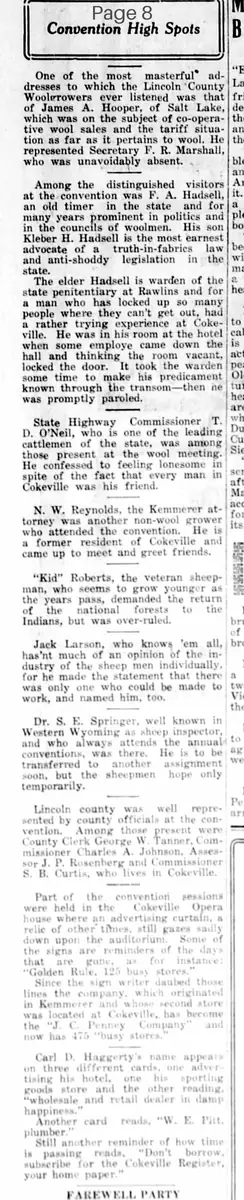
One of the most masterful addresses to which the Lincoln County Woolgrowers ever listened was that of James A. Hooper, of Salt Lake, which was on the subject of cooperative wool sales and the tariff situation as far as it pertains to wool. He represented Secretary F. R. Marshall, who was unavoidably absent.
Among the distinguished visitors at the convention was F. A. Hadsell, an old timer in the state and for many years prominent in politics and in the councils of woolmen. His son Kleber H. Hadsell is the most earnest advocate of a truth-in-fabrics law and anti-shoddy legislation in the state.
The elder Hadsell is warden of the state penitentiary at Rawlins and for a man who has locked up so many people where they can't get out, had a rather trying experience at Cokeville. He was in his room at the hotel when some employee came down the hall and thinking the room vacant, locked the door. It took the warden some time to make his predicament known through the transom—then he was promptly paroled.
State Highway Commissioner T. D. O'Neil, who is one of the leading cattlemen of the state, was among those present at the wool meeting. He confessed to feeling lonesome in spite of the fact that every man in Cokeville was his friend.
N. W. Reynolds, the Kemmerer attorney was another non-wool grower who attended the convention. He is a former resident of Cokeville and came up to meet and greet friends.
"Kid" Roberts, the veteran sheepman, who seems to grow younger as the years pass, demanded the return of the national forests to the Indians, but was over-ruled.
Jack Larson, who knows 'em all, hasn't much of an opinion of the industry of the sheep men individually, for he made the statement that there was only one who could be made to work, and named him, too.
Dr. S. E. Springer, well known in Western Wyoming as sheep inspector, and who always attends the annual conventions, was there. He is to be transferred to another assignment soon, but the sheepmen hope only temporarily.
Lincoln county was well represented by county officials at the convention. Among those present were County Clerk George W. Tanner, Commissioner Charles A. Johnson, Assessor J. P. Rosenberg and Commissioner S. B. Curtis, who lives in Cokeville.
Part of the convention sessions were held in the Cokeville Opera house where an advertising curtain, a relic of other times, still gazes sadly down upon the auditorium. Some of the signs are reminders of the days that are gone, as for instance:
"Golden Rule. 125 busy stores."
Since the sign writer daubed those lines the company, which originated in Kemmerer and whose second store was located at Cokeville, has become the "J. C. Penney Company" and now has 475 "busy stores."
Carl D. Haggerty's name appears on three different cards, one advertising his hotel, one his sporting goods store and the other reading, "wholesale and retail dealer in damp happiness."
Another card reads, "W. E. Pitt, plumber."
Still another reminder of how time is passing reads, "Don't borrow, subscribe for the Cokeville Register, your home paper."
What sub-type of article is it?
What keywords are associated?
What entities or persons were involved?
Where did it happen?
Domestic News Details
Primary Location
Cokeville
Key Persons
Event Details
The Lincoln County Woolgrowers convention featured a masterful address by James A. Hooper on cooperative wool sales and the tariff situation. Distinguished visitors included F. A. Hadsell and his son Kleber H. Hadsell, State Highway Commissioner T. D. O'Neil, attorney N. W. Reynolds, veteran sheepman "Kid" Roberts, Jack Larson, and Dr. S. E. Springer. County officials such as George W. Tanner, Charles A. Johnson, J. P. Rosenberg, and S. B. Curtis attended. Sessions were held in the Cokeville Opera house with old advertising signs noted, including references to the Golden Rule stores now J. C. Penney Company.