Thank you for visiting SNEWPapers!
Sign up free
Editorial
September 5, 1792
Gazette Of The United States
New York, New York County, New York
What is this article about?
This editorial, republished from the Herald of Vermont and signed 'A FREEMAN,' advocates for balanced representation in Congress. It argues that all national interests—agriculture, commerce, manufactures, arts, and sciences—must be proportionately represented to ensure prosperity, emphasizing legislators with broad knowledge to avoid class prejudices.
Clipping
OCR Quality
98%
Excellent
Full Text
FOR THE GAZETTE OF THE UNITED STATES.
No. V.
REPRESENTATIVES IN CONGRESS.
[The following remarks appear in the Herald of Vermont—they are ingenious, liberal, and national—and having particular relation to the important subject of REPRESENTATION, cannot be too extensively known.—The Author of the Essays under the signature of C. therefore offers them as a substitute for No. 5, of his own writing—fully convinced that the performance will meet the approbation of every candid reader.]
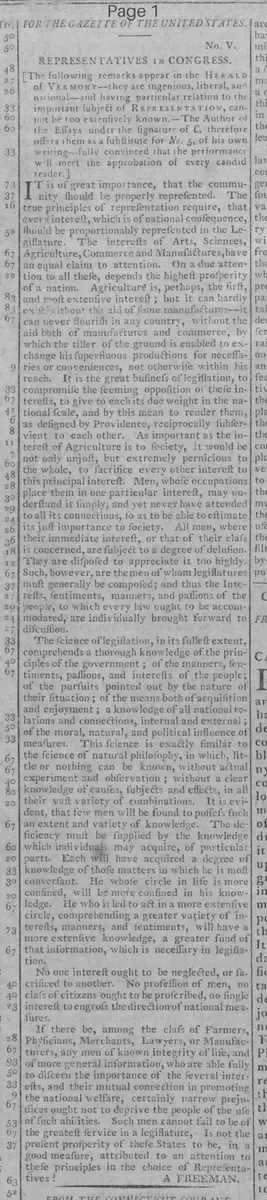
It is of great importance, that the community should be properly represented. The true principles of representation require, that every interest, which is of national consequence, should be proportionably represented in the Legislature. The interests of Arts, Sciences, Agriculture, Commerce and Manufactures, have an equal claim to attention. On a due attention to all these, depends the highest prosperity of a nation. Agriculture is, perhaps, the first, and most extensive interest; but it can hardly exist without the aid of some manufactures—it can never flourish in any country, without the aid both of manufactures and commerce, by which the tiller of the ground is enabled to exchange his superfluous productions for necessaries or conveniences, not otherwise within his reach. It is the great business of legislation, to compromise the seeming opposition of these interests, to give to each its due weight in the national scale, and by this means to render them, as designed by Providence, reciprocally subservient to each other. As important as the interest of Agriculture is to society, it would be not only unjust, but extremely pernicious to the whole, to sacrifice every other interest to this principal interest. Men, whose occupations place them in one particular interest, may understand it simply, and yet never have attended to all its connections, so as to be able to estimate its just importance to society. All men, where their immediate interest, or that of their class is concerned, are subject to a degree of delusion. They are disposed to appreciate it too highly. Such, however, are the men of whom legislatures must generally be composed; and thus the interests, sentiments, manners, and passions of the people, to which every law ought to be accommodated, are individually brought forward to discussion.
The science of legislation, in its fullest extent, comprehends a thorough knowledge of the principles of the government; of the manners, sentiments, passions, and interests of the people; of the pursuits pointed out by the nature of their situation; of the means both of acquisition and enjoyment; a knowledge of all national relations and connections, internal and external; of the moral, natural, and political influence of measures. This science is exactly similar to the science of natural philosophy, in which, little or nothing can be known, without actual experiment and observation; without a clear knowledge of causes, subjects and effects, in all their vast variety of combinations. It is evident, that few men will be found to possess such an extent and variety of knowledge. The deficiency must be supplied by the knowledge which individuals may acquire, of particular parts. Each will have acquired a degree of knowledge of those matters in which he is most conversant. He whose circle in life is more confined, will be more confined in his knowledge. He who is led to act in a more extensive circle, comprehending a greater variety of interests, manners, and sentiments, will have a more extensive knowledge, a greater fund of that information, which is necessary in legislation.
No one interest ought to be neglected, or sacrificed to another. No profession of men, no class of citizens ought to be proscribed, no single interest to engross the direction of national measures.
If there be, among the class of Farmers, Physicians, Merchants, Lawyers, or Manufacturers, any men of known integrity of life, and of more general information, who are able fully to discern the importance of the several interests, and their mutual connection in promoting the national welfare, certainly narrow prejudices ought not to deprive the people of the use of such abilities. Such men cannot fail to be of the greatest service in a legislature. Is not the present prosperity of these States to be, in a good measure, attributed to an attention to these principles in the choice of Representatives?
A FREEMAN.
No. V.
REPRESENTATIVES IN CONGRESS.
[The following remarks appear in the Herald of Vermont—they are ingenious, liberal, and national—and having particular relation to the important subject of REPRESENTATION, cannot be too extensively known.—The Author of the Essays under the signature of C. therefore offers them as a substitute for No. 5, of his own writing—fully convinced that the performance will meet the approbation of every candid reader.]
It is of great importance, that the community should be properly represented. The true principles of representation require, that every interest, which is of national consequence, should be proportionably represented in the Legislature. The interests of Arts, Sciences, Agriculture, Commerce and Manufactures, have an equal claim to attention. On a due attention to all these, depends the highest prosperity of a nation. Agriculture is, perhaps, the first, and most extensive interest; but it can hardly exist without the aid of some manufactures—it can never flourish in any country, without the aid both of manufactures and commerce, by which the tiller of the ground is enabled to exchange his superfluous productions for necessaries or conveniences, not otherwise within his reach. It is the great business of legislation, to compromise the seeming opposition of these interests, to give to each its due weight in the national scale, and by this means to render them, as designed by Providence, reciprocally subservient to each other. As important as the interest of Agriculture is to society, it would be not only unjust, but extremely pernicious to the whole, to sacrifice every other interest to this principal interest. Men, whose occupations place them in one particular interest, may understand it simply, and yet never have attended to all its connections, so as to be able to estimate its just importance to society. All men, where their immediate interest, or that of their class is concerned, are subject to a degree of delusion. They are disposed to appreciate it too highly. Such, however, are the men of whom legislatures must generally be composed; and thus the interests, sentiments, manners, and passions of the people, to which every law ought to be accommodated, are individually brought forward to discussion.
The science of legislation, in its fullest extent, comprehends a thorough knowledge of the principles of the government; of the manners, sentiments, passions, and interests of the people; of the pursuits pointed out by the nature of their situation; of the means both of acquisition and enjoyment; a knowledge of all national relations and connections, internal and external; of the moral, natural, and political influence of measures. This science is exactly similar to the science of natural philosophy, in which, little or nothing can be known, without actual experiment and observation; without a clear knowledge of causes, subjects and effects, in all their vast variety of combinations. It is evident, that few men will be found to possess such an extent and variety of knowledge. The deficiency must be supplied by the knowledge which individuals may acquire, of particular parts. Each will have acquired a degree of knowledge of those matters in which he is most conversant. He whose circle in life is more confined, will be more confined in his knowledge. He who is led to act in a more extensive circle, comprehending a greater variety of interests, manners, and sentiments, will have a more extensive knowledge, a greater fund of that information, which is necessary in legislation.
No one interest ought to be neglected, or sacrificed to another. No profession of men, no class of citizens ought to be proscribed, no single interest to engross the direction of national measures.
If there be, among the class of Farmers, Physicians, Merchants, Lawyers, or Manufacturers, any men of known integrity of life, and of more general information, who are able fully to discern the importance of the several interests, and their mutual connection in promoting the national welfare, certainly narrow prejudices ought not to deprive the people of the use of such abilities. Such men cannot fail to be of the greatest service in a legislature. Is not the present prosperity of these States to be, in a good measure, attributed to an attention to these principles in the choice of Representatives?
A FREEMAN.
What sub-type of article is it?
Constitutional
Economic Policy
What keywords are associated?
Representation
Congress
National Interests
Agriculture
Commerce
Manufactures
Legislation
Prejudices
What entities or persons were involved?
Farmers
Physicians
Merchants
Lawyers
Manufacturers
Congress
Editorial Details
Primary Topic
Principles Of Representation In Congress
Stance / Tone
Advocacy For Balanced And Informed Representation
Key Figures
Farmers
Physicians
Merchants
Lawyers
Manufacturers
Congress
Key Arguments
Every National Interest Must Be Proportionably Represented In The Legislature
Agriculture, Commerce, Manufactures, Arts, And Sciences Have Equal Claims To Attention
Legislation Should Balance Interests To Promote Reciprocal Prosperity
Narrow Class Prejudices Can Lead To Overvaluing One's Own Interest
Legislators Need Broad Knowledge Of Government, Society, And National Relations
No Single Interest Or Class Should Dominate National Measures
Men Of Integrity And General Information From Any Profession Serve Best In Legislature