Thank you for visiting SNEWPapers!
Sign up free
Editorial
April 23, 1951
The Daily Record
Dunn, Harnett County, North Carolina
What is this article about?
Editorial argues Congress is the core of US government, quoting MacArthur's views on constitutional authority, criticism of clergymen defying laws, warnings against executive secrecy, and historical lessons on national decline.
Clipping
OCR Quality
95%
Excellent
Full Text
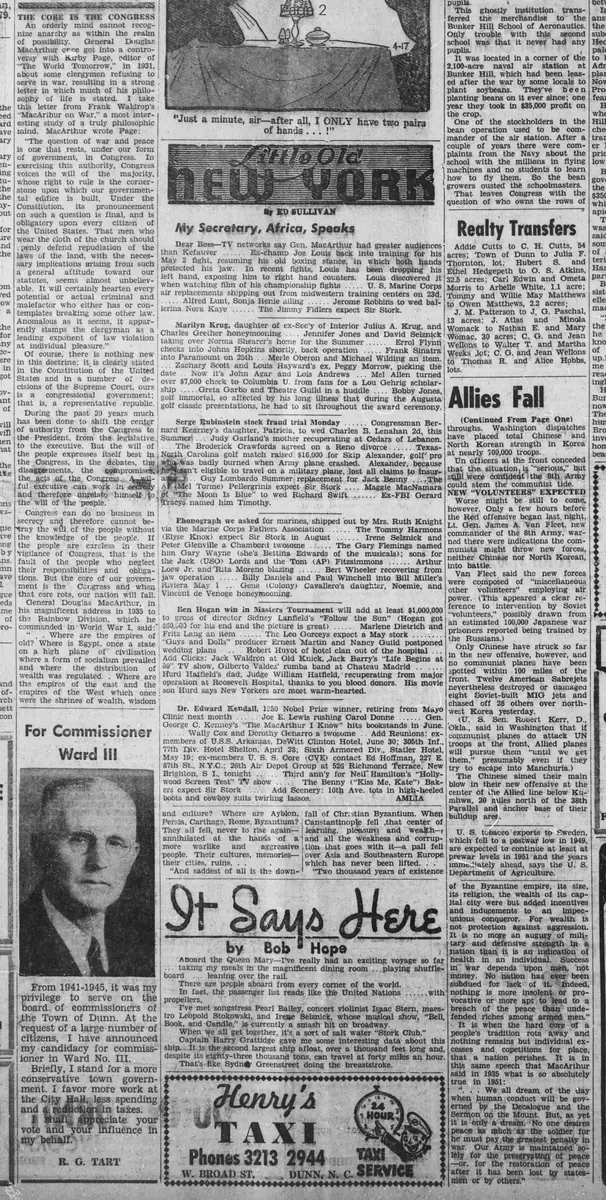
THE CORE IS THE CONGRESS
An orderly mind cannot recognize anarchy as within the realm of possibility.
General Douglas MacArthur once got into a controversy with Kirby Page, editor of "The World Tomorrow," in 1931, about some clergymen refusing to serve in war, resulting in a strong letter in which much of his philosophy of life is stated. I take this letter from Frank Waldrop's "MacArthur on War," a most interesting study of a truly philosophic mind. MacArthur wrote Page:
"The question of war and peace is one that rests, under our form of government, in Congress. In exercising this authority, Congress voices the will of the majority, whose right to rule is the cornerstone upon which our governmental edifice is built. Under the Constitution, its pronouncement on such a question is final, and is obligatory upon every citizen of the United States. That men who wear the cloth of the church should openly defend repudiation of the laws of the land, with the necessary implications arising from such a general attitude toward our statutes, seems almost unbelievable. It will certainly hearten every potential or actual criminal and malefactor who either has or contemplates breaking some other law. Anomalous as it seems, it apparently stamps the clergyman as a leading exponent of law violation at individual pleasure.
Of course, there is nothing new in this doctrine: it is clearly stated in the Constitution of the United States and in a number of decisions of the Supreme Court, ours is a congressional government; that is, a representative republic. During the past 20 years much has been done to shift the center of authority from the Congress to the President, from the legislative to the executive. But the will of the people expresses itself best in the Congress, in the debates, the disagreements, the compromises, the acts of the Congress. A willful executive can work in secrecy and therefore unrelate himself to the will of the people.
Congress can do no business in secrecy and therefore cannot betray the will of the people without the knowledge of the people. If the people are careless in their vigilance of Congress, that is the fault of the people who neglect their responsibilities and obligations. But the core of our government is the Congress and when that core rots, our nation will fall.
General Douglas MacArthur, in his magnificent address in 1935 to the Rainbow Division, which he commanded in World War I, said:
Where are the empires of old? Where is Egypt, once a state on a high plane of civilization where a form of socialism prevailed and where the distribution of wealth was regulated. Where are the empires of the east and the empires of the West which once were the shrines of wealth, wisdom and culture? Where are Babylon, Persia, Carthage, Rome, Byzantium? They all fell, never to rise again-annihilated at the hands of a more warlike and aggressive people. Their cultures, memories-their cities, ruins.
"And saddest of all is the fall of Christian Byzantium. When Constantinople fell that center of learning, pleasure and wealth-and all the weakness and corruption that goes with it-a pall fell over Asia and Southeastern Europe which has never been lifted.
"Two thousand years of existence of the Byzantine empire, its size, its religion, the wealth of its capital city were but added incentives and inducements to an impecunious conqueror. For wealth is not protection against aggression. It is no more an augury of military and defensive strength in a nation than it is an indication of health in an individual. Success in war depends upon men, not money. No nation has ever been subdued for lack of it. Indeed, nothing is more insolent or provocative or more apt to lead to a breach of the peace than undefended riches among armed men."
It is when the hard core of a people's tradition rots away and nothing remains but individual excesses and competitions for place, that a nation perishes. It is in this same speech that MacArthur said in 1935 what is so absolutely true in 1951:
"... We all dream of the day when human conduct will be governed by the Decalogue and the Sermon on the Mount. But, as yet it is only a dream. No one desires peace as much as the soldier for he must pay the greatest penalty in war. Our Army is maintained solely for the preservation of peace-or, for the restoration of peace after it has been lost by statesmen or by others."
An orderly mind cannot recognize anarchy as within the realm of possibility.
General Douglas MacArthur once got into a controversy with Kirby Page, editor of "The World Tomorrow," in 1931, about some clergymen refusing to serve in war, resulting in a strong letter in which much of his philosophy of life is stated. I take this letter from Frank Waldrop's "MacArthur on War," a most interesting study of a truly philosophic mind. MacArthur wrote Page:
"The question of war and peace is one that rests, under our form of government, in Congress. In exercising this authority, Congress voices the will of the majority, whose right to rule is the cornerstone upon which our governmental edifice is built. Under the Constitution, its pronouncement on such a question is final, and is obligatory upon every citizen of the United States. That men who wear the cloth of the church should openly defend repudiation of the laws of the land, with the necessary implications arising from such a general attitude toward our statutes, seems almost unbelievable. It will certainly hearten every potential or actual criminal and malefactor who either has or contemplates breaking some other law. Anomalous as it seems, it apparently stamps the clergyman as a leading exponent of law violation at individual pleasure.
Of course, there is nothing new in this doctrine: it is clearly stated in the Constitution of the United States and in a number of decisions of the Supreme Court, ours is a congressional government; that is, a representative republic. During the past 20 years much has been done to shift the center of authority from the Congress to the President, from the legislative to the executive. But the will of the people expresses itself best in the Congress, in the debates, the disagreements, the compromises, the acts of the Congress. A willful executive can work in secrecy and therefore unrelate himself to the will of the people.
Congress can do no business in secrecy and therefore cannot betray the will of the people without the knowledge of the people. If the people are careless in their vigilance of Congress, that is the fault of the people who neglect their responsibilities and obligations. But the core of our government is the Congress and when that core rots, our nation will fall.
General Douglas MacArthur, in his magnificent address in 1935 to the Rainbow Division, which he commanded in World War I, said:
Where are the empires of old? Where is Egypt, once a state on a high plane of civilization where a form of socialism prevailed and where the distribution of wealth was regulated. Where are the empires of the east and the empires of the West which once were the shrines of wealth, wisdom and culture? Where are Babylon, Persia, Carthage, Rome, Byzantium? They all fell, never to rise again-annihilated at the hands of a more warlike and aggressive people. Their cultures, memories-their cities, ruins.
"And saddest of all is the fall of Christian Byzantium. When Constantinople fell that center of learning, pleasure and wealth-and all the weakness and corruption that goes with it-a pall fell over Asia and Southeastern Europe which has never been lifted.
"Two thousand years of existence of the Byzantine empire, its size, its religion, the wealth of its capital city were but added incentives and inducements to an impecunious conqueror. For wealth is not protection against aggression. It is no more an augury of military and defensive strength in a nation than it is an indication of health in an individual. Success in war depends upon men, not money. No nation has ever been subdued for lack of it. Indeed, nothing is more insolent or provocative or more apt to lead to a breach of the peace than undefended riches among armed men."
It is when the hard core of a people's tradition rots away and nothing remains but individual excesses and competitions for place, that a nation perishes. It is in this same speech that MacArthur said in 1935 what is so absolutely true in 1951:
"... We all dream of the day when human conduct will be governed by the Decalogue and the Sermon on the Mount. But, as yet it is only a dream. No one desires peace as much as the soldier for he must pay the greatest penalty in war. Our Army is maintained solely for the preservation of peace-or, for the restoration of peace after it has been lost by statesmen or by others."
What sub-type of article is it?
Constitutional
Military Affairs
Moral Or Religious
What keywords are associated?
Congress Authority
Macarthur Philosophy
Government Core
War And Peace
Constitutional Republic
Executive Overreach
Historical Empires
Peace Preservation
What entities or persons were involved?
General Douglas Macarthur
Kirby Page
Congress
President
Editorial Details
Primary Topic
Importance Of Congress As The Core Of Us Government
Stance / Tone
Supportive Of Congressional Authority And Warning Against Executive Overreach
Key Figures
General Douglas Macarthur
Kirby Page
Congress
President
Key Arguments
Congress Voices The Will Of The Majority Under The Constitution
Clergymen Defending Repudiation Of Laws Is Unbelievable And Encourages Crime
Shift Of Authority From Congress To President Undermines Representative Republic
Congress Operates Openly, Preventing Betrayal Of People's Will
Core Of Government Is Congress; Its Rot Leads To National Fall
Historical Empires Fell Due To Internal Rot And Weakness
Success In War Depends On Men, Not Money
Army Maintained For Preservation Or Restoration Of Peace