Thank you for visiting SNEWPapers!
Sign up free
Editorial
June 18, 1792
National Gazette
Philadelphia, Philadelphia County, Pennsylvania
What is this article about?
Editorial criticizes the Secretary of the Treasury's proposal to increase import duties, arguing it will promote smuggling, oppress merchants, contradict prior advice, and destabilize the federal government, citing Spanish colonial policy failures and Federalist arguments.
Clipping
OCR Quality
98%
Excellent
Full Text
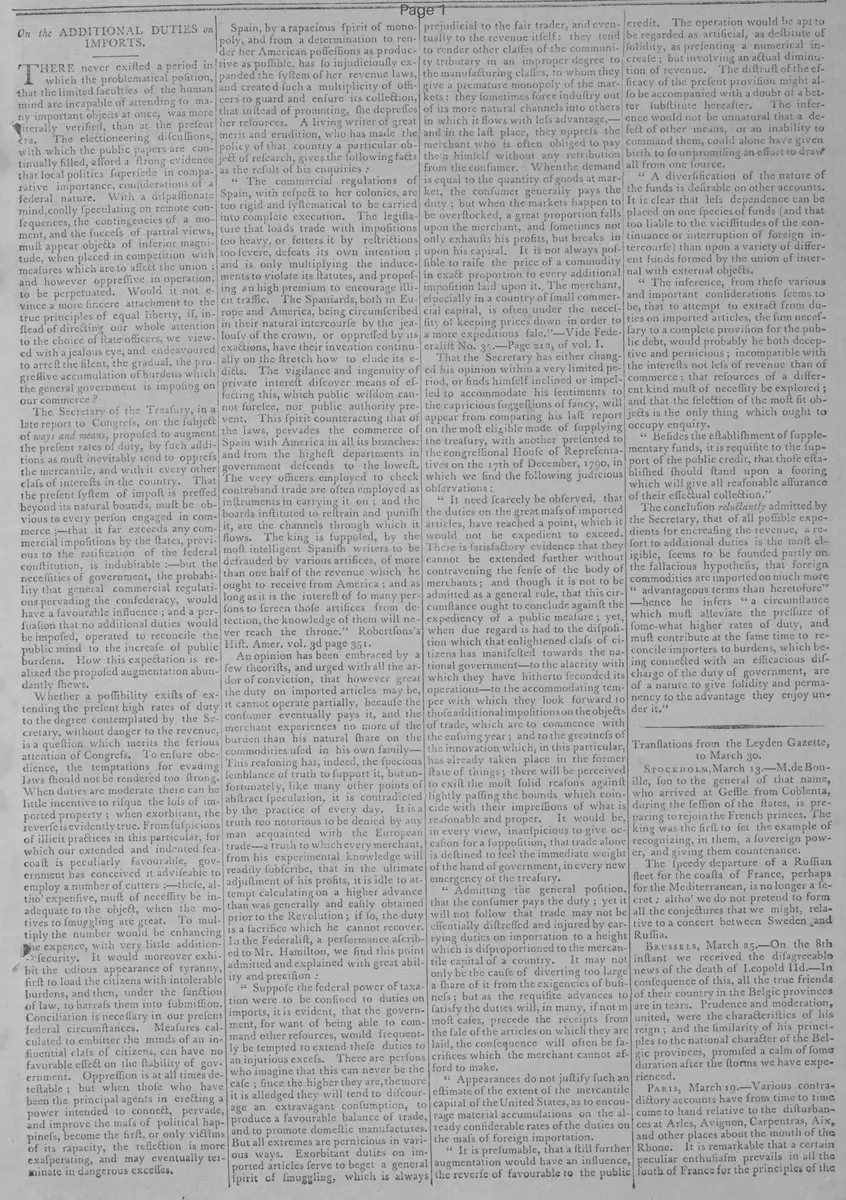
On the ADDITIONAL DUTIES on IMPORTS.
There never existed a period in which the problematical position, that the limited faculties of the human mind are incapable of attending to many important objects at once, was more literally verified, than at the present era. The electioneering discussions, with which the public papers are continually filled, afford a strong evidence that local politics supersede in comparative importance, considerations of a federal nature. With a dispassionate mind, coolly speculating on remote consequences, the contingencies of a moment, and the success of partial views, must appear objects of inferior magnitude, when placed in competition with measures which are to affect the union; and however oppressive in operation, to be perpetuated. Would it not evince a more sincere attachment to the true principles of equal liberty, if, instead of directing our whole attention to the choice of state officers, we viewed with a jealous eye, and endeavoured to arrest the silent, the gradual, the progressive accumulation of burdens which the general government is imposing on our commerce?
The Secretary of the Treasury, in a late report to Congress, on the subject of ways and means, proposed to augment the present rates of duty, by such additions as must inevitably tend to oppress the mercantile, and with it every other class of interests in the country. That the present system of impost is pressed beyond its natural bounds, must be obvious to every person engaged in commerce; that it far exceeds any commercial impositions by the states, previous to the ratification of the federal constitution, is indubitable: but the necessities of government, the probability that general commercial regulations pervading the confederacy, would have a favourable influence: and a persuasion that no additional duties would be imposed, operated to reconcile the public mind to the increase of public burdens. How this expectation is realized the proposed augmentation abundantly shows.
Whether a possibility exists of extending the present high rates of duty to the degree contemplated by the Secretary, without danger to the revenue, is a question which merits the serious attention of Congress. To ensure obedience, the temptations for evading laws should not be rendered too strong. When duties are moderate there can be little incentive to risk the loss of imported property; when exorbitant, the reverse is evidently true. From suspicions of illicit practices in this particular, for which our extended and indented seacoast is peculiarly favourable, government has conceived it advisable to employ a number of cutters; these, although expensive, must of necessity be inadequate to the object, when the motives to smuggling are great. To multiply the number would be enhancing the expense, with very little additional security. It would moreover exhibit the odious appearance of tyranny, first to load the citizens with intolerable burdens, and then, under the sanction of law, to harass them into submission. Conciliation is necessary in our present federal circumstances. Measures calculated to embitter the minds of an influential class of citizens, can have no favorable effect on the stability of government. Oppression is at all times detestable; but when those who have been the principal agents in erecting a power intended to connect, pervade and improve the mass of political happiness, become the first, or only victims of its rapacity, the reflection is more exasperating, and may eventually terminate in dangerous excesses.
Spain, by a rapacious spirit of monopoly, and from a determination to render her American possessions as productive as possible, has so injudiciously expanded the system of her revenue laws, and created such a multiplicity of officers to guard and ensure its collection, that instead of promoting, she depresses her resources. A living writer of great merit and erudition, who has made the policy of that country a particular object of research, gives the following facts as the result of his enquiries:
"The commercial regulations of Spain, with respect to her colonies, are too rigid and systematical to be carried into complete execution. The legislature that loads trade with impositions too heavy, or fetters it by restrictions too severe, defeats its own intention; and is only multiplying the inducements to violate its statutes, and proposing an high premium to encourage illicit traffic. The Spaniards, both in Europe and America, being circumscribed in their natural intercourse by the jealousy of the crown, or oppressed by its exactions, have their invention continually on the stretch how to elude its edicts. The vigilance and ingenuity of private interest discover means of effecting this, which public wisdom cannot foresee, nor public authority prevent. This spirit counteracting that of the laws, pervades the commerce of Spain with America in all its branches: and from the highest departments in government descends to the lowest. The very officers employed to check contraband trade are often employed as instruments in carrying it on; and the boards instituted to restrain and punish it, are the channels through which it flows. The king is supposed, by the most intelligent Spanish writers to be defrauded by various artifices, of more than one half of the revenue which he ought to receive from America; and as long as it is the interest of so many persons to screen those artifices from detection, the knowledge of them will never reach the throne."
Robertson's Hist. Amer. vol. 3d page 351.
An opinion has been embraced by a few theorists, and urged with all the ardor of conviction, that however great the duty on imported articles may be, it cannot operate partially, because the consumer eventually pays it, and the merchant experiences no more of the burden than his natural share on the commodities used in his own family. This reasoning has, indeed, the specious semblance of truth to support it, but unfortunately, like many other points of abstract speculation, it is contradicted by the practice of every day. It is a truth too notorious to be denied by any man acquainted with the European trade—a truth to which every merchant, from his experimental knowledge will readily subscribe, that in the ultimate adjustment of his profits, it is idle to attempt calculating on a higher advance than was generally and easily obtained prior to the Revolution; if so, the duty is a sacrifice which he cannot recover.
In the Federalist, a performance ascribed to Mr. Hamilton, we find this point admitted and explained with great ability and precision:
"Suppose the federal power of taxation were to be confined to duties on imports, it is evident, that the government, for want of being able to command other resources, would frequently be tempted to extend these duties to an injurious excess. There are persons who imagine that this can never be the case; since the higher they are, the more it is alleged they will tend to discourage an extravagant consumption, to produce a favourable balance of trade, and to promote domestic manufactures. But all extremes are pernicious in various ways. Exorbitant duties on imported articles serve to beget a general spirit of smuggling, which is always prejudicial to the fair trader, and eventually to the revenue itself: they tend to render other classes of the community tributary in an improper degree to the manufacturing classes, to whom they give a premature monopoly of the markets: they sometimes force industry out of its more natural channels into others in which it flows with less advantage, and in the last place, they oppress the merchant who is often obliged to pay the duty himself without any retribution from the consumer. When the demand is equal to the quantity of goods at market, the consumer generally pays the duty; but when the markets happen to be overstocked, a great proportion falls upon the merchant, and sometimes not only exhausts his profits, but breaks in upon his capital. It is not always possible to raise the price of a commodity in exact proportion to every additional imposition laid upon it. The merchant, especially in a country of small commercial capital, is often under the necessity of keeping prices down in order to a more expeditious sale."—Vide Federalist No. 35. Page 212, of vol. I.
That the Secretary has either changed his opinion within a very limited period, or finds himself inclined or impelled to accommodate his sentiments to the capricious suggestions of fancy, will appear from comparing his last report on the most eligible mode of supplying the treasury, with another presented to the congressional House of Representatives on the 17th of December, 1790, in which we find the following judicious observations:
"It need scarcely be observed, that the duties on the great mass of imported articles, have reached a point, which it would not be expedient to exceed. There is satisfactory evidence that they cannot be extended further without contravening the sense of the body of merchants; and though it is not to be admitted as a general rule, that this circumstance ought to conclude against the expediency of a public measure; yet, when due regard is had to the disposition which that enlightened class of citizens has manifested towards the national government—to the alacrity with which they have hitherto seconded its operations—to the accommodating temper with which they look forward to those additional impositions on the objects of trade, which are to commence with the ensuing year; and to the greatness of the innovation which, in this particular, has already taken place in the former state of things; there will be perceived to exist the most solid reasons against lightly passing the bounds which coincide with their impressions of what is reasonable and proper. It would be, in every view, inauspicious to give occasion for a supposition, that trade alone is destined to feel the immediate weight of the hand of government, in every new emergency of the treasury."
"Admitting the general position, that the consumer pays the duty; yet it will not follow that trade may not be essentially distressed and injured by carrying duties on importation to a height which is disproportioned to the mercantile capital of a country. It may not only be the cause of diverting too large a share of it from the exigencies of business; but as the requisite advances to satisfy the duties will, in many, if not in most cases, precede the receipts from the sale of the articles on which they are laid, the consequence will often be sacrifices which the merchant cannot afford to make.
Appearances do not justify such an estimate of the extent of the mercantile capital of the United States, as to encourage material accumulations on the already considerable rates of the duties on the mass of foreign importation.
"It is presumable, that a still further augmentation would have an influence, the reverse of favourable to the public credit. The operation would be apt to be regarded as artificial, as destitute of solidity, as presenting a numerical increase; but involving an actual diminution of revenue. The distrust of the efficacy of the present provision might also be accompanied with a doubt of a better substitute hereafter. The inference would not be unnatural that a defect of other means, or an inability to command them, could alone have given birth to so unpromising an effort to draw all from one source.
"A diversification of the nature of the funds is desirable on other accounts. It is clear that less dependence can be placed on one species of funds (and that too liable to the vicissitudes of the continuance or interruption of foreign intercourse) than upon a variety of different funds formed by the union of internal with external objects.
"The inference, from these various and important considerations seems to be, that to attempt to extract from duties on imported articles, the sum necessary to a complete provision for the public debt, would probably be both deceptive and pernicious; incompatible with the interests not less of revenue than of commerce; that resources of a different kind must of necessity be explored; and that the election of the most fit objects is the only thing which ought to occupy enquiry.
"Besides the establishment of supplementary funds, it is requisite to the support of the public credit, that those established should stand upon a footing which will give all reasonable assurance of their effectual collection."
The conclusion reluctantly admitted by the Secretary, that of all possible expedients for increasing the revenue, a resort to additional duties is the most eligible, seems to be founded partly on the fallacious hypothesis, that foreign commodities are imported on much more "advantageous terms than heretofore"—hence he infers "a circumstance which must alleviate the pressure of some-what higher rates of duty, and must contribute at the same time to reconcile importers to burdens, which being connected with an efficacious discharge of the duty of government, are of a nature to give solidity and permanency to the advantage they enjoy under it."
There never existed a period in which the problematical position, that the limited faculties of the human mind are incapable of attending to many important objects at once, was more literally verified, than at the present era. The electioneering discussions, with which the public papers are continually filled, afford a strong evidence that local politics supersede in comparative importance, considerations of a federal nature. With a dispassionate mind, coolly speculating on remote consequences, the contingencies of a moment, and the success of partial views, must appear objects of inferior magnitude, when placed in competition with measures which are to affect the union; and however oppressive in operation, to be perpetuated. Would it not evince a more sincere attachment to the true principles of equal liberty, if, instead of directing our whole attention to the choice of state officers, we viewed with a jealous eye, and endeavoured to arrest the silent, the gradual, the progressive accumulation of burdens which the general government is imposing on our commerce?
The Secretary of the Treasury, in a late report to Congress, on the subject of ways and means, proposed to augment the present rates of duty, by such additions as must inevitably tend to oppress the mercantile, and with it every other class of interests in the country. That the present system of impost is pressed beyond its natural bounds, must be obvious to every person engaged in commerce; that it far exceeds any commercial impositions by the states, previous to the ratification of the federal constitution, is indubitable: but the necessities of government, the probability that general commercial regulations pervading the confederacy, would have a favourable influence: and a persuasion that no additional duties would be imposed, operated to reconcile the public mind to the increase of public burdens. How this expectation is realized the proposed augmentation abundantly shows.
Whether a possibility exists of extending the present high rates of duty to the degree contemplated by the Secretary, without danger to the revenue, is a question which merits the serious attention of Congress. To ensure obedience, the temptations for evading laws should not be rendered too strong. When duties are moderate there can be little incentive to risk the loss of imported property; when exorbitant, the reverse is evidently true. From suspicions of illicit practices in this particular, for which our extended and indented seacoast is peculiarly favourable, government has conceived it advisable to employ a number of cutters; these, although expensive, must of necessity be inadequate to the object, when the motives to smuggling are great. To multiply the number would be enhancing the expense, with very little additional security. It would moreover exhibit the odious appearance of tyranny, first to load the citizens with intolerable burdens, and then, under the sanction of law, to harass them into submission. Conciliation is necessary in our present federal circumstances. Measures calculated to embitter the minds of an influential class of citizens, can have no favorable effect on the stability of government. Oppression is at all times detestable; but when those who have been the principal agents in erecting a power intended to connect, pervade and improve the mass of political happiness, become the first, or only victims of its rapacity, the reflection is more exasperating, and may eventually terminate in dangerous excesses.
Spain, by a rapacious spirit of monopoly, and from a determination to render her American possessions as productive as possible, has so injudiciously expanded the system of her revenue laws, and created such a multiplicity of officers to guard and ensure its collection, that instead of promoting, she depresses her resources. A living writer of great merit and erudition, who has made the policy of that country a particular object of research, gives the following facts as the result of his enquiries:
"The commercial regulations of Spain, with respect to her colonies, are too rigid and systematical to be carried into complete execution. The legislature that loads trade with impositions too heavy, or fetters it by restrictions too severe, defeats its own intention; and is only multiplying the inducements to violate its statutes, and proposing an high premium to encourage illicit traffic. The Spaniards, both in Europe and America, being circumscribed in their natural intercourse by the jealousy of the crown, or oppressed by its exactions, have their invention continually on the stretch how to elude its edicts. The vigilance and ingenuity of private interest discover means of effecting this, which public wisdom cannot foresee, nor public authority prevent. This spirit counteracting that of the laws, pervades the commerce of Spain with America in all its branches: and from the highest departments in government descends to the lowest. The very officers employed to check contraband trade are often employed as instruments in carrying it on; and the boards instituted to restrain and punish it, are the channels through which it flows. The king is supposed, by the most intelligent Spanish writers to be defrauded by various artifices, of more than one half of the revenue which he ought to receive from America; and as long as it is the interest of so many persons to screen those artifices from detection, the knowledge of them will never reach the throne."
Robertson's Hist. Amer. vol. 3d page 351.
An opinion has been embraced by a few theorists, and urged with all the ardor of conviction, that however great the duty on imported articles may be, it cannot operate partially, because the consumer eventually pays it, and the merchant experiences no more of the burden than his natural share on the commodities used in his own family. This reasoning has, indeed, the specious semblance of truth to support it, but unfortunately, like many other points of abstract speculation, it is contradicted by the practice of every day. It is a truth too notorious to be denied by any man acquainted with the European trade—a truth to which every merchant, from his experimental knowledge will readily subscribe, that in the ultimate adjustment of his profits, it is idle to attempt calculating on a higher advance than was generally and easily obtained prior to the Revolution; if so, the duty is a sacrifice which he cannot recover.
In the Federalist, a performance ascribed to Mr. Hamilton, we find this point admitted and explained with great ability and precision:
"Suppose the federal power of taxation were to be confined to duties on imports, it is evident, that the government, for want of being able to command other resources, would frequently be tempted to extend these duties to an injurious excess. There are persons who imagine that this can never be the case; since the higher they are, the more it is alleged they will tend to discourage an extravagant consumption, to produce a favourable balance of trade, and to promote domestic manufactures. But all extremes are pernicious in various ways. Exorbitant duties on imported articles serve to beget a general spirit of smuggling, which is always prejudicial to the fair trader, and eventually to the revenue itself: they tend to render other classes of the community tributary in an improper degree to the manufacturing classes, to whom they give a premature monopoly of the markets: they sometimes force industry out of its more natural channels into others in which it flows with less advantage, and in the last place, they oppress the merchant who is often obliged to pay the duty himself without any retribution from the consumer. When the demand is equal to the quantity of goods at market, the consumer generally pays the duty; but when the markets happen to be overstocked, a great proportion falls upon the merchant, and sometimes not only exhausts his profits, but breaks in upon his capital. It is not always possible to raise the price of a commodity in exact proportion to every additional imposition laid upon it. The merchant, especially in a country of small commercial capital, is often under the necessity of keeping prices down in order to a more expeditious sale."—Vide Federalist No. 35. Page 212, of vol. I.
That the Secretary has either changed his opinion within a very limited period, or finds himself inclined or impelled to accommodate his sentiments to the capricious suggestions of fancy, will appear from comparing his last report on the most eligible mode of supplying the treasury, with another presented to the congressional House of Representatives on the 17th of December, 1790, in which we find the following judicious observations:
"It need scarcely be observed, that the duties on the great mass of imported articles, have reached a point, which it would not be expedient to exceed. There is satisfactory evidence that they cannot be extended further without contravening the sense of the body of merchants; and though it is not to be admitted as a general rule, that this circumstance ought to conclude against the expediency of a public measure; yet, when due regard is had to the disposition which that enlightened class of citizens has manifested towards the national government—to the alacrity with which they have hitherto seconded its operations—to the accommodating temper with which they look forward to those additional impositions on the objects of trade, which are to commence with the ensuing year; and to the greatness of the innovation which, in this particular, has already taken place in the former state of things; there will be perceived to exist the most solid reasons against lightly passing the bounds which coincide with their impressions of what is reasonable and proper. It would be, in every view, inauspicious to give occasion for a supposition, that trade alone is destined to feel the immediate weight of the hand of government, in every new emergency of the treasury."
"Admitting the general position, that the consumer pays the duty; yet it will not follow that trade may not be essentially distressed and injured by carrying duties on importation to a height which is disproportioned to the mercantile capital of a country. It may not only be the cause of diverting too large a share of it from the exigencies of business; but as the requisite advances to satisfy the duties will, in many, if not in most cases, precede the receipts from the sale of the articles on which they are laid, the consequence will often be sacrifices which the merchant cannot afford to make.
Appearances do not justify such an estimate of the extent of the mercantile capital of the United States, as to encourage material accumulations on the already considerable rates of the duties on the mass of foreign importation.
"It is presumable, that a still further augmentation would have an influence, the reverse of favourable to the public credit. The operation would be apt to be regarded as artificial, as destitute of solidity, as presenting a numerical increase; but involving an actual diminution of revenue. The distrust of the efficacy of the present provision might also be accompanied with a doubt of a better substitute hereafter. The inference would not be unnatural that a defect of other means, or an inability to command them, could alone have given birth to so unpromising an effort to draw all from one source.
"A diversification of the nature of the funds is desirable on other accounts. It is clear that less dependence can be placed on one species of funds (and that too liable to the vicissitudes of the continuance or interruption of foreign intercourse) than upon a variety of different funds formed by the union of internal with external objects.
"The inference, from these various and important considerations seems to be, that to attempt to extract from duties on imported articles, the sum necessary to a complete provision for the public debt, would probably be both deceptive and pernicious; incompatible with the interests not less of revenue than of commerce; that resources of a different kind must of necessity be explored; and that the election of the most fit objects is the only thing which ought to occupy enquiry.
"Besides the establishment of supplementary funds, it is requisite to the support of the public credit, that those established should stand upon a footing which will give all reasonable assurance of their effectual collection."
The conclusion reluctantly admitted by the Secretary, that of all possible expedients for increasing the revenue, a resort to additional duties is the most eligible, seems to be founded partly on the fallacious hypothesis, that foreign commodities are imported on much more "advantageous terms than heretofore"—hence he infers "a circumstance which must alleviate the pressure of some-what higher rates of duty, and must contribute at the same time to reconcile importers to burdens, which being connected with an efficacious discharge of the duty of government, are of a nature to give solidity and permanency to the advantage they enjoy under it."
What sub-type of article is it?
Economic Policy
Taxation
Trade Or Commerce
What keywords are associated?
Import Duties
Tariffs
Smuggling
Commerce
Revenue
Mercantile Capital
Federal Government
Public Credit
What entities or persons were involved?
Secretary Of The Treasury
Congress
Mr. Hamilton
Spain
Editorial Details
Primary Topic
Opposition To Additional Duties On Imports
Stance / Tone
Critical Of Tariff Increases And Their Effects On Commerce
Key Figures
Secretary Of The Treasury
Congress
Mr. Hamilton
Spain
Key Arguments
Increasing Duties Will Encourage Smuggling And Reduce Revenue
Oppresses Merchants Who Bear The Burden Without Full Recovery From Consumers
Contradicts The Secretary's Earlier Report From 1790 12 17 Advising Against Further Increases
Historical Example Of Spain's Rigid Revenue Laws Leading To Widespread Evasion
Quotes Federalist No. 35 On Harms Of Exorbitant Duties To Trade And Government Stability
Local Politics Distract From Federal Economic Burdens
Need For Diversified Revenue Sources Rather Than Relying On Imports