Thank you for visiting SNEWPapers!
Sign up free
Republican Herald
Providence, Providence County, Rhode Island
What is this article about?
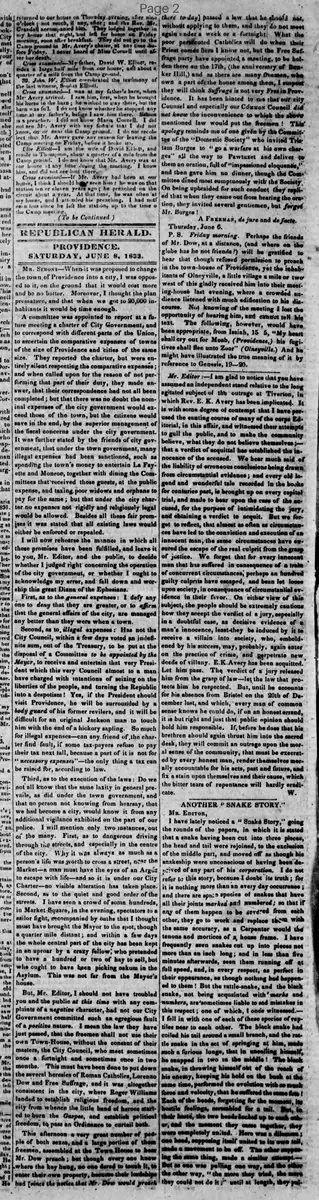
A Providence resident criticizes the town's conversion to city government in 1833, citing increased expenses, illegal spending on entertaining figures like the President, lax law enforcement, and a new ordinance restricting freemen's access to the Town House for events like Lorenzo Dow's preaching and Free Suffrage meetings.
Clipping
OCR Quality
Full Text
PROVIDENCE.
SATURDAY, JUNE 8, 1833.
MR. SIMMONS—When it was proposed to change the town of Providence into a city, I was opposed to it, on the ground that it would cost more and be no better. Moreover, I thought the plan premature, and that when we got to 20,000 inhabitants it would be time enough.
A committee was appointed to report at a future meeting a charter of City Government, and to correspond with different parts of the Union, to ascertain the comparative expenses of towns of the size of Providence and cities of the same size. They reported the charter, but were entirely silent respecting the comparative expenses; and when called upon for the reason of not performing that part of their duty, they made answer, that their correspondence had not all been completed; but that there was no doubt the nominal expenses of the city government would exceed those of the town, but the citizens would save in the end, by the superior management of the fiscal concerns under the city government.
It was further stated by the friends of city government, that under the town government, many illegal expenses had been sanctioned, such as spending the town's money to entertain La Fayette and Monroe, together with dining the Committees that received those guests, at the public expense, and taxing poor widows and orphans to pay for the same; but that under the city charter no expenses not rigidly and religiously legal would be allowed. Besides all these fair promises it was stated that all existing laws would either be enforced or repealed.
I will now rehearse the manner in which all these promises have been fulfilled, and leave it to you, Mr. Editor, and the public, to decide whether I judged right concerning the operation of the city government, or whether I ought to acknowledge my error, and fall down and worship this great Diana of the Ephesians.
First, as to the general expenses: I defy any one to deny that they are greater, or to affirm that the general affairs of the city, are managed any better than they were when a town.
Second, as to illegal expenses: Has not the City Council, within a few days voted an indefinite sum, out of the Treasury, to be put at the disposal of a Committee to be appointed by the Mayor, to receive and entertain that very President which this very Council almost to a man have charged with intentions of seizing on the liberties of the people, and turning the Republic into a despotism! Yes, if the President should visit Providence, he will be surrounded by a body guard of his former revilers, and it will be difficult for an original Jackson man to touch him with the end of a hickory sapling. So much for illegal expenses—can any friend of the charter find fault, if some tax-payers refuse to pay their tax next fall, because a part of it is not for "necessary expenses"—the only thing a tax can be raised for, according to law.
Third, as to the execution of the laws: Do we not all know that the same laxity in general prevails, as did under the town government, and that no person not knowing from hearsay, that we had become a city, would know it from any additional vigilance exhibited on the part of our police. I will mention only two instances, out of the many. First, as to dangerous driving through the streets, and especially in the centre of the city. Why it was always as much as a person's life was worth to cross a street, near the Market—a man must have the eyes of an Argus to escape with life—and so it is under our City Charter—no visible alteration has taken place.
Second, as to the quiet and good order of the streets. I have seen a crowd of some hundreds, in Market Square, in the evening, spectators to a sailor fight, accompanied by oaths that I thought must have brought the Mayor to the spot, though a quarter mile distant; and within a few days the whole central part of the city has been kept in an uproar by a crazy fellow; who pretended to have a hundred or two of hay to sell, but who ought to have been picking oakum in the Asylum. This was not far from the Mayor's house.
But, Mr. Editor, I should not have troubled you and the public at this time with any complaints of a negative character, had not our City Government committed such an egregious fault of a positive nature. I mean the law they have just passed, that the freemen shall not use their own Town-House, without the consent of their masters, the City Council, who meet sometimes once a fortnight and sometimes once in two months. This must have been done to put down the several heresies of Roman Catholics, Lorenzo Dow and Free Suffrage, and it was altogether consistent in the city, where Roger Williams landed to establish religious freedom, and the city from whence the little band of heroes started to burn the Gaspee, and establish political freedom, to pass an Ordinance to curtail both.
This afternoon a very great number of people of both sexes, and large portion of them freemen, assembled at the Town House to hear Mr. Dow preach; but though every one knew where the key hung, no one dared to touch it, to enter their own property, because their lordships had (since the notice that Mr. Dow would preach there to-day) passed a law that he should not, without applying to them, and they do not meet again under a week or a fortnight. What the poor persecuted Catholics will do when their Priest comes here I know not, but the Free Suffrage party have appointed a meeting, to be held there on the 17th, (the anniversary of Bunker Hill,) and as there are many freemen, who own a part of the house among them, I suspect they will think Suffrage is not very Free in Providence. It has been hinted to me that our city Council and especially our Common Council did not know the inconvenience to which the above mentioned law would put the freemen! This apology reminds me of one given by the Committee of the "Domestic Society" who invited Tristram Burges to "go a warfare at his own charges" all the way to Pawtuxet and deliver to them an oration, full of "impassioned eloquence." and then gave him no dinner, though the Committee dined most sumptuously with the Society. On being upbraided for such conduct they replied that when they came out from hearing the oration, they invited several gentlemen, but forgot Mr. Burges!
A Freeman, de jure and de facto.
Thursday, June 6.
P. S. Friday morning. Perhaps the friends of Mr. Dow, at a distance, (and where on the globe has he not friends?) will be gratified to hear that though refused permission to preach in the town-house of Providence, yet the inhabitants of Olneyville, a little village a mile or two west of this gladly received him into their meeting-house last evening, where a crowded audience listened with much edification to his discourse. Not knowing of the meeting I lost the opportunity of hearing him, and cannot tell his text. The following, however, would have been appropriate, from Isaiah, 15:5, "My heart shall cry out for Moab, (Providence,)—his fugitives shall flee unto Zoar" (Olneyville.) And he might have illustrated the true meaning of it by reference to Genesis, 19-20.
What sub-type of article is it?
What themes does it cover?
What keywords are associated?
What entities or persons were involved?
Letter to Editor Details
Author
A Freeman, De Jure And De Facto.
Recipient
Mr. Simmons
Main Argument
the transition to city government in providence has led to higher expenses without better management, continued illegal spending such as on entertaining the president, lax enforcement of laws, and a new ordinance restricting freemen's access to the town house, contradicting promises of efficiency and legality.
Notable Details