Thank you for visiting SNEWPapers!
Sign up free
The Indianapolis Journal
Indianapolis, Marion County, Indiana
What is this article about?
Mississippi's constitutional convention debates suffrage to effectively disfranchise Black voters and ensure white supremacy, proposing methods like felony upgrades for minor crimes and literacy tests, but constrained by U.S. readmission laws. Republicans advocate fair ballot and poll-tax systems.
Clipping
OCR Quality
Full Text
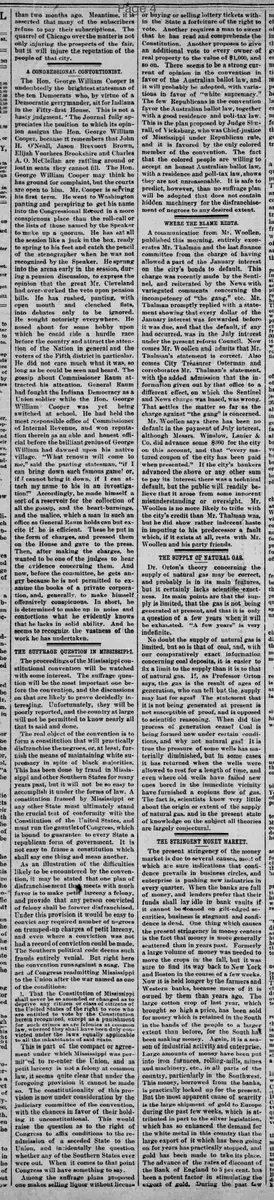
The proceedings of the Mississippi constitutional convention will be watched with some interest. The suffrage question will be the most important one before the convention, and the discussions on that are likely to prove decidedly interesting. Unfortunately, they will be poorly reported, and the country at large will not be permitted to know nearly all that is said and done.
The real object of the convention is to form a constitution that will practically disfranchise the negroes, or, at least, furnish the means of maintaining white supremacy in spite of black majorities. This has been done by fraud in Mississippi and other Southern States for many years past, but it will not be so easy to accomplish it under the forms of law. A constitution framed by Mississippi or any other State must ultimately stand the crucial test of conformity with the Constitution of the United States, and must run the gauntlet of Congress, which is bound to guarantee to every State a republican form of government. It is not easy to frame a constitution which shall say one thing and mean another.
As an illustration of the difficulties likely to be encountered by the convention, it may be stated that one plan of disfranchisement that meets with much favor is to make petit larceny a felony, and provide that any person convicted of felony shall be forever disfranchised. Under this provision it would be easy to convict any required number of negroes on trumped-up charges of petit larceny, and even where a conviction was not had a record of conviction could be made. The Southern political code deems such frauds entirely venial. But right here the convention runs against a snag. The act of Congress readmitting Mississippi to the Union after the war named as one of the conditions:
1. That the Constitution of Mississippi shall never be so amended or changed as to deprive any citizen or class of citizens of the United States of the right to vote who are entitled to vote by the Constitution herein recognized, except as a punishment for such crimes as are felonies at common law, whereof they shall have been duly convicted under the laws equally applicable to all the inhabitants of said State.
This is part of the compact or agreement under which Mississippi was permitted to re-enter the Union, and as petit larceny is not a felony at common law, it seems quite clear that under the foregoing provision it cannot be made so. The constitutionality of this provision is now under consideration by the judiciary committee of the convention, with the chances in favor of their holding it unconstitutional. This would raise the question as to the right of Congress to affix conditions to the re-admission of a seceded State to the Union, and incidentally the question whether any of the Southern States ever were out. When it comes to that point Congress will have something to say.
Among the suffrage plans proposed one makes selling liquor without license or buying or selling lottery tickets within the State a forfeiture of the right to vote. Another requires a man to swear that he has read and comprehends the Constitution. Another proposes to give an additional vote to every owner of real property to the value of $1,000, and so on. There seems to be a strong current of opinion in the convention in favor of the Australian ballot law, and it will probably be adopted, with variations in favor of "white supremacy."
The few Republicans in the convention favor the Australian ballot law, together with a good residence and poll-tax law. This is the plan proposed by Judge Simrall, of Vicksburg, who was Chief Justice of Mississippi under Republican rule, and it is favored by the only colored member of the convention. The fact that the colored people are willing to accept an honest Australian ballot law, with a residence and poll-tax law, shows they are not unreasonable. It is safe to predict, however, that no suffrage plan will be adopted that does not contain hidden machinery for the disfranchisement of negroes to any desired extent.
What sub-type of article is it?
What themes does it cover?
What keywords are associated?
What entities or persons were involved?
Where did it happen?
Story Details
Key Persons
Location
Mississippi
Story Details
The Mississippi constitutional convention seeks to frame a constitution that disfranchises negroes to maintain white supremacy, facing challenges from federal readmission conditions prohibiting changes to voting rights except for common law felonies. Various proposals include making petit larceny a felony, literacy tests, property qualifications, and the Australian ballot with variations. Republicans favor honest Australian ballot, residence, and poll-tax laws.