Thank you for visiting SNEWPapers!
Sign up free
Windham County Observer
Putnam, Windham County, Connecticut
What is this article about?
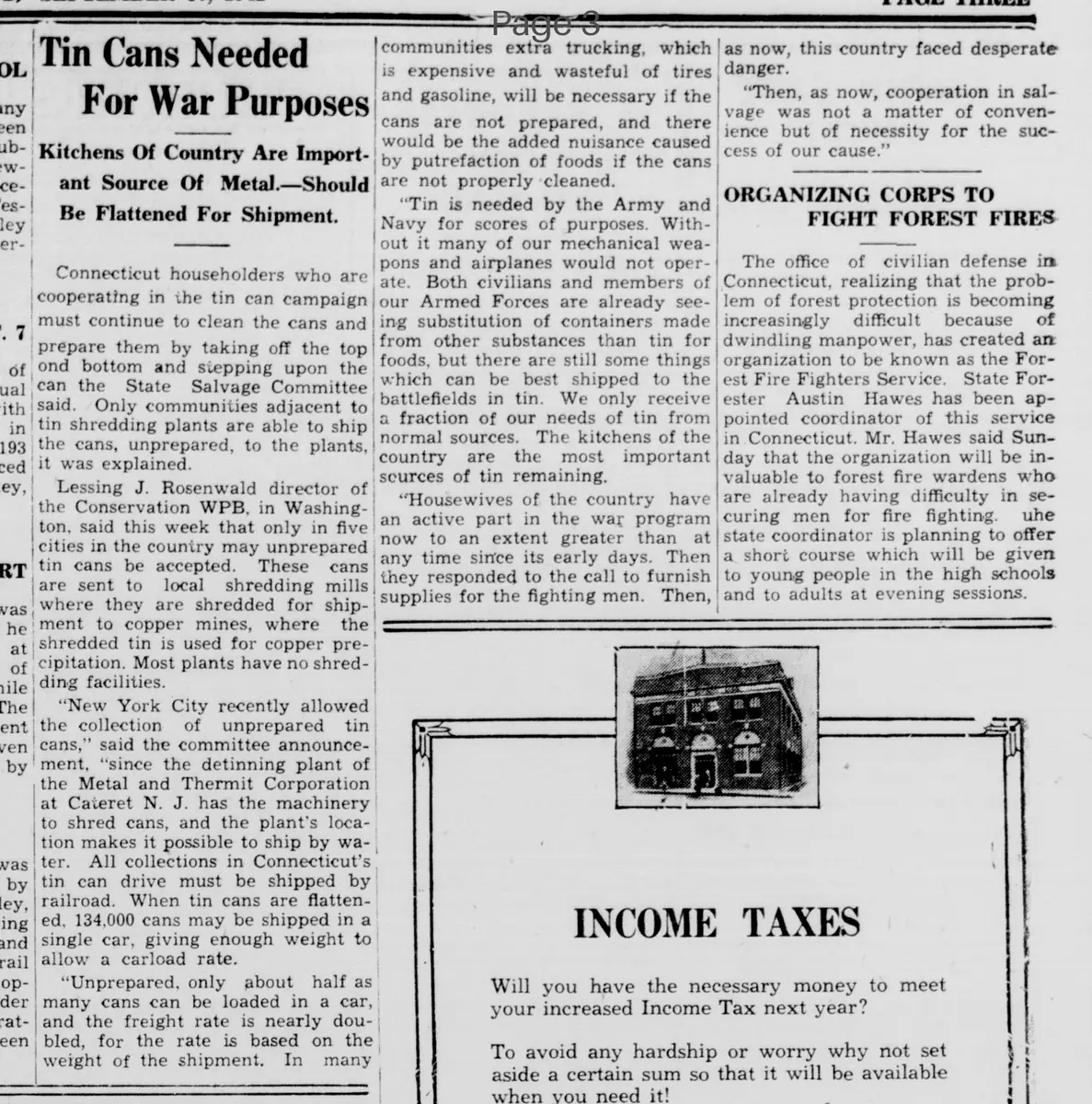
Connecticut householders are instructed to clean, remove tops and bottoms, and flatten tin cans for a wartime salvage campaign to provide metal for military uses, as explained by the State Salvage Committee and WPB director Lessing J. Rosenwald. Only select cities accept unprepared cans due to limited shredding facilities.
Clipping
OCR Quality
Full Text
Kitchens Of Country Are Important Source Of Metal. Should Be Flattened For Shipment.
Connecticut householders who are cooperating in the tin can campaign must continue to clean the cans and prepare them by taking off the top and bottom and stepping upon the can the State Salvage Committee said. Only communities adjacent to tin shredding plants are able to ship the cans, unprepared, to the plants, it was explained.
Lessing J. Rosenwald director of the Conservation WPB. in Washington, said this week that only in five cities in the country may unprepared tin cans be accepted. These cans are sent to local shredding mills where they are shredded for shipment to copper mines, where the shredded tin is used for copper precipitation. Most plants have no shredding facilities.
"New York City recently allowed the collection of unprepared tin cans." said the committee announcement. "since the detinning plant of the Metal and Thermit Corporation at Carteret N. J. has the machinery to shred cans. and the plant's location makes it possible to ship by water. All collections in Connecticut's tin can drive must be shipped by railroad, When tin cans are flattened. 134.000 cans may be shipped in a single car, giving enough weight to allow a carload rate.
"Unprepared, only about half as many cans can be loaded in a car, and the freight rate is nearly doubled. for the rate is based on the weight of the shipment. In many communities extra trucking, which is expensive and wasteful of tires and gasoline, will be necessary if the cans are not prepared, and there would be the added nuisance caused by putrefaction of foods if the cans are not properly cleaned.
"Tin is needed by the Army and Navy for scores of purposes. Without it many of our mechanical weapons and airplanes would not operate. Both civilians and members of our Armed Forces are already seeing substitution of containers made from other substances than tin for foods, but there are still some things which can be best shipped to the battlefields in tin. We only receive a fraction of our needs of tin from normal sources. The kitchens of the country are the most important sources of tin remaining.
"Housewives of the country have an active part in the war program now to an extent greater than at any time since its early days. Then they responded to the call to furnish supplies for the fighting men. Then, as now, this country faced desperate danger.
"Then, as now, cooperation in salvage was not a matter of convenience but of necessity for the success of our cause."
What sub-type of article is it?
What keywords are associated?
What entities or persons were involved?
Where did it happen?
Domestic News Details
Primary Location
Connecticut
Event Date
This Week
Key Persons
Outcome
flattening cans allows 134,000 per rail car at carload rates, reducing costs and waste; unprepared cans lead to higher freight, extra trucking, and putrefaction risks. supports army and navy needs amid tin shortages.
Event Details
Householders must clean tin cans, remove top and bottom, and flatten them for shipment to tin shredding plants, except in communities adjacent to plants. Only five cities accept unprepared cans, which are shredded for use in copper precipitation at mines. New York City recently allowed unprepared collections due to nearby shredding facilities. Connecticut collections ship by rail, where flattening maximizes load and secures lower rates. Tin is vital for military weapons and airplanes; civilian kitchens are key salvage source amid shortages.